Oklahoma Social Studies OKH.C.3.4
Standard Cluster
- OKH.C.3
- Evaluate the major political and economic events that transformed the land and its people in the post-Civil War era to statehood.
Explain how American Indians experienced decreasing control over Tribal lands through congressional action. Compare multiple points of view to evaluate the impact of the Dawes Act of 1877 (General Allotment Act) which resulted in the loss of Tribal communal lands through a transfer to individual property. Describe the intent and effects of the Indian Appropriations Act and methods (e.g., land runs, lotteries) used for the forced redistribution of Tribal lands, such as the Unassigned Lands and the Cherokee Outlet.
Oklahoma Academic Standards for Social Studies (2026) · OKH.C.3
Cluster contents
Standards in This Cluster
OKH.C.3.4 is a cluster heading. These are the individual standards under it.
- OKH.C.3.4.A
Compare multiple points of view to evaluate the impact of the Dawes Act of 1877 (General Allotment Act) which resulted in the loss of Tribal communal lands thro...
- OKH.C.3.4.B
Describe the intent and effects of the Indian Appropriations Act and methods (e.g., land runs, lotteries) used for the forced redistribution of Tribal lands, su...
Teacher's field guide
What This Cluster Means
What Students Need to Do
- Students explain how federal appropriations laws opened land to settlers and how allotment split communal land into private parcels. They compare Tribal, federal, and settler views of land runs and lotteries.
What Mastery Looks Like
- Given a map, students can identify land allotted to individuals and land opened to settlers. They can explain why federal officials called allotment a reform while many Tribal people saw land loss and less control over decisions.
Common Misconceptions
- Students may think allotment gave Tribes more land because individuals received parcels. They may assume land runs and lotteries were fair to Tribes because settlers followed rules.
How to Assess It
- Exit ticket: How did allotment and the 1889 land run each reduce Tribal control of land? Include one Tribal view and one federal or settler view.
Lesson moves
Ways to Teach It
Give groups a paper grid representing communal land; have them mark individual allotments and land opened to settlers, then count the remaining squares.
Give students a Tribal leader's statement and a congressional speech; ask them to write who gained land and who lost decision-making power.
Run a card sort matching allotment, the 1889 land run, the 1893 Cherokee Outlet run, and later lotteries to their outcomes.
Have students find the Unassigned Lands and Cherokee Outlet on a historical map, then locate those areas on a current Oklahoma map.
Free download
Printable OKH.C.3.4 Worksheet
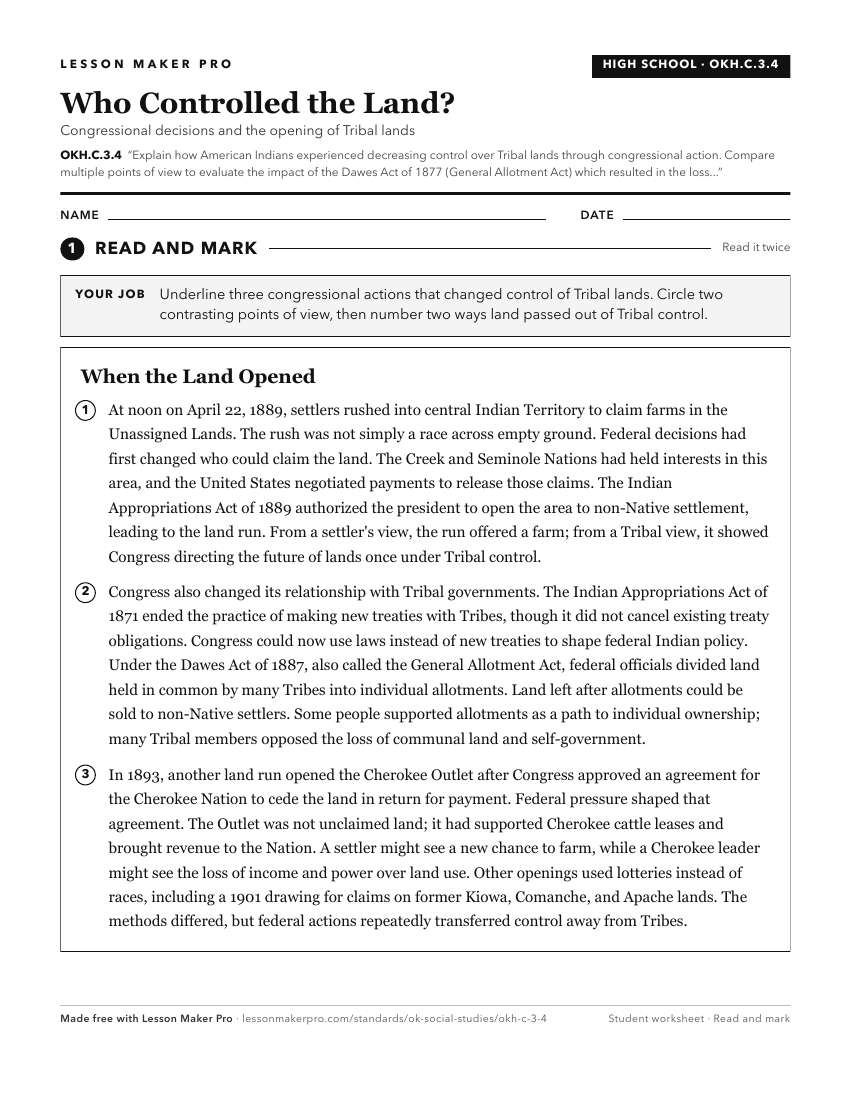
A ready-to-print activity worksheet aligned to OKH.C.3.4, with an answer key for the teacher on its own page. No account needed.
PDF, US Letter, prints cleanly in black and white.
Download the worksheetKeep exploring
Related Standards
- 8.C.8.3.A
Explain the federal government’s inconsistent adherence to treaties with Tribal Nations and the political pressures from states seeking control over Tribal land...
- 8.C.4.3.C
Explain that Tribal governments retain powers of internal self-government, including making and enforcing laws, determining citizenship, and managing lands and ...
- USH.C.7.2.B
Explain changes in Tribal self-determination gained through legislation, such as the Indian Civil Rights Act of 1968, Indian Self Determination and Education As...
Turn this cluster into a lesson
Grade, subject, topic, and the complete cluster are prefilled. Create one free, no account needed.
Also for this cluster:Make a WorksheetMake a QuizMake a Sub Lesson