Oklahoma Social Studies OKH.C.3.4.A
The Standard
- OKH.C.3
- Evaluate the major political and economic events that transformed the land and its people in the post-Civil War era to statehood.
- OKH.C.3.4
- Explain how American Indians experienced decreasing control over Tribal lands through congressional action.
Compare multiple points of view to evaluate the impact of the Dawes Act of 1877 (General Allotment Act) which resulted in the loss of Tribal communal lands through a transfer to individual property.
Oklahoma Academic Standards for Social Studies (2026) · OKH.C.3.4
Teacher's field guide
What This Standard Means
What Students Need to Do
- Students compare federal arguments for the 1887 allotment law with tribal accounts of its effects. They explain how individual parcels and sales of remaining land changed land ownership. They use both views to judge who gained land and who lost control.
What Mastery Looks Like
- A student can explain what a federal official hoped allotment would achieve and what a tribal source says was lost. They use details from both sources to show how allotment and land sales reduced tribal landholdings.
Common Misconceptions
- Students may think tribes kept all land not assigned to families. They may assume the law applied to every Oklahoma tribe at once, though the Five Tribes were allotted under later laws. They may mistake federal promises of prosperity for proof that Native families benefited.
How to Assess It
- Exit ticket: A federal official praises individual farms, while a tribal leader warns of land loss. Explain how sales of remaining land changed tribal control, using both views.
Lesson moves
Ways to Teach It
Give pairs a grid map labeled tribal land; have them assign individual plots, then shade surplus land the government could sell.
Give students a federal argument for allotment and a tribal account of land loss; ask whose interests each source reflects.
Hand out cards labeled individual plots, surplus land sales, and reduced tribal control; have students arrange them in cause-and-effect order.
Compare a current Oklahoma county parcel map with a tribal jurisdiction map; ask why private ownership does not erase tribal government.
Free download
Printable OKH.C.3.4.A Worksheet
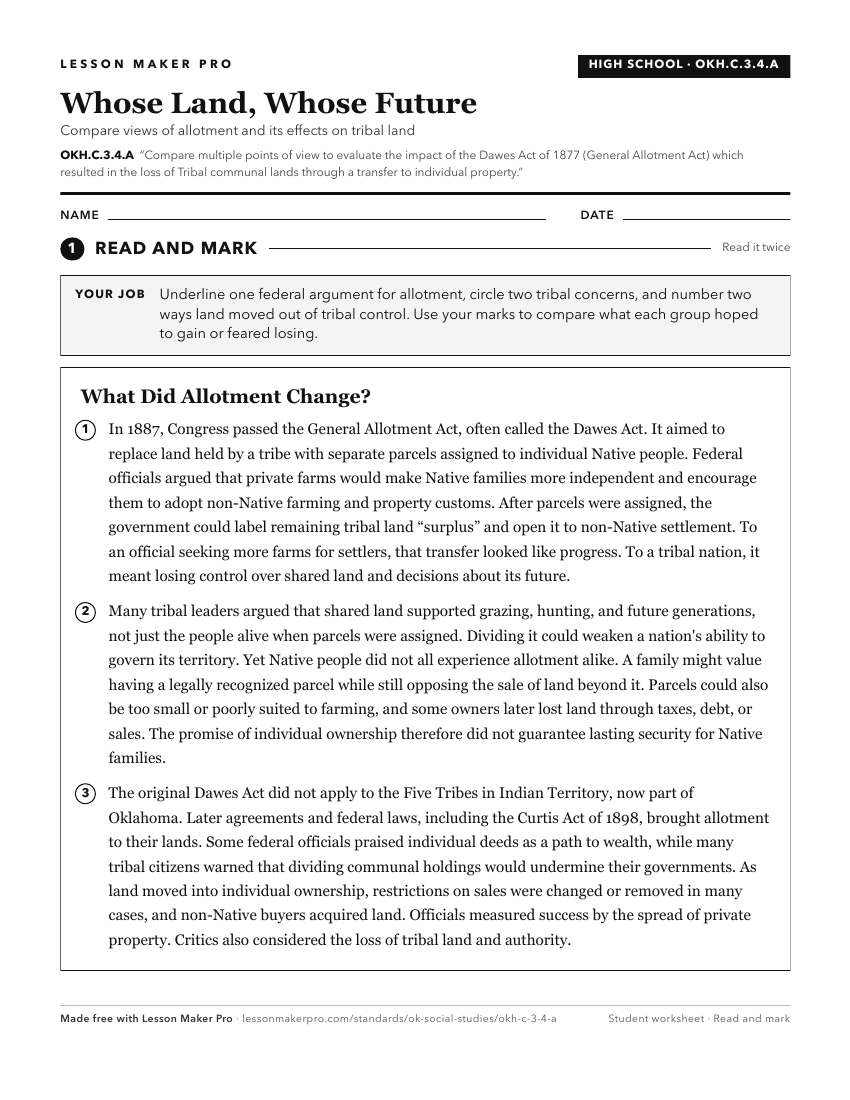
A ready-to-print activity worksheet aligned to OKH.C.3.4.A, with an answer key for the teacher on its own page. No account needed.
PDF, US Letter, prints cleanly in black and white.
Download the worksheetKeep exploring
Related Standards
- OKH.C.8.3.A
Explain how Tribal governments in Indian Territory were altered or disestablished by congressional acts prior to Oklahoma statehood, including the effects of al...
- OKH.C.3.4.B
Describe the intent and effects of the Indian Appropriations Act and methods (e.g., land runs, lotteries) used for the forced redistribution of Tribal lands, su...
- 8.C.5.1.C
Examine Washington’s attempt to develop a cohesive American Indian policy through treaties, assimilation, and the delineation of Tribal lands.
- USH.C.1.3.E
Explain how federal policies such as allotment and assimilation contributed to the restructuring of Tribal governments and land ownership in Indian Territory pr...
Turn this exact standard into a lesson
Grade, subject, topic, and the complete standard are prefilled. Create one free, no account needed.
Also for this standard:Make a WorksheetMake a QuizMake a Sub Lesson