Oklahoma Social Studies OKH.C.1
Standard Cluster
Describe the state’s geography and the historic foundations laid by American Indian, European, and American cultures. Describe the diverse physical features of Oklahoma and how the environment, ecological regions, and natural resources can affect human activity, by comparing information on historical and contemporary thematic maps. Explain the significance of the Cooper Bison Kill Site as credible evidence of the early presence of prehistoric Native cultures. Describe the region as home to well-developed and complex pre-contact societies, such as the Spiro Mound Builders. Describe the Caddo and Wichita cultures, once active in the production and trading of goods using extensive transcontinental, intertribal trade routes prior to European contact. Compare the goals and significance of early European interactions with Native cultures, such as the benefits of trade, the impact of disease, the transformation of Native life brought about by the arrival of the horse, and new technologies. Compare cultural perspectives of American Indians and settlers regarding land ownership, social structures (e.g., matrilineal vs. patrilineal), religion, spirituality, and concepts of government.
Oklahoma Academic Standards for Social Studies (2026)
Cluster contents
Standards in This Cluster
OKH.C.1 is a cluster heading. These are the individual standards under it.
- OKH.C.1.1
Describe the diverse physical features of Oklahoma and how the environment, ecological regions, and natural resources can affect human activity, by comparing in...
- OKH.C.1.2
Explain the significance of the Cooper Bison Kill Site as credible evidence of the early presence of prehistoric Native cultures.
- OKH.C.1.3
Describe the region as home to well-developed and complex pre-contact societies, such as the Spiro Mound Builders.
- OKH.C.1.4
Describe the Caddo and Wichita cultures, once active in the production and trading of goods using extensive transcontinental, intertribal trade routes prior to ...
- OKH.C.1.5
Compare the goals and significance of early European interactions with Native cultures, such as the benefits of trade, the impact of disease, the transformation...
- OKH.C.1.6
Compare cultural perspectives of American Indians and settlers regarding land ownership, social structures (e.g., matrilineal vs. patrilineal), religion, spirit...
Teacher's field guide
What This Cluster Means
What Students Need to Do
- Students compare past and present Oklahoma maps to explain how land and resources shaped daily life. They use evidence from Cooper, Spiro, Caddo, and Wichita communities to describe life before European contact. They explain changes brought by trade, disease, horses, and new tools, then compare Native and settler views of land, family, beliefs, and government.
What Mastery Looks Like
- A student can connect a map pattern to a resource, such as rivers near settlements. They can use stone points found with bison remains at Cooper and objects from Spiro to support claims about early communities. They can explain an effect of European contact without treating all Native nations as one culture.
Common Misconceptions
- Students may assume complex societies and long-distance trade began only after Europeans arrived. Some think horses were always in Oklahoma or that all Native nations held the same views about land and leadership. Others read modern borders and land use back into pre-contact maps.
How to Assess It
- Show a historical vegetation map and a current land-use map of Oklahoma. Ask, "How did one natural resource shape human activity, and what evidence from Cooper or Spiro tells us about early people?"
Lesson moves
Ways to Teach It
Trace rivers and grasslands from a historical Oklahoma vegetation map onto a current land-use map; mark two places where resources shaped work.
Read Article 2 of the Treaty of Dancing Rabbit Creek and a sample land deed; ask who has authority to transfer land in each.
Run a six-card sort: Cooper points, Spiro shells, Caddo trade, Wichita farming, horses, and smallpox; sort into pre-contact life or contact effects.
Check the U.S. Drought Monitor and an Oklahoma crop map; pick a county and explain how water shortages could affect local farms.
Free download
Printable OKH.C.1 Worksheet
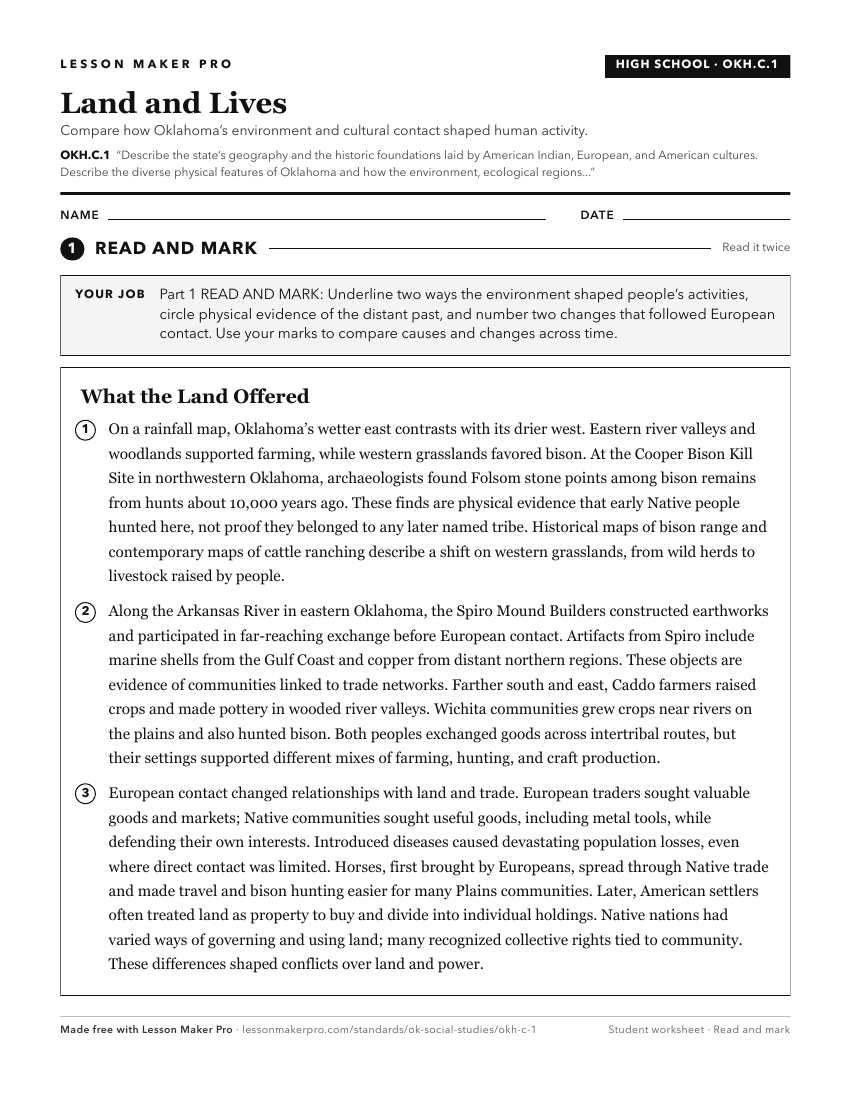
A ready-to-print activity worksheet aligned to OKH.C.1, with an answer key for the teacher on its own page. No account needed.
PDF, US Letter, prints cleanly in black and white.
Download the worksheetKeep exploring
Related Standards
- 4.C.3
Analyze how geography has impacted cultures and interactions during the early history of our nation.
- 6.C.3.6
Describe the cultural interactions between American Indian cultures and European settlers which impacted the heritage and history of major regions of the Wester...
- 4.C.3.1
Examine the various American Indian cultures inhabiting the nation prior to European explorations.
- 3.C.2.3.C
Identify the ways in which physical geography influenced early American Indian cultures of the region (e.g., bison hunting, fur trading, farming).
Turn this cluster into a lesson
Grade, subject, topic, and the complete cluster are prefilled. Create one free, no account needed.
Also for this cluster:Make a WorksheetMake a QuizMake a Sub Lesson