Oklahoma Social Studies 2.C.1
Standard Cluster
Explain the importance of the basic principles that provide the foundation of the United States of America’s system of government. Describe the fundamental principles of our nation’s government, including liberty, equality, fair treatment, and respect for the property of others. Explain and describe how a free people form a government to better protect their lives, property, and freedoms, and how the Constitution of the United States of America outlines the structure of our nation’s three branches of government. Identify the basic roles of national leaders including the President of the United States of America, members of the United States of America Congress, and justices of the Supreme Court. Explain that local, state, national, and Tribal governments exist to represent the needs of the people, make and enforce laws, and help resolve conflicts. Explain how American Indian Nations are self-governing people who make decisions through Tribal representatives in order to meet the needs of their citizens and manage their land and resources. Explain how individual liberties are protected by the Bill of Rights, using examples from the First Amendment. Explain how active citizens participate in democratic governments by voting to elect officials who represent them and by running for public office. Explain how all people can play important and responsible roles in their community through making good choices, obeying laws, volunteering, and working in public service (e.g., law enforcement, fire and rescue, public education). Describe the responsibility of paying taxes and explain how taxes are used to provide community services (e.g.,schools, fire and police protection, roads, parks and recreation). Examine the meaning of the phrase, “E Pluribus Unum” ("Out of many, one") found on the Great Seal of the United States of America.
Oklahoma Academic Standards for Social Studies (2026)
Cluster contents
Standards in This Cluster
2.C.1 is a cluster heading. These are the individual standards under it.
- 2.C.1.1
Describe the fundamental principles of our nation’s government, including liberty, equality, fair treatment, and respect for the property of others.
- 2.C.1.2
Explain and describe how a free people form a government to better protect their lives, property, and freedoms, and how the Constitution of the United States of...
- 2.C.1.3
Identify the basic roles of national leaders including the President of the United States of America, members of the United States of America Congress, and just...
- 2.C.1.4
Explain that local, state, national, and Tribal governments exist to represent the needs of the people, make and enforce laws, and help resolve conflicts.
- 2.C.1.5
Explain how American Indian Nations are self-governing people who make decisions through Tribal representatives in order to meet the needs of their citizens and...
- 2.C.1.6
Explain how individual liberties are protected by the Bill of Rights, using examples from the First Amendment.
- 2.C.1.7
Explain how active citizens participate in democratic governments by voting to elect officials who represent them and by running for public office.
- 2.C.1.8
Explain how all people can play important and responsible roles in their community through making good choices, obeying laws, volunteering, and working in publi...
- 2.C.1.9
Describe the responsibility of paying taxes and explain how taxes are used to provide community services (e.g.,schools, fire and police protection, roads, parks...
- 2.C.1.10
Examine the meaning of the phrase, “E Pluribus Unum” ("Out of many, one") found on the Great Seal of the United States of America.
Teacher's field guide
What This Cluster Means
What Students Need to Do
- Students explain why people form governments to protect safety, freedom, and property. They describe fair treatment, name the three branches set up by the Constitution, and identify the leaders in each branch. They compare local, state, national, and self-governing Tribal governments and describe ways people can take part.
What Mastery Looks Like
- A student matches Congress with making laws, the President with carrying them out, and Supreme Court justices with deciding cases about laws. They explain that Tribal representatives make decisions about their nation’s land and resources. They give an example of free speech, explain that taxes pay for services, and tell how “Out of many, one” fits a country of different people.
Common Misconceptions
- Students may think the President makes every law or that judges enforce laws. They may think Tribal governments are run by cities or states. Some think free speech means they can interrupt others, or that public parks cost nothing to maintain.
How to Assess It
- Exit ticket: Neighbors want a safer park. Name who could make a local rule, one way residents could speak up, and one service taxes could pay for.
Lesson moves
Ways to Teach It
Give pairs picture cards showing a city park, state highway, national passport, and Tribal land to sort onto four government mats.
Ask, “How can you disagree with a playground rule while respecting a classmate’s right to speak and their belongings?”
Play leader match with cards for the President, Congress, Supreme Court justices, and each group’s job.
Show a fire station photo, then ask who pays for the service and how a neighbor could help the community.
Free download
Printable 2.C.1 Worksheet
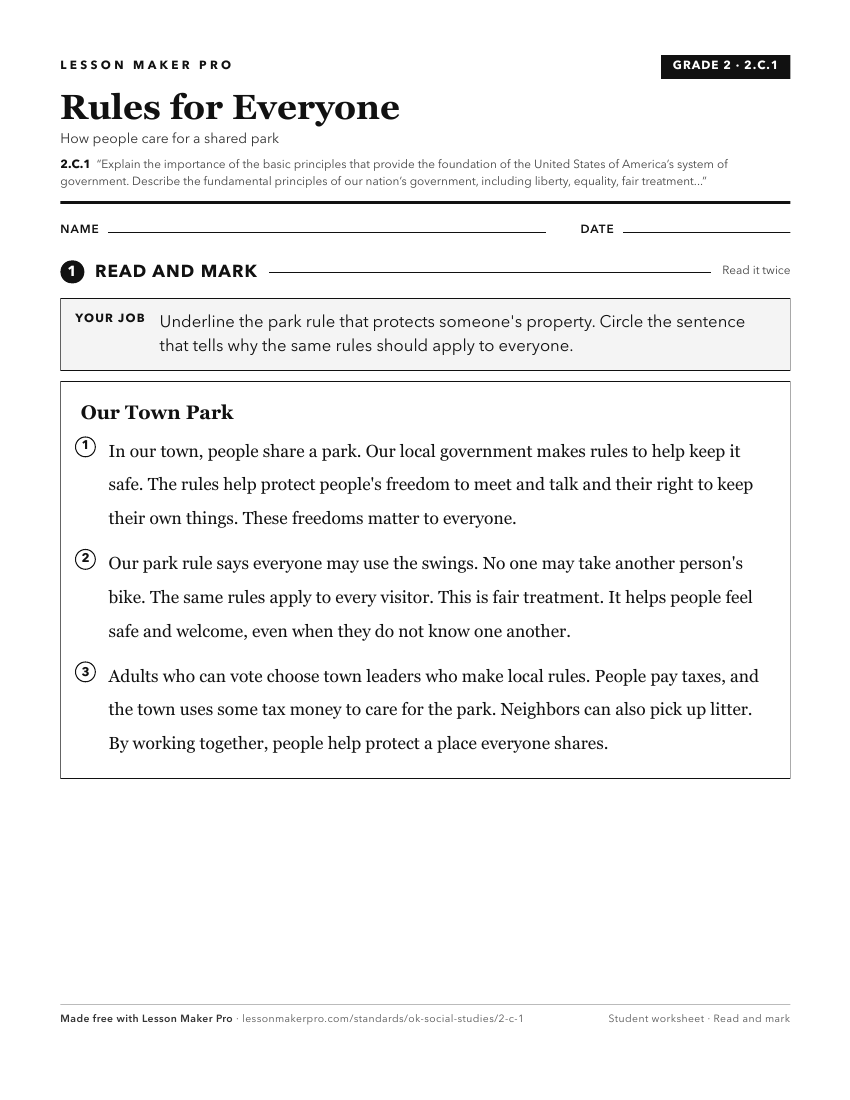
A ready-to-print activity worksheet aligned to 2.C.1, with an answer key for the teacher on its own page. No account needed.
PDF, US Letter, prints cleanly in black and white.
Download the worksheetKeep exploring
Related Standards
- 4.C.1.1.A
Identify the principles upon which our nation’s government is based, including the rule of law, compromise, equality, and individual rights of life, liberty and...
- USG.C.3
Analyze the fundamental principles of the American republic, as established in the Constitution of the United States of America.
- USG.C.1.3
Examine the founding principles of the United States of America’s constitutional republic.
- 8.C.4
Examine the key principles and structure of the United States of America’s government as established by the Constitution of the United States of America.
Turn this cluster into a lesson
Grade, subject, topic, and the complete cluster are prefilled. Create one free, no account needed.
Also for this cluster:Make a WorksheetMake a QuizMake a Sub Lesson