Oklahoma Social Studies AWH.C.8.2
The Standard
Explain the origins and significant aspects of Buddhism, including the life and teachings of Siddhartha Gautama, the evolution and central principles of Buddhism, and the significance of early Indian Hindu and Buddhist monarchies.
Oklahoma Academic Standards for Social Studies (2026)
Teacher's field guide
What This Standard Means
What Students Need to Do
- Students trace Siddhartha Gautama’s life from prince to Buddhist teacher. They explain his teachings about suffering and the path to ending it. They compare how Ashoka supported Buddhism and Gupta rulers supported Hindu traditions.
What Mastery Looks Like
- A student can place Gautama, Ashoka, and the Gupta rulers in order and explain what each contributed. They can explain the Four Noble Truths and Eightfold Path, and identify Theravada and Mahayana as later Buddhist traditions.
Common Misconceptions
- Students may think the Buddha was a god or that Buddhism teaches people to stop feeling emotions. They may think Ashoka founded Buddhism or that Gupta rulers mainly promoted Buddhism.
How to Assess It
- On an exit ticket, have students place Gautama, Ashoka, and the Gupta rulers in order. Ask them to name one Buddhist teaching, one later Buddhist tradition, and one way each monarchy supported a religion.
Lesson moves
Ways to Teach It
Give pairs dated cards for Gautama, Ashoka, and the Gupta rulers; have them arrange the cards and add one teaching or policy to each.
Ask students to compare an excerpt from Ashoka’s edicts with a photo of a Gupta-era Hindu temple: What did each ruler support?
Play a matching game with cards for the Four Noble Truths, Eightfold Path, Theravada, and Mahayana, plus plain-language descriptions.
Have students trace Buddhism’s route from India to Sri Lanka on a map and label Ashoka’s role in sending Buddhist teachers.
Free download
Printable AWH.C.8.2 Worksheet
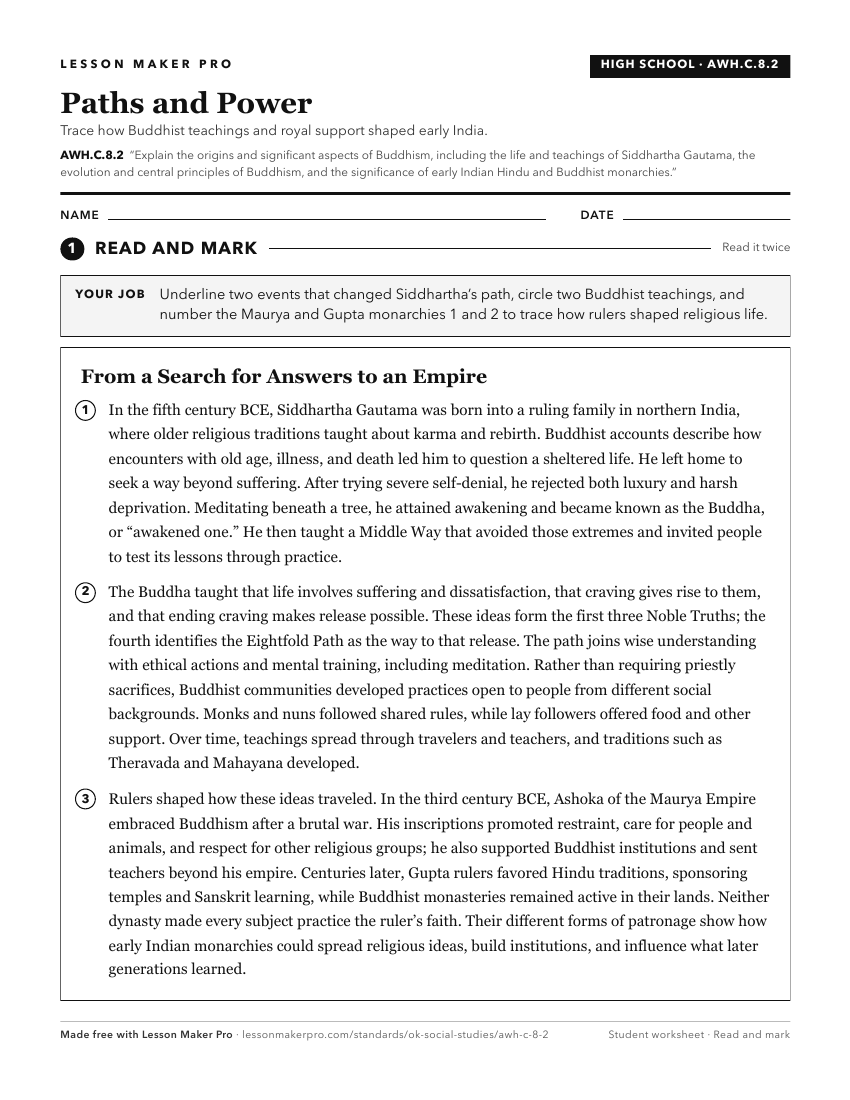
A ready-to-print activity worksheet aligned to AWH.C.8.2, with an answer key for the teacher on its own page. No account needed.
PDF, US Letter, prints cleanly in black and white.
Download the worksheetKeep exploring
Related Standards
- MWH.C.1.1.A
Compare the origins and spread of the world’s major religions and philosophies, including Judaism, Hinduism, Buddhism, Christianity, Islam, Confucianism, and Si...
- AWH.C.8.1
Describe the origins of Indian civilizations such as those of the Indus Valley, the evolution and central principles of Hinduism and the development of early In...
- AWH.C.11.2
Describe the rise and fall of the Mughal Empire, including important political, economic, and cultural aspects of early modern Indian history (e.g., rise and de...
- AWH.C.8.3
Describe important political, economic, and cultural aspects of Indian history, including the Maurya and Kushan Empires, the Gupta Empire, Golden Age of India, ...
Turn this exact standard into a lesson
Grade, subject, topic, and the complete standard are prefilled. Create one free, no account needed.
Also for this standard:Make a WorksheetMake a QuizMake a Sub Lesson