Oklahoma Social Studies MWH.C.7.3.B
The Standard
- MWH.C.7
- Evaluate post-World War II regional events leading to the transformations of the modern world.
- MWH.C.7.3
- Assess the impact of independence movements on human rights and the global expansion of democracy in South Asia.
Describe the partitioning of India and subsequent international relations (e.g., Indo-Pakistani wars, Non-Aligned Movement, India’s secular constitution, experiences with socialism, free-market reforms).
Oklahoma Academic Standards for Social Studies (2026) · MWH.C.7.3
Teacher's field guide
What This Standard Means
What Students Need to Do
- Students explain how the 1947 division of British India led to mass migration, violence, and conflict over Kashmir. They connect later wars and India's nonalignment to its relations with other countries. They describe India's secular constitution, state planning, and later market reforms.
What Mastery Looks Like
- A student can place partition, the first Kashmir war, the constitution, the Non-Aligned Movement, and 1991 reforms in order. They can use a map to explain the Kashmir dispute and describe how India's foreign and economic policies changed.
Common Misconceptions
- Students may think partition separated religious groups neatly, without mixed communities or forced migration. They may read nonalignment as isolation and secular government as a ban on religion. Some think state planning banned all private business or that market reforms ended government involvement.
How to Assess It
- Exit ticket: On a map, mark Kashmir. Write two sentences explaining how partition led to conflict there and what nonalignment meant during the Cold War.
Lesson moves
Ways to Teach It
Give pairs a partition map and tracing paper; have them outline new borders, mark Kashmir, and trace migration routes shown on the map.
Read an excerpt on religious freedom from India's constitution and ask, 'How could a secular government handle religious differences after partition?'
Teams order cards for partition, the constitution, state planning, nonalignment, wars, and 1991 reforms, then explain two cause-and-effect links.
Compare 1947 and current South Asia maps; circle Kashmir and write one sentence connecting its disputed border to India-Pakistan news.
Free download
Printable MWH.C.7.3.B Worksheet
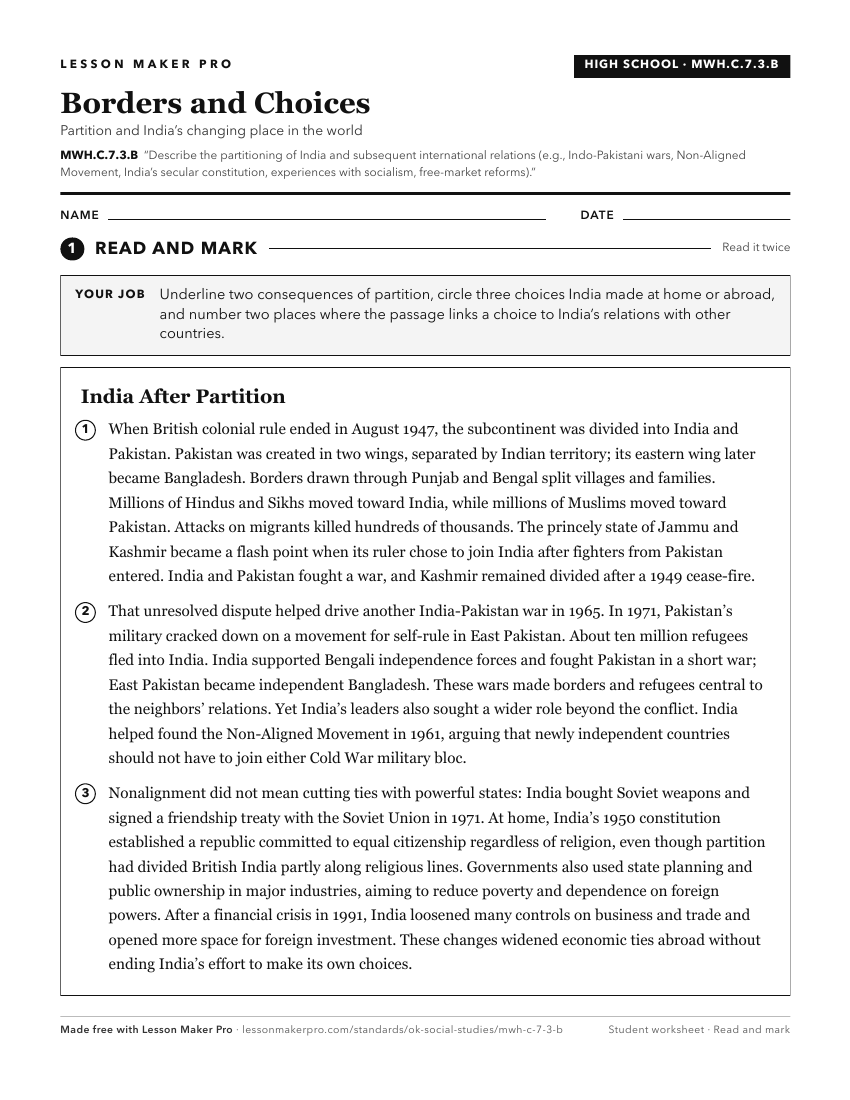
A ready-to-print activity worksheet aligned to MWH.C.7.3.B, with an answer key for the teacher on its own page. No account needed.
PDF, US Letter, prints cleanly in black and white.
Download the worksheetKeep exploring
Related Standards
- MWH.C.5.3.D
Assess the political, economic, and cultural impact of the British Raj, Britain’s subordination of India, as characterized by economic, educational, and infrast...
- MWH.C.7.3.A
Describe the fall of the British Raj and the emergence of an independent India and Pakistan, including the influence, ideas, and acts of civil disobedience by M...
- MWH.C.7.3
Assess the impact of independence movements on human rights and the global expansion of democracy in South Asia.
- AWH.C.8.3
Describe important political, economic, and cultural aspects of Indian history, including the Maurya and Kushan Empires, the Gupta Empire, Golden Age of India, ...
Turn this exact standard into a lesson
Grade, subject, topic, and the complete standard are prefilled. Create one free, no account needed.
Also for this standard:Make a WorksheetMake a QuizMake a Sub Lesson