Oklahoma Social Studies 8.C.2.3
Standard Cluster
- 8.C.2
- Examine key military and diplomatic events of the Revolutionary War that resulted in an independent nation.
Evaluate the challenges and reasons for the colonial victory over the British Empire. Compare military strength and available resources, including financial support from private individuals and allied nations, as well as French support negotiated by Benjamin Franklin. Summarize the impact of key military turning points of the Revolutionary War, including the victories at Boston, Trenton, Saratoga, and Yorktown. Explain how an effective military force was shaped by the leadership of General George Washington, Thomas Paine's The Crisis, and conditions at the Valley Forge encampment. Describe the significance of the Treaty of Paris (1783) as it relates to the recognition of the United States of America as an independent nation and the extension of American authority over western territory ceded by Britain.
Oklahoma Academic Standards for Social Studies (2026) · 8.C.2
Cluster contents
Standards in This Cluster
8.C.2.3 is a cluster heading. These are the individual standards under it.
- 8.C.2.3.A
Compare military strength and available resources, including financial support from private individuals and allied nations, as well as French support negotiated...
- 8.C.2.3.B
Summarize the impact of key military turning points of the Revolutionary War, including the victories at Boston, Trenton, Saratoga, and Yorktown.
- 8.C.2.3.C
Explain how an effective military force was shaped by the leadership of General George Washington, Thomas Paine's The Crisis, and conditions at the Valley Forge...
- 8.C.2.3.D
Describe the significance of the Treaty of Paris (1783) as it relates to the recognition of the United States of America as an independent nation and the extens...
Teacher's field guide
What This Cluster Means
What Students Need to Do
- Students compare British military strength with colonial shortages, private funding, and French aid negotiated by Benjamin Franklin. They explain how Boston, Trenton, Saratoga, and Yorktown changed the war, and how Washington's leadership, Paine's The Crisis, and Valley Forge shaped the army. They explain how the 1783 peace treaty recognized independence and ceded British claims to western land.
What Mastery Looks Like
- Students can name a British advantage and explain how private money or French support helped offset it. They link Boston to British withdrawal, Trenton to renewed morale, Saratoga to the French alliance, and Yorktown to British surrender. They explain how Washington, Paine, and Valley Forge sustained the army, then describe what the peace treaty changed.
Common Misconceptions
- Students may assume the colonies had as many supplies as Britain or that France was a formal ally from the start. They may mistake Yorktown for the signing of the peace treaty. They may think the treaty settled Native nations' claims to western lands.
How to Assess It
- On an exit ticket, ask: "How did the colonies win despite Britain's stronger military? Use one battle, one source of money or aid, and one result of the 1783 peace treaty."
Lesson moves
Ways to Teach It
Give groups cards for Boston, Trenton, Saratoga, and Yorktown; have them arrange the battles by date and write each battle's effect.
Ask: "Could the colonists have won without French ships?" Have partners defend their answers using Franklin's diplomacy and Yorktown.
Play a matching game with cards for Washington, The Crisis, Valley Forge, private lenders, and French aid, paired with their contributions.
Give students a $100 travel budget and a $50 donor card; ask what the gift buys, then compare it with private funding for troops.
Free download
Printable 8.C.2.3 Worksheet
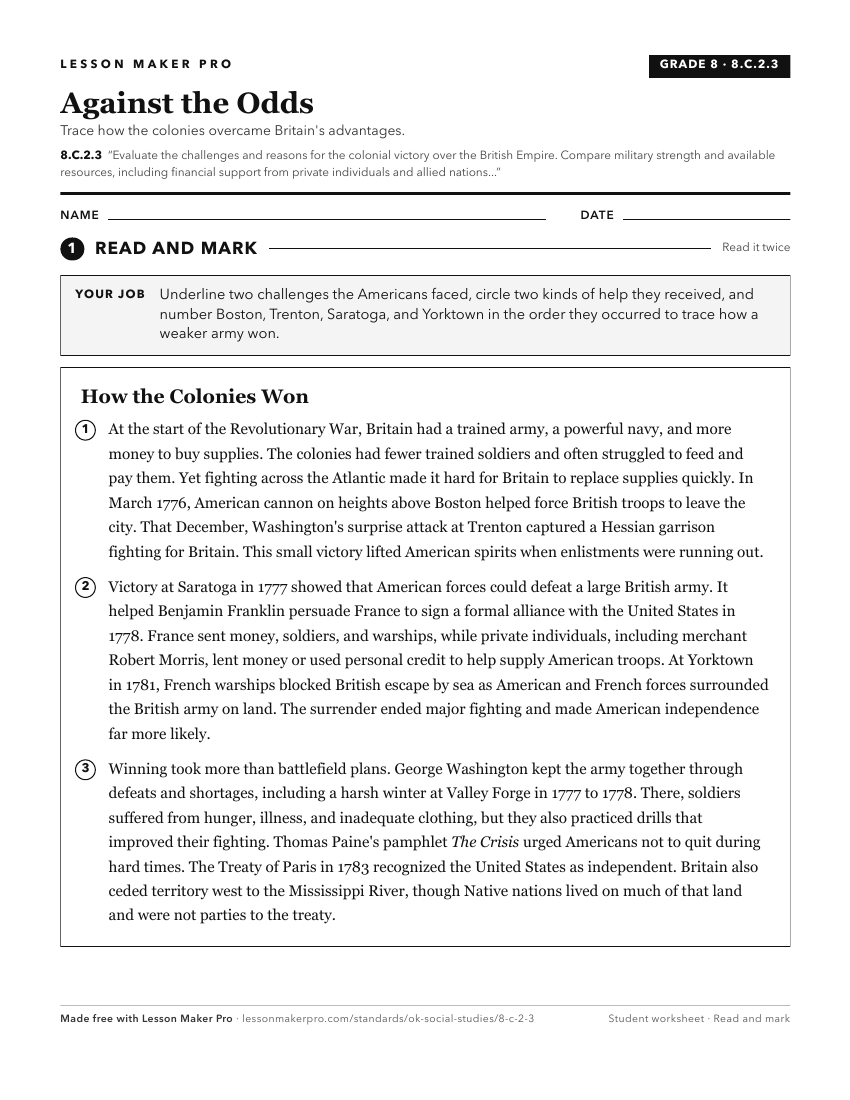
A ready-to-print activity worksheet aligned to 8.C.2.3, with an answer key for the teacher on its own page. No account needed.
PDF, US Letter, prints cleanly in black and white.
Download the worksheetKeep exploring
Related Standards
- 8.C.1.1
Analyze the political and economic climate in the British colonies on the eve of the French and Indian War.
- 8.C.1.5.E
Evaluate the diverse political, economic, and religious influences that shaped colonial arguments for independence.
- 5.C.4
Examine the struggles of the Revolutionary War and ultimate victory to gain independence.
- 5.C.4.2
Compare the advantages and disadvantages of the British and the American colonies during the Revolutionary War, including military leadership and strength, popu...
Turn this cluster into a lesson
Grade, subject, topic, and the complete cluster are prefilled. Create one free, no account needed.
Also for this cluster:Make a WorksheetMake a QuizMake a Sub Lesson