Oklahoma Social Studies 5.C.4
Standard Cluster
Examine the struggles of the Revolutionary War and ultimate victory to gain independence. Explain how the colonists were divided toward the growing call for independence by identifying various points of view and motivations, including patriots, loyalists, American Indian Nations, women, and enslaved persons. Compare the advantages and disadvantages of the British and the American colonies during the Revolutionary War, including military leadership and strength, population, resources, and foreign alliances. Examine the first United States of America centralized system of government under the Continental Congress and established by the Articles of Confederation. Identify the Articles of Confederation as a loose alliance of states. Explain the importance of the Articles of Confederation to wage a war and conduct foreign diplomacy. Analyze the relationships of significant military and diplomatic events of the Revolutionary War. Explain how the Battle of Bunker Hill, although a Patriot loss, confirmed colonial commitment to the patriot cause. Describe the Continental Army’s victory at Trenton, exemplified by Washington’s military leadership against professional British and Hessian troops. Explain that the Battles of Saratoga are considered a turning point with regards to securing French support for the revolution. Describe the harsh conditions at the Valley Forge Encampment and how Washington’s leadership created a cohesive, disciplined fighting force. Explain the significance of Thomas Paine’s The Crisis in bolstering patriot morale among the public and the military. Describe how the support of the French army and navy helped Americans defeat Lord Cornwallis at Yorktown. Summarize the significance of the Treaty of Paris (1783) on the United States of America’s status as a free nation. Identify the contributions of key individuals influential to the American Revolution in the fields of patriot leadership (e.g., Samuel Adams, Benjamin Rush, Paul Revere) politics and diplomacy (e.g., Patrick Henry, Benjamin Franklin, John Adams, Nancy Ward “Nanyehi”) military service (e.g., Nathan Hale, John Paul Jones, Daniel Morgan, Ethan Allen, Nathanael Greene, Benedict Arnold, Marquis de Lafayette) Native alliances (e.g., Stockbridge Indian regiment of Minutemen, Oneida scouts) ideological writing (e.g., Thomas Paine, Mercy Otis Warren, Phillis Wheatley).
Oklahoma Academic Standards for Social Studies (2026)
Cluster contents
Standards in This Cluster
5.C.4 is a cluster heading. These are the individual standards under it.
- 5.C.4.1
Explain how the colonists were divided toward the growing call for independence by identifying various points of view and motivations, including patriots, loyal...
- 5.C.4.2
Compare the advantages and disadvantages of the British and the American colonies during the Revolutionary War, including military leadership and strength, popu...
- 5.C.4.3
Examine the first United States of America centralized system of government under the Continental Congress and established by the Articles of Confederation.
- 5.C.4.3.A
Identify the Articles of Confederation as a loose alliance of states.
- 5.C.4.3.B
Explain the importance of the Articles of Confederation to wage a war and conduct foreign diplomacy.
- 5.C.4.4
Analyze the relationships of significant military and diplomatic events of the Revolutionary War.
- 5.C.4.4.A
Explain how the Battle of Bunker Hill, although a Patriot loss, confirmed colonial commitment to the patriot cause.
- 5.C.4.4.B
Describe the Continental Army’s victory at Trenton, exemplified by Washington’s military leadership against professional British and Hessian troops.
- 5.C.4.4.C
Explain that the Battles of Saratoga are considered a turning point with regards to securing French support for the revolution.
- 5.C.4.4.D
Describe the harsh conditions at the Valley Forge Encampment and how Washington’s leadership created a cohesive, disciplined fighting force.
- 5.C.4.4.E
Explain the significance of Thomas Paine’s The Crisis in bolstering patriot morale among the public and the military.
- 5.C.4.4.F
Describe how the support of the French army and navy helped Americans defeat Lord Cornwallis at Yorktown.
- 5.C.4.4.G
Summarize the significance of the Treaty of Paris (1783) on the United States of America’s status as a free nation.
- 5.C.4.5
Identify the contributions of key individuals influential to the American Revolution in the fields of
- 5.C.4.5.A
patriot leadership (e.g., Samuel Adams, Benjamin Rush, Paul Revere)
- 5.C.4.5.B
politics and diplomacy (e.g., Patrick Henry, Benjamin Franklin, John Adams, Nancy Ward “Nanyehi”)
- 5.C.4.5.C
military service (e.g., Nathan Hale, John Paul Jones, Daniel Morgan, Ethan Allen, Nathanael Greene, Benedict Arnold, Marquis de Lafayette)
- 5.C.4.5.D
Native alliances (e.g., Stockbridge Indian regiment of Minutemen, Oneida scouts)
- 5.C.4.5.E
ideological writing (e.g., Thomas Paine, Mercy Otis Warren, Phillis Wheatley).
Teacher's field guide
What This Cluster Means
What Students Need to Do
- Students explain why Patriots, Loyalists, Native nations, women, and enslaved people made different choices during the war. They compare the two sides' troops, leaders, supplies, and allies. They trace how battles, Congress, and foreign help led to independence.
What Mastery Looks Like
- A student can explain why the loss at Bunker Hill mattered and how Washington's actions at Trenton and Valley Forge helped the army. They connect Paine's writing to morale, Saratoga to French support, and French ships at Yorktown to British surrender. They explain what Congress could do under the Articles and why it depended on the states for money.
Common Misconceptions
- Students may assume all colonists wanted independence or that all Native nations chose the same side. They may think American troops won at Yorktown without French help. Some confuse the Articles with the Constitution and assume Congress could tax states directly.
How to Assess It
- On an exit ticket, ask: How did Saratoga help lead to victory at Yorktown? Name one thing Congress could do under the Articles and one thing it could not do.
Lesson moves
Ways to Teach It
Mark British troops, American troops, and French ships on a printed Yorktown map; use arrows to show why Cornwallis could not escape.
Read role cards for a Patriot, Loyalist, Oneida scout, Nancy Ward, farm woman, and enslaved person; discuss what each stood to gain or lose.
Have teams order Bunker Hill, The Crisis, Trenton, Saratoga, Valley Forge, Yorktown, and peace treaty cards, then draw two cause arrows.
Ask a class council to fund a field trip using only voluntary table donations, then compare its problem with Congress's wartime budget.
Free download
Printable 5.C.4 Worksheet
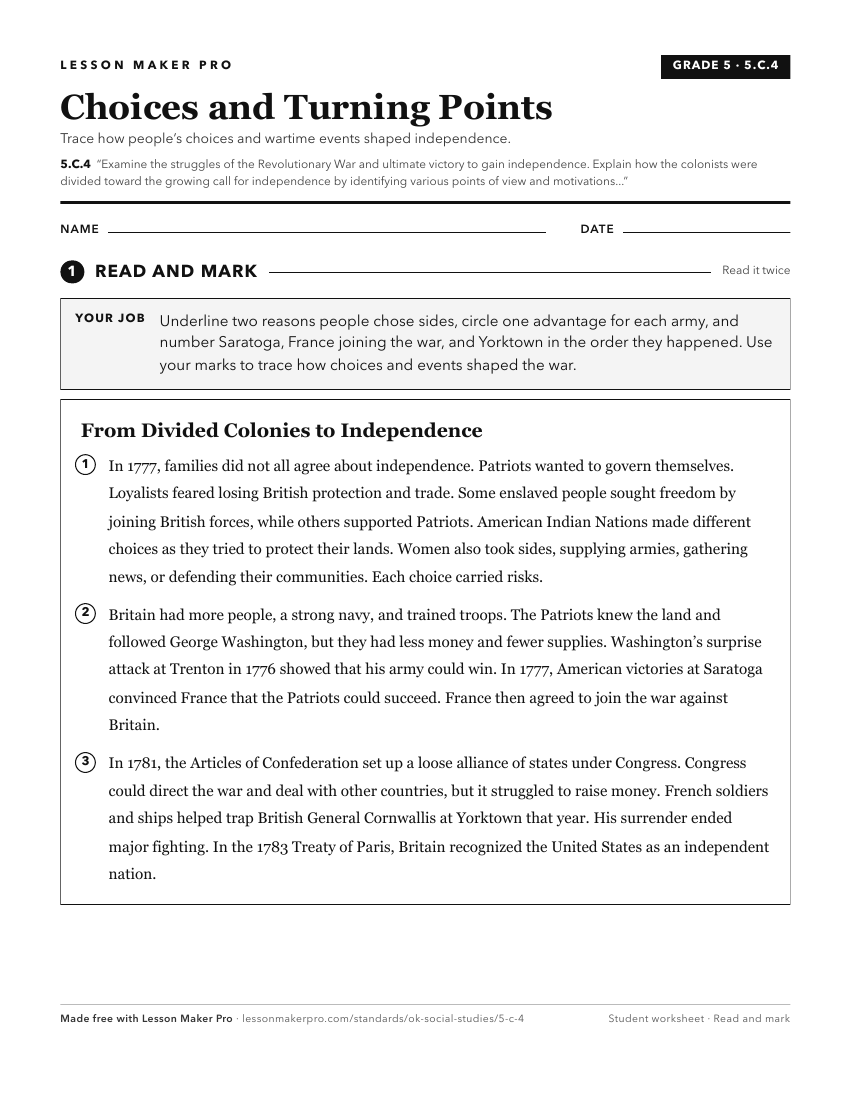
A ready-to-print activity worksheet aligned to 5.C.4, with an answer key for the teacher on its own page. No account needed.
PDF, US Letter, prints cleanly in black and white.
Download the worksheetKeep exploring
Related Standards
- 5.C.3
Analyze the series of events and policies which led colonists to seek and declare independence.
- 8.C.2
Examine key military and diplomatic events of the Revolutionary War that resulted in an independent nation.
- 8.C.2.3
Evaluate the challenges and reasons for the colonial victory over the British Empire.
Turn this cluster into a lesson
Grade, subject, topic, and the complete cluster are prefilled. Create one free, no account needed.
Also for this cluster:Make a WorksheetMake a QuizMake a Sub Lesson