Oklahoma Social Studies MWH.C.7.4
Standard Cluster
- MWH.C.7
- Evaluate post-World War II regional events leading to the transformations of the modern world.
Analyze political and cultural transformations occurring in East and Southeast Asia during the postwar era. Explain how civil conflicts in Korea and French Indochina became proxy wars between superpowers during the Cold War. Describe significant political and economic change in China, including the influence of Sun Yat-Sen and the 1911 Revolution, and examine the consequences of the Chinese Civil War, resulting in the establishment of the People’s Republic of China and the Republic of China (Taiwan), and compare their subsequent political and economic development. Describe the effects of the Chinese Communist Revolution, including the repressive economic and social policies of Mao Zedong, the Great Leap Forward and resulting famine, and the Cultural Revolution and political persecution. Explain the significance of pro-democracy movements such as Tiananmen Square and evaluate how economic reforms under Deng Xiaoping contributed to China’s modernization, expanding global influence, and evolving relationship with the United States of America.
Oklahoma Academic Standards for Social Studies (2026) · MWH.C.7
Cluster contents
Standards in This Cluster
MWH.C.7.4 is a cluster heading. These are the individual standards under it.
- MWH.C.7.4.A
Explain how civil conflicts in Korea and French Indochina became proxy wars between superpowers during the Cold War.
- MWH.C.7.4.B
Describe significant political and economic change in China, including the influence of Sun Yat-Sen and the 1911 Revolution, and examine the consequences of the...
- MWH.C.7.4.C
Describe the effects of the Chinese Communist Revolution, including the repressive economic and social policies of Mao Zedong, the Great Leap Forward and result...
- MWH.C.7.4.D
Explain the significance of pro-democracy movements such as Tiananmen Square and evaluate how economic reforms under Deng Xiaoping contributed to China’s modern...
Teacher's field guide
What This Cluster Means
What Students Need to Do
- Students trace Sun Yat-sen's ideas, the 1911 Revolution, and the civil war that split China and Taiwan. They identify foreign backers in the Korean and French Indochina wars. They explain Mao's campaigns, Deng's reforms, Tiananmen Square, and China's changing ties with the United States.
What Mastery Looks Like
- A student can identify who backed each side in Korea and French Indochina and explain why those wars drew foreign support. They can compare China's one-party rule and economic reforms with Taiwan's shift to democracy and export-led growth. They link the Great Leap Forward to famine and the Cultural Revolution to persecution.
Common Misconceptions
- Students may date the People's Republic of China to 1911 instead of 1949. They may think U.S. and Soviet troops did all the fighting in Korea and French Indochina. Some assume Deng's economic reforms brought free elections or that Taiwan was democratic from 1949.
How to Assess It
- Exit ticket: How did Deng's reforms change China's economy without ending Communist Party rule? Use the response to Tiananmen Square protests as evidence.
Lesson moves
Ways to Teach It
Pairs arrange dated cards for 1911, 1949, the Great Leap Forward, the Cultural Revolution, Deng's reforms, and Tiananmen, then label consequences.
Ask: Why could China grow richer after Deng's reforms while students at Tiananmen Square still demanded political change?
Teams race to match North Korea, South Korea, the Viet Minh, and French forces with foreign backers using labeled arrow cards.
Show U.S. Census import figures for China and Taiwan; students compare totals and name one way each economy connects to U.S. consumers.
Free download
Printable MWH.C.7.4 Worksheet
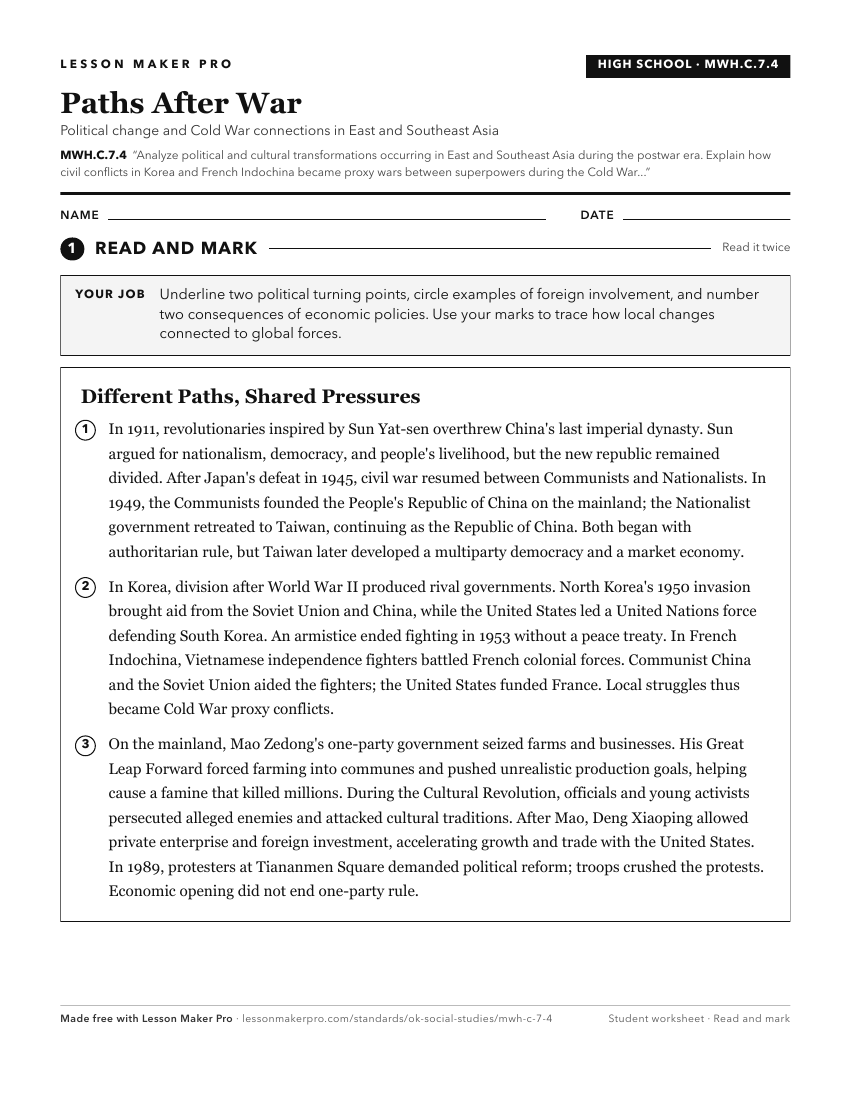
A ready-to-print activity worksheet aligned to MWH.C.7.4, with an answer key for the teacher on its own page. No account needed.
PDF, US Letter, prints cleanly in black and white.
Download the worksheetKeep exploring
Related Standards
- USH.C.7.3
Analyze the ongoing social and political transformations within the United States of America , affecting domestic and foreign policy.
- MWH.C.6.4
Analyze the economic, social, and political conditions that resulted in World War II.
- MWH.C.7
Evaluate post-World War II regional events leading to the transformations of the modern world.
- 8.C.13
Analyze the political, social, and economic transformations during the Reconstruction Era.
Turn this cluster into a lesson
Grade, subject, topic, and the complete cluster are prefilled. Create one free, no account needed.
Also for this cluster:Make a WorksheetMake a QuizMake a Sub Lesson