Oklahoma Social Studies MWH.C.7.7.A
The Standard
- MWH.C.7
- Evaluate post-World War II regional events leading to the transformations of the modern world.
- MWH.C.7.7
- Analyze recent threats to global security and regional stability.
Examine the religious, ethnic, and political origins and the lasting effects of ethnic conflict, modern genocide, and atrocities (e.g., Cambodia’s Khmer Rouge, Northern Ireland’s “Troubles”, Rwanda’s civil war, the Balkan’s ethnic cleansing).
Oklahoma Academic Standards for Social Studies (2026) · MWH.C.7.7
Teacher's field guide
What This Standard Means
What Students Need to Do
- Students investigate how political decisions and group identities contributed to specific conflicts. They use evidence to explain who was harmed and what effects lasted after the violence ended.
What Mastery Looks Like
- A student can explain how political leaders and ethnic divisions contributed to the 1994 genocide in Rwanda. They can compare it with Northern Ireland's Troubles and name a lasting effect of each without treating them as the same kind of violence.
Common Misconceptions
- Students may describe ethnic or religious groups as natural enemies, leaving out the actions of leaders and governments. They may call every atrocity genocide or assume a peace agreement ends distrust.
How to Assess It
- Exit ticket: For Rwanda in 1994 and Northern Ireland's Troubles, name one political cause and one identity factor in each. Then describe one lasting effect of either conflict.
Lesson moves
Ways to Teach It
Give pairs dated source cards from Rwanda and Northern Ireland to arrange on paper timelines, marking each card as a cause, event, or aftermath.
Ask students to write three sentences explaining how political power shaped both conflicts, using one dated event from each.
Have teams match cards naming Cambodia, Rwanda, Bosnia, and Northern Ireland to cause and aftermath cards, then defend one match.
Use a Kigali Genocide Memorial page to identify one present-day remembrance practice and connect it to an event from 1994.
Free download
Printable MWH.C.7.7.A Worksheet
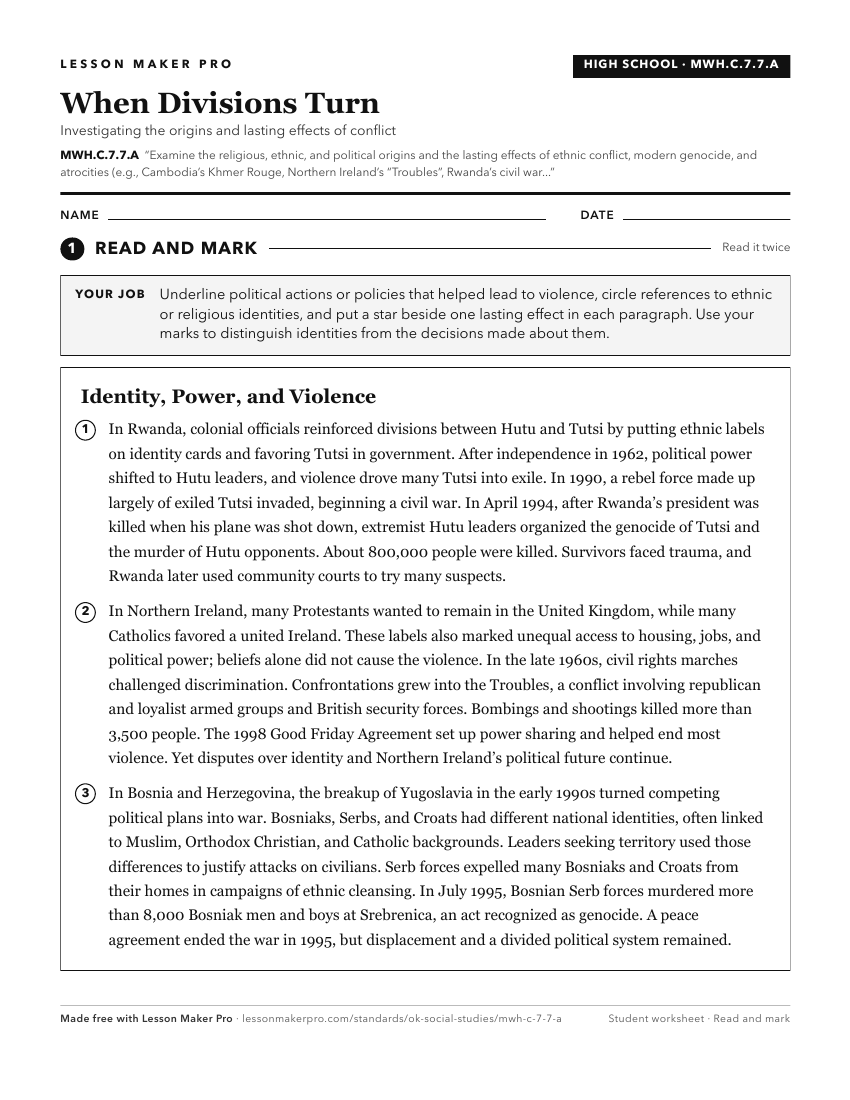
A ready-to-print activity worksheet aligned to MWH.C.7.7.A, with an answer key for the teacher on its own page. No account needed.
PDF, US Letter, prints cleanly in black and white.
Download the worksheetKeep exploring
Related Standards
- MWH.C.7.1
Evaluate the effects of World War II including the origins and escalation of the Cold War.
- 7.C.5.3
Examine the dominant religions of the world, including Chrisitanity, Judaism, Islam, Hinduism, and Buddhism. Examine how major belief systems influence societie...
- 7.C.8.6
Describe how political, economic, and cultural forces (e.g., civil wars, terrorism, genocide, ethnic separatism) have challenged political arrangements (e.g., p...
- MWH.C.6.6
Examine the background, causes, series of events, and effects of the Shoah (Holocaust), the state-sponsored systematic persecution and annihilation of European ...
Turn this exact standard into a lesson
Grade, subject, topic, and the complete standard are prefilled. Create one free, no account needed.
Also for this standard:Make a WorksheetMake a QuizMake a Sub Lesson