Oklahoma Social Studies MWH.C.7.7
Standard Cluster
- MWH.C.7
- Evaluate post-World War II regional events leading to the transformations of the modern world.
Analyze recent threats to global security and regional stability. Examine the religious, ethnic, and political origins and the lasting effects of ethnic conflict, modern genocide, and atrocities (e.g., Cambodia’s Khmer Rouge, Northern Ireland’s “Troubles”, Rwanda’s civil war, the Balkan’s ethnic cleansing). Identify conditions that have given rise to international terrorism and the rising threat of weapons of mass destruction, evaluating responses by governments and societies. Describe the challenges and impact of trade and increasing economic interdependence on modern economies.
Oklahoma Academic Standards for Social Studies (2026) · MWH.C.7
Cluster contents
Standards in This Cluster
MWH.C.7.7 is a cluster heading. These are the individual standards under it.
- MWH.C.7.7.A
Examine the religious, ethnic, and political origins and the lasting effects of ethnic conflict, modern genocide, and atrocities (e.g., Cambodia’s Khmer Rouge, ...
- MWH.C.7.7.B
Identify conditions that have given rise to international terrorism and the rising threat of weapons of mass destruction, evaluating responses by governments an...
- MWH.C.7.7.C
Describe the challenges and impact of trade and increasing economic interdependence on modern economies.
Teacher's field guide
What This Cluster Means
What Students Need to Do
- Students explain how political, ethnic, and sometimes religious factors contributed to conflicts and atrocities. They examine lasting harm, causes of terrorism, and threats from weapons of mass destruction. They weigh security responses and explain how trade links economies.
What Mastery Looks Like
- A student can explain how Khmer Rouge policies led to mass killings and how Cambodia still feels the effects. They can use evidence to weigh a security measure against a cost to civil rights. They can explain how a shipping delay affects trading partners.
Common Misconceptions
- Students may call ethnic conflict an ancient feud and miss the role of leaders and propaganda. They may assume terrorism has one religious cause or that only nuclear weapons count as weapons of mass destruction. They may think trade benefits every worker equally.
How to Assess It
- Exit ticket: Ask students to name one cause and lasting effect of the Rwandan genocide, then explain one strength and one limit of an international response.
Lesson moves
Ways to Teach It
Give groups event cards from Cambodia, Rwanda, and Northern Ireland; have them build timelines marking a cause, turning point, and lasting effect.
Ask, "When should a government limit privacy to reduce terrorism risk?" Have students name one possible benefit and one harm.
Give pairs cards showing airport screening, nuclear inspections, and community reporting; have them match each response to a threat and defend one choice.
Use a map showing Taiwanese chips, South Korean screens, and Vietnamese phone assembly; ask how a shipping delay could affect prices and jobs.
Free download
Printable MWH.C.7.7 Worksheet
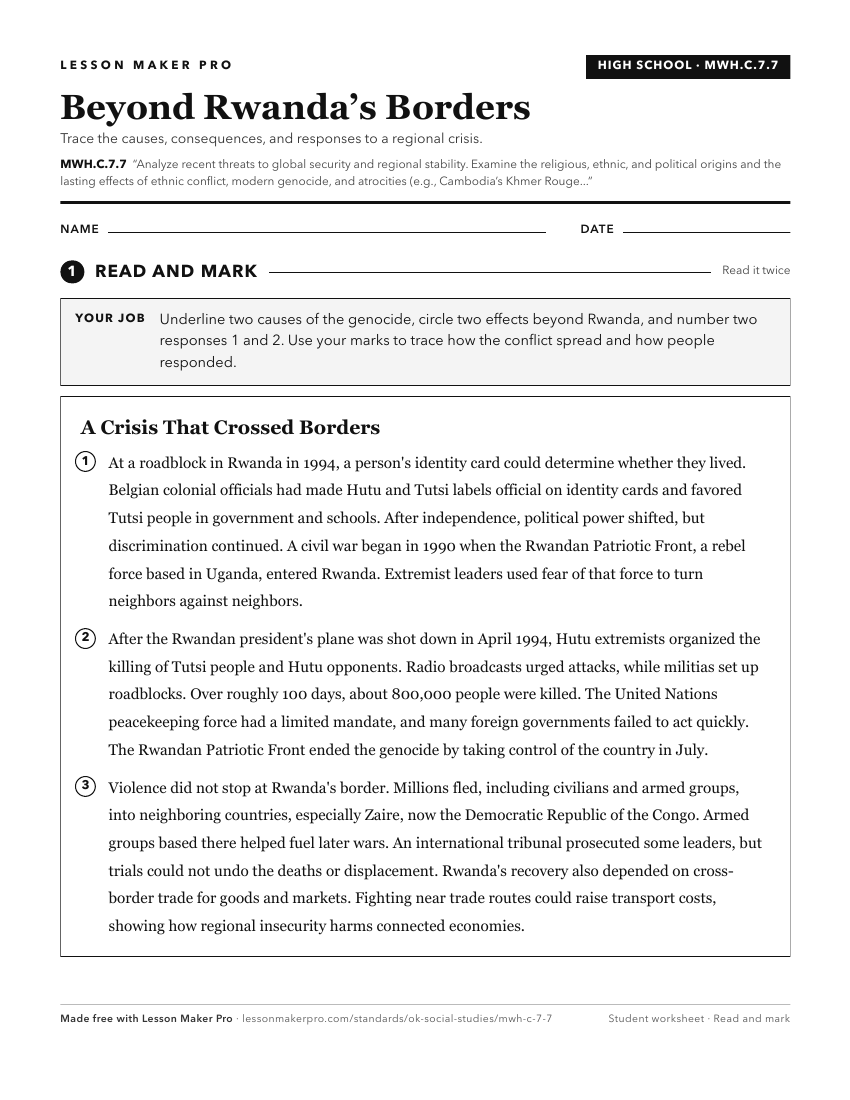
A ready-to-print activity worksheet aligned to MWH.C.7.7, with an answer key for the teacher on its own page. No account needed.
PDF, US Letter, prints cleanly in black and white.
Download the worksheetKeep exploring
Related Standards
- WG.C.4.3
Examine changes and challenges to political/territorial arrangements, by describing the forces that shape the world’s contemporary political map, including the ...
- MWH.C.7.2.C
Examine the roots of the ongoing regional instability of the Middle East, including the rise of Islamic fundamentalism, the Iranian Revolution and its establish...
- MWH.C.7.2
Evaluate ongoing regional disputes of the Middle East.
Turn this cluster into a lesson
Grade, subject, topic, and the complete cluster are prefilled. Create one free, no account needed.
Also for this cluster:Make a WorksheetMake a QuizMake a Sub Lesson