Oklahoma Social Studies MWH.C.7.2
Standard Cluster
- MWH.C.7
- Evaluate post-World War II regional events leading to the transformations of the modern world.
Evaluate ongoing regional disputes of the Middle East. Describe the creation of the modern State of Israel, including the rationale for its establishment, the Zionist movement, increased migration of Jews to the British Mandate for Palestine, and the United Nations Partition Plan. Explain how the 1948 War between five Arab states and Israel unfolded, how it contributed to a refugee crisis, and how it led to future conflicts (e.g., Six-Day War, Yom Kippur War) as well as various peace initiatives. Examine the roots of the ongoing regional instability of the Middle East, including the rise of Islamic fundamentalism, the Iranian Revolution and its establishment of a theocracy, the Iran-Iraq conflict, and the invasion of Kuwait.
Oklahoma Academic Standards for Social Studies (2026) · MWH.C.7
Cluster contents
Standards in This Cluster
MWH.C.7.2 is a cluster heading. These are the individual standards under it.
- MWH.C.7.2.A
Describe the creation of the modern State of Israel, including the rationale for its establishment, the Zionist movement, increased migration of Jews to the Bri...
- MWH.C.7.2.B
Explain how the 1948 War between five Arab states and Israel unfolded, how it contributed to a refugee crisis, and how it led to future conflicts (e.g., Six-Day...
- MWH.C.7.2.C
Examine the roots of the ongoing regional instability of the Middle East, including the rise of Islamic fundamentalism, the Iranian Revolution and its establish...
Teacher's field guide
What This Cluster Means
What Students Need to Do
- Students connect Zionism, persecution of Jews, migration to British-ruled Palestine, and the UN partition plan to Israel's founding. They trace the 1948 war, Palestinian displacement, later wars, and peace efforts. They explain how Islamist movements, Iran's revolution, the Iran-Iraq War, and Iraq's invasion of Kuwait added other sources of conflict.
What Mastery Looks Like
- A student can explain why Zionists sought a Jewish state and why many Palestinian Arabs opposed partition. They trace how the 1948 war drew in five Arab states, displaced many Palestinians, and shaped later wars and peace talks. They can tell those disputes apart from Iran's revolution, the Iran-Iraq War, and Iraq's invasion of Kuwait.
Common Misconceptions
- Some students think Zionism began after World War II, overlooking earlier migration and calls for a Jewish homeland. Others assume all Palestinians left voluntarily in 1948 or that the UN plan settled the dispute. They may treat Islam, Islamist political movements, and Iran's government as the same thing.
How to Assess It
- Give students a blank timeline with 1947, 1948, 1979, and 1990. Ask them to label each date and write one cause and one human consequence of the 1948 war.
Lesson moves
Ways to Teach It
Give pairs partition, armistice, and refugee-route maps; have them trace changed boundaries and mark two routes Palestinians took in 1948.
Ask: Why did some Jews support a homeland in Palestine, and why did many Palestinian Arabs oppose the 1947 partition plan?
Run a card sort: students group the 1948, 1967, and 1973 wars, the Egypt-Israel treaty, Iran's revolution, and Iraq's invasion of Kuwait by dispute.
Bring a news report on a Middle East dispute; students locate two places it mentions and connect the report to one dated historical event.
Free download
Printable MWH.C.7.2 Worksheet
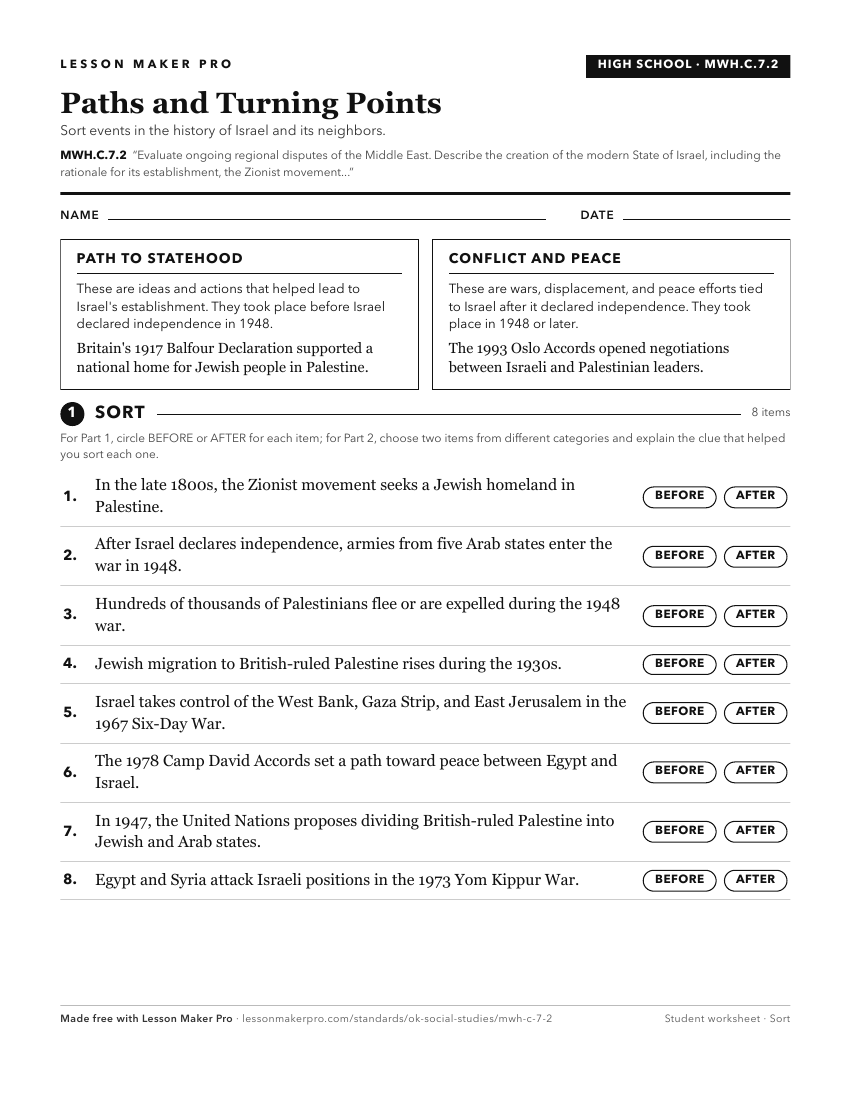
A ready-to-print activity worksheet aligned to MWH.C.7.2, with an answer key for the teacher on its own page. No account needed.
PDF, US Letter, prints cleanly in black and white.
Download the worksheetKeep exploring
Related Standards
- MWH.C.7.7
Analyze recent threats to global security and regional stability.
- 7.C.8.7
Analyze reasons for conflict and cooperation among regions, evaluating the advantages and disadvantages of international organizations and alliances (e.g., Euro...
- 7.C.2.4
Identify examples of scarcity and how the availability of natural resources impacts regional economies, potentially leading to both conflict and cooperation.
Turn this cluster into a lesson
Grade, subject, topic, and the complete cluster are prefilled. Create one free, no account needed.
Also for this cluster:Make a WorksheetMake a QuizMake a Sub Lesson