Oklahoma Social Studies 7.C.2.4
The Standard
- 7.C.2
- Analyze the physical systems of the major regions of the Eastern Hemisphere.
Identify examples of scarcity and how the availability of natural resources impacts regional economies, potentially leading to both conflict and cooperation.
Oklahoma Academic Standards for Social Studies (2026) · 7.C.2
Teacher's field guide
What This Standard Means
What Students Need to Do
- Students identify natural resources that cannot meet every demand in a region. They explain how limited supplies affect local jobs and why people may compete or make agreements over those resources.
What Mastery Looks Like
- A student can explain how less Colorado River water could reduce irrigation and farm income. They can describe a dispute over water use and an agreement to limit it.
Common Misconceptions
- Students may think scarcity means a resource is completely gone. They may also assume that competing over a resource rules out cooperation.
How to Assess It
- Exit ticket: Two counties share a shrinking aquifer. How might this affect farm income, what could they fight over, and what could they agree to do?
Lesson moves
Ways to Teach It
Give three groups 12 water counters; assign farms 8, towns 6, and a power plant 4, then have groups negotiate shares.
Ask students to write: When Colorado River water drops, which jobs lose income, and what might two states argue or agree about?
Give students cards naming timber, oil, and water; have them match each to a regional job, a likely dispute, and a possible agreement.
Show the latest Oklahoma drought map and ask students how dry areas might affect ranches and water-sharing agreements between towns.
Free download
Printable 7.C.2.4 Worksheet
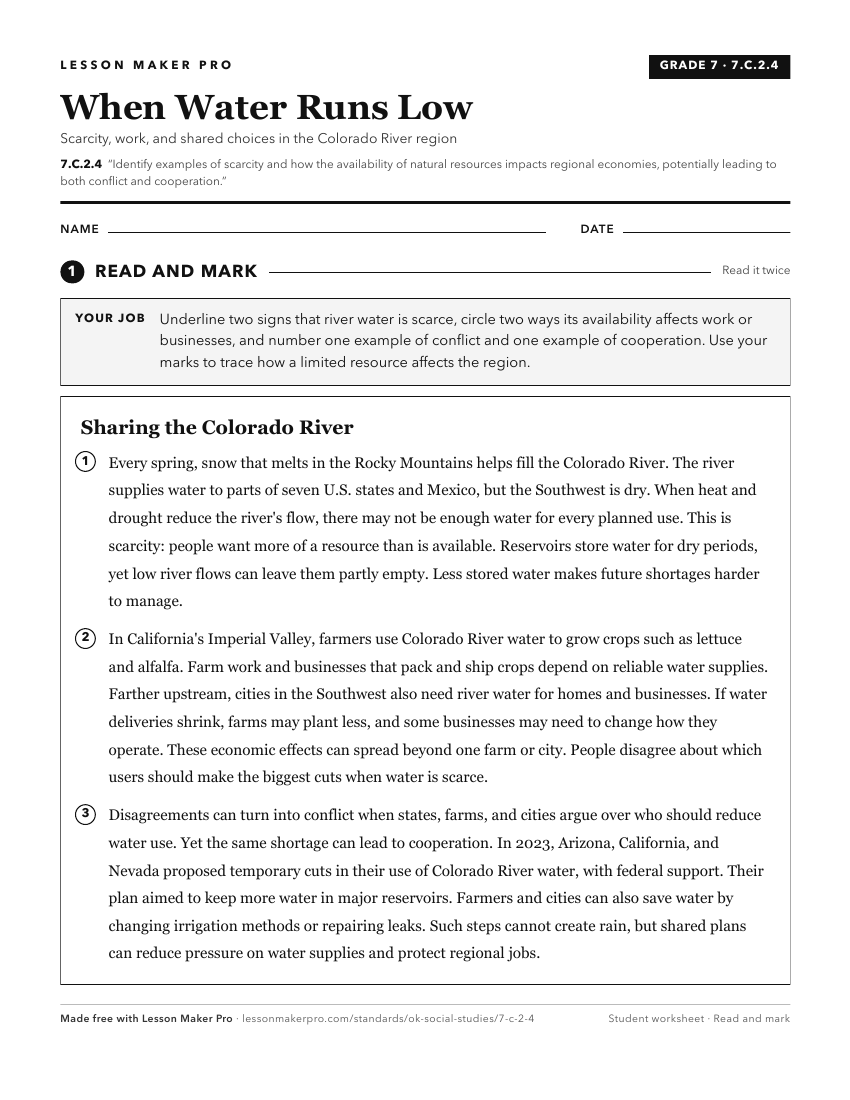
A ready-to-print activity worksheet aligned to 7.C.2.4, with an answer key for the teacher on its own page. No account needed.
PDF, US Letter, prints cleanly in black and white.
Download the worksheetKeep exploring
Related Standards
- WG.C.6.1
Examine the significance of access to natural resources, energy, and technological innovations (e.g., wind, solar, nuclear) to the economic development of a reg...
- 4.C.4.2.B
Distinguish between renewable (e.g., water, soil, solar) and nonrenewable resources (e.g., fossil fuels: oil, natural gas, coal) and explain how they are used t...
- 6.C.2.4
Describe the distribution of natural resources found in each region, delineating between renewable and nonrenewable resources, and explaining how the relative l...
- 3.C.2.4.C
Examine the concepts of scarcity and surplus of natural resources and describe the role of citizens in conserving the state’s resources (e.g., water rationing, ...
Turn this exact standard into a lesson
Grade, subject, topic, and the complete standard are prefilled. Create one free, no account needed.
Also for this standard:Make a WorksheetMake a QuizMake a Sub Lesson