Oklahoma Social Studies 6.C.2.4
The Standard
- 6.C.2
- Analyze the physical systems of the major regions of the Western Hemisphere.
Describe the distribution of natural resources found in each region, delineating between renewable and nonrenewable resources, and explaining how the relative location to such resources can influence the economic development of a region.
Oklahoma Academic Standards for Social Studies (2026) · 6.C.2
Teacher's field guide
What This Standard Means
What Students Need to Do
- Students locate natural resources on a map of the Western Hemisphere. They sort resources as renewable or nonrenewable and explain how being near a resource can shape jobs and trade.
What Mastery Looks Like
- A student can place Canadian timber, Andean copper, and Caribbean fisheries in the right regions. They can explain why a copper mine may bring mining and transport jobs to a nearby town.
Common Misconceptions
- Students may think every region has the same resources. They may call timber renewable without considering how long trees take to regrow. They may assume a resource creates jobs everywhere, regardless of distance or transport.
How to Assess It
- Give students a blank map and ask them to mark Canadian timber and Andean copper. Have them label each resource and write one sentence about a job it could support nearby.
Lesson moves
Ways to Teach It
Give pairs a map and resource cards for Canadian timber, Andean copper, Caribbean fish, Mexican oil, and Costa Rican coffee to place and sort.
Ask students to write: Why might a town near an Andean copper mine have different jobs from a Caribbean fishing village?
Play a matching game with region cards, resource cards, and renewable or nonrenewable labels.
Read the origin label on a banana from Costa Rica, then trace its route to a store and name jobs along the way.
Free download
Printable 6.C.2.4 Worksheet
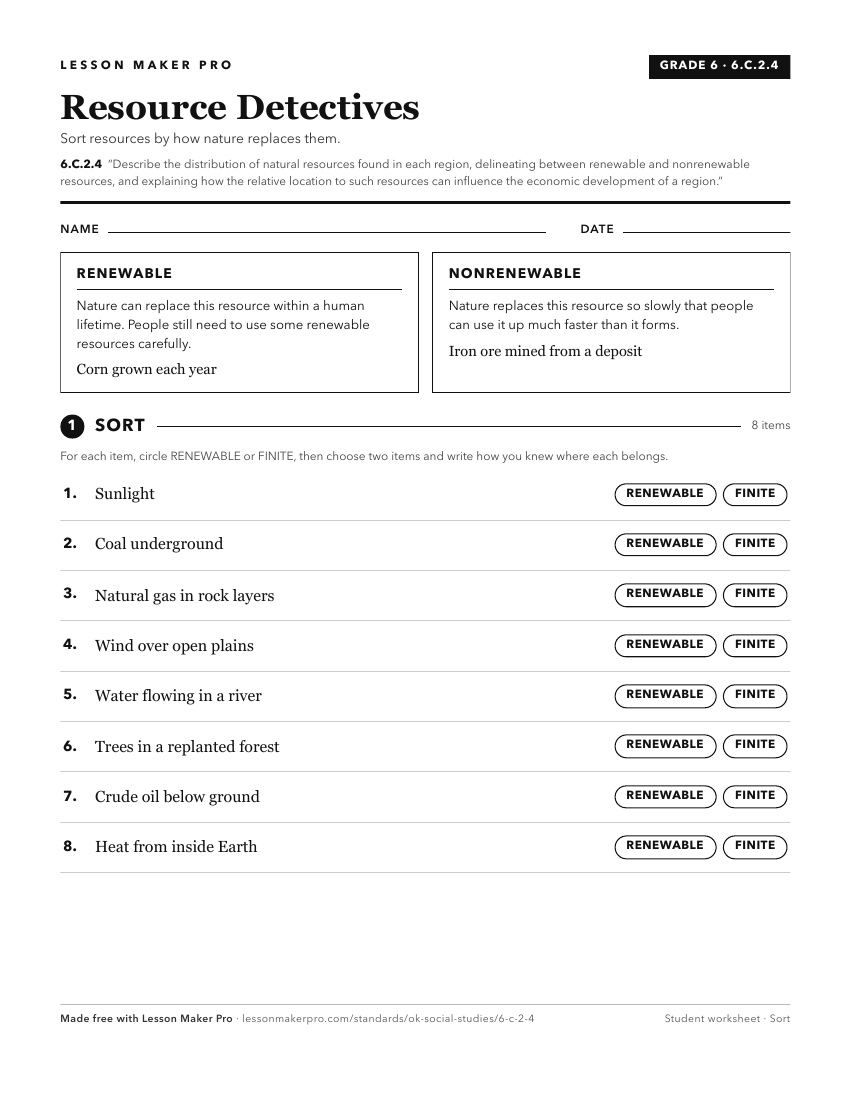
A ready-to-print activity worksheet aligned to 6.C.2.4, with an answer key for the teacher on its own page. No account needed.
PDF, US Letter, prints cleanly in black and white.
Download the worksheetKeep exploring
Related Standards
- WG.C.6.1
Examine the significance of access to natural resources, energy, and technological innovations (e.g., wind, solar, nuclear) to the economic development of a reg...
- 4.C.4.2.B
Distinguish between renewable (e.g., water, soil, solar) and nonrenewable resources (e.g., fossil fuels: oil, natural gas, coal) and explain how they are used t...
- 4.C.4.2.C
Describe the relative location and importance of natural resources which support human development in each region (e.g., Mid-Continent oilfield, Appalachian and...
- 7.C.2.3
Compare the characteristics and distribution of major renewable and nonrenewable resources of each region, identifying major nations in which natural resources ...
Turn this exact standard into a lesson
Grade, subject, topic, and the complete standard are prefilled. Create one free, no account needed.
Also for this standard:Make a WorksheetMake a QuizMake a Sub Lesson