Oklahoma Social Studies 7.C.2.3
The Standard
- 7.C.2
- Analyze the physical systems of the major regions of the Eastern Hemisphere.
Compare the characteristics and distribution of major renewable and nonrenewable resources of each region, identifying major nations in which natural resources (e.g., fossil fuels, minerals, agricultural crops) are the primary source of economic activities.
Oklahoma Academic Standards for Social Studies (2026) · 7.C.2
Teacher's field guide
What This Standard Means
What Students Need to Do
- Students read maps to find where crops, fuels, and minerals are produced. They sort resources by whether they can be replaced on a human timescale and connect them to farming, mining, or fuel production.
What Mastery Looks Like
- A student can locate tea in Kenya, oil in Saudi Arabia, and iron ore in Australia. They can explain why tea regrows but oil and iron ore do not, then name a job or export tied to each.
Common Misconceptions
- Students may call oil renewable because people keep finding new deposits. They may assume every country in a region has the same resources, or that finding a resource means it drives the country's economy.
How to Assess It
- Give students a map showing Kenya, Saudi Arabia, and Australia. Ask them to label tea, oil, and iron ore, sort each by renewability, and name one related job or export.
Lesson moves
Ways to Teach It
Give pairs a blank world map and stickers for Kenyan tea, Saudi oil, and Australian iron ore; have them place and sort each.
Ask: Why can Kenyan tea farms produce another crop next year while Saudi oil fields cannot replace pumped oil?
Match Kenya, Saudi Arabia, and Australia cards to tea, oil, and iron ore cards; say whether each renews and name one related job.
Check a Kenyan tea box and an Australian iron ore export chart; trace each product to its source and the work it supports.
Free download
Printable 7.C.2.3 Worksheet
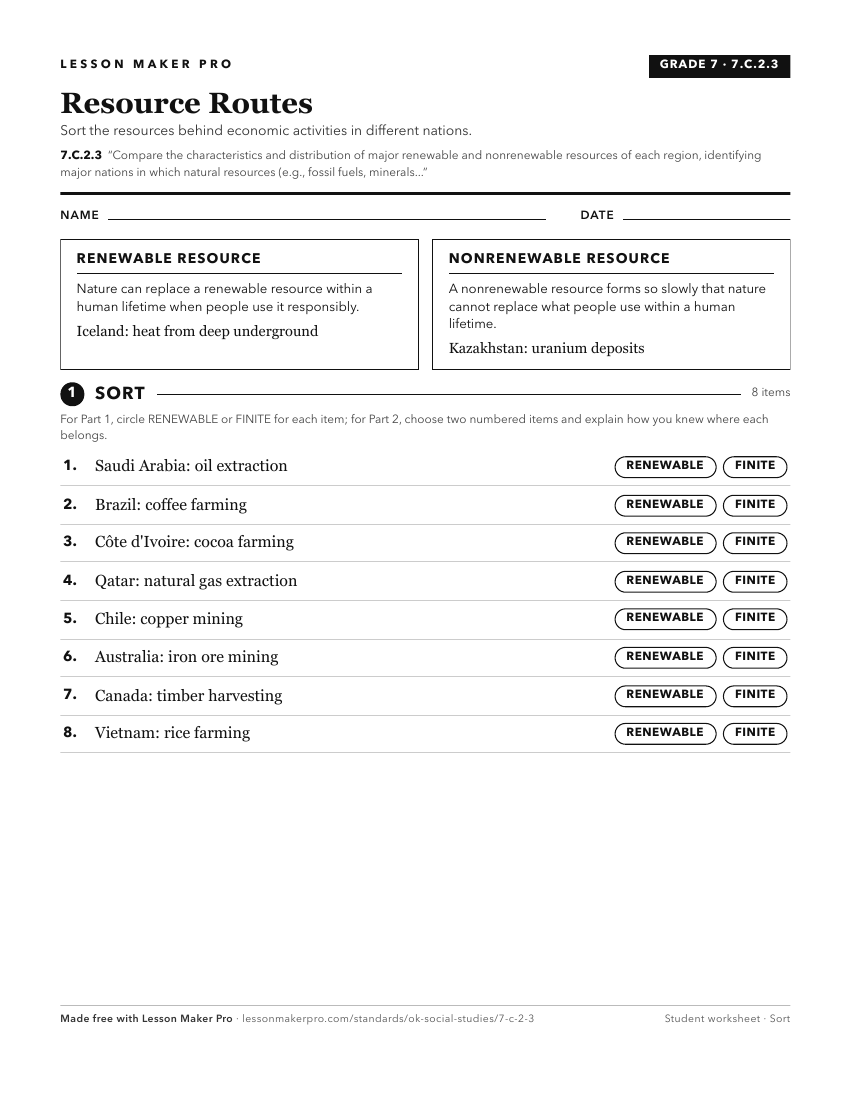
A ready-to-print activity worksheet aligned to 7.C.2.3, with an answer key for the teacher on its own page. No account needed.
PDF, US Letter, prints cleanly in black and white.
Download the worksheetKeep exploring
Related Standards
- WG.C.6.1
Examine the significance of access to natural resources, energy, and technological innovations (e.g., wind, solar, nuclear) to the economic development of a reg...
- 4.C.4.2.B
Distinguish between renewable (e.g., water, soil, solar) and nonrenewable resources (e.g., fossil fuels: oil, natural gas, coal) and explain how they are used t...
- 6.C.2.4
Describe the distribution of natural resources found in each region, delineating between renewable and nonrenewable resources, and explaining how the relative l...
- 4.C.4.2.C
Describe the relative location and importance of natural resources which support human development in each region (e.g., Mid-Continent oilfield, Appalachian and...
Turn this exact standard into a lesson
Grade, subject, topic, and the complete standard are prefilled. Create one free, no account needed.
Also for this standard:Make a WorksheetMake a QuizMake a Sub Lesson