Virginia SOL PS.1
SOL Standard (Key Ideas Cluster)
The student will demonstrate an understanding of scientific and engineering practices by asking questions and defining problems ask questions that require empirical evidence to answer develop hypotheses indicating relationships between independent and dependent variables offer simple solutions to design problems planning and carrying out investigations independently and collaboratively plan and conduct observational and experimental investigations; identify variables, constants, and controls where appropriate and include the safe use of chemicals and equipment evaluate the accuracy of various methods for collecting data take metric measurements using appropriate tools and technologies apply scientific ideas or principles to design, construct, and/or test a design of an object, tool, process or system interpreting, analyzing, and evaluating data construct and interpret data tables showing independent and dependent variables, repeated trials, and means construct, analyze, and interpret graphical displays of data and consider limitations of data analysis apply mathematical concepts and processes to scientific questions use data to evaluate and refine design solutions to best meet criteria constructing and critiquing conclusions and explanations construct scientific explanations based on valid and reliable evidence obtained from sources (including the students’ own investigations) construct arguments supported by empirical evidence and scientific reasoning generate and compare multiple solutions to problems based on how well they meet the criteria and constraints differentiate between a scientific hypothesis, theory, and law developing and using models construct, develop, and use models and simulations to illustrate and/or explain observable and unobservable phenomena evaluate limitations of models obtaining, evaluating, and communicating information read scientific texts, including those adapted for classroom use, to determine the central idea and/or obtain scientific and/or technical information gather, read, and synthesize information from multiple appropriate sources and assess the credibility, accuracy, and possible bias of each publication construct, use, and/or present an oral and written argument supported by empirical evidence and scientific reasoning
Virginia Standards of Learning for Science
Cluster contents
Key Ideas in This Standard
PS.1 is a Standards of Learning science standard. These are the key ideas and practices under it.
- PS.1.a
asking questions and defining problems
- PS.1.a.i
ask questions that require empirical evidence to answer
- PS.1.a.ii
develop hypotheses indicating relationships between independent and dependent variables
- PS.1.a.iii
offer simple solutions to design problems
- PS.1.b
planning and carrying out investigations
- PS.1.b.i
independently and collaboratively plan and conduct observational and experimental investigations; identify variables, constants, and controls where appropriate ...
- PS.1.b.ii
evaluate the accuracy of various methods for collecting data
- PS.1.b.iii
take metric measurements using appropriate tools and technologies
- PS.1.b.iv
apply scientific ideas or principles to design, construct, and/or test a design of an object, tool, process or system
- PS.1.c
interpreting, analyzing, and evaluating data
- PS.1.c.i
construct and interpret data tables showing independent and dependent variables, repeated trials, and means
- PS.1.c.ii
construct, analyze, and interpret graphical displays of data and consider limitations of data analysis
- PS.1.c.iii
apply mathematical concepts and processes to scientific questions
- PS.1.c.iv
use data to evaluate and refine design solutions to best meet criteria
- PS.1.d
constructing and critiquing conclusions and explanations
- PS.1.d.i
construct scientific explanations based on valid and reliable evidence obtained from sources (including the students' own investigations)
- PS.1.d.ii
construct arguments supported by empirical evidence and scientific reasoning
- PS.1.d.iii
generate and compare multiple solutions to problems based on how well they meet the criteria and constraints
- PS.1.d.iv
differentiate between a scientific hypothesis, theory, and law
- PS.1.e
developing and using models
- PS.1.e.i
construct, develop, and use models and simulations to illustrate and/or explain observable and unobservable phenomena
- PS.1.e.ii
evaluate limitations of models
- PS.1.f
obtaining, evaluating, and communicating information
- PS.1.f.i
read scientific texts, including those adapted for classroom use, to determine the central idea and/or obtain scientific and/or technical information
- PS.1.f.ii
gather, read, and synthesize information from multiple appropriate sources and assess the credibility, accuracy, and possible bias of each publication
- PS.1.f.iii
construct, use, and/or present an oral and written argument supported by empirical evidence and scientific reasoning
Teacher's field guide
What This Cluster Means
What Students Need to Do
- Students ask testable questions and write hypotheses that link changed and measured variables. They plan safe investigations, take metric measurements, repeat trials, and organize results in tables and graphs. They use evidence, models, calculations, and reliable sources to explain results or improve a design.
What Mastery Looks Like
- Given a question, a student can identify variables, constants, controls, tools, and a safe procedure. The student can calculate means, choose a useful graph, and explain what the data supports and where it is limited. The student can compare solutions and defend a conclusion with evidence and sound reasoning.
Common Misconceptions
- Students may treat a hypothesis as a guess or believe theories become laws after enough testing. They often confuse independent and dependent variables, or change several variables in one trial. They may assume a graph proves cause, a model is exact, or a polished source is automatically reliable.
How to Assess It
- Exit ticket: “Does ramp height affect a toy car’s travel distance?” Have students name both variables, two constants, a metric tool, a hypothesis, and headings for a three-trial data table.
Lesson moves
Ways to Teach It
Build paper helicopters with two blade lengths, run three timed drops per design, calculate means, graph results, and revise one feature.
Give two conflicting claims about sports drinks, then have students write which evidence they would trust and why.
Run a card sort where teams match investigation scenarios to variables, constants, controls, tools, and suitable graph types.
Test which reusable cup keeps water coldest, using temperature data and cost limits to recommend a purchase for the cafeteria.
Free download
Printable PS.1 Worksheet
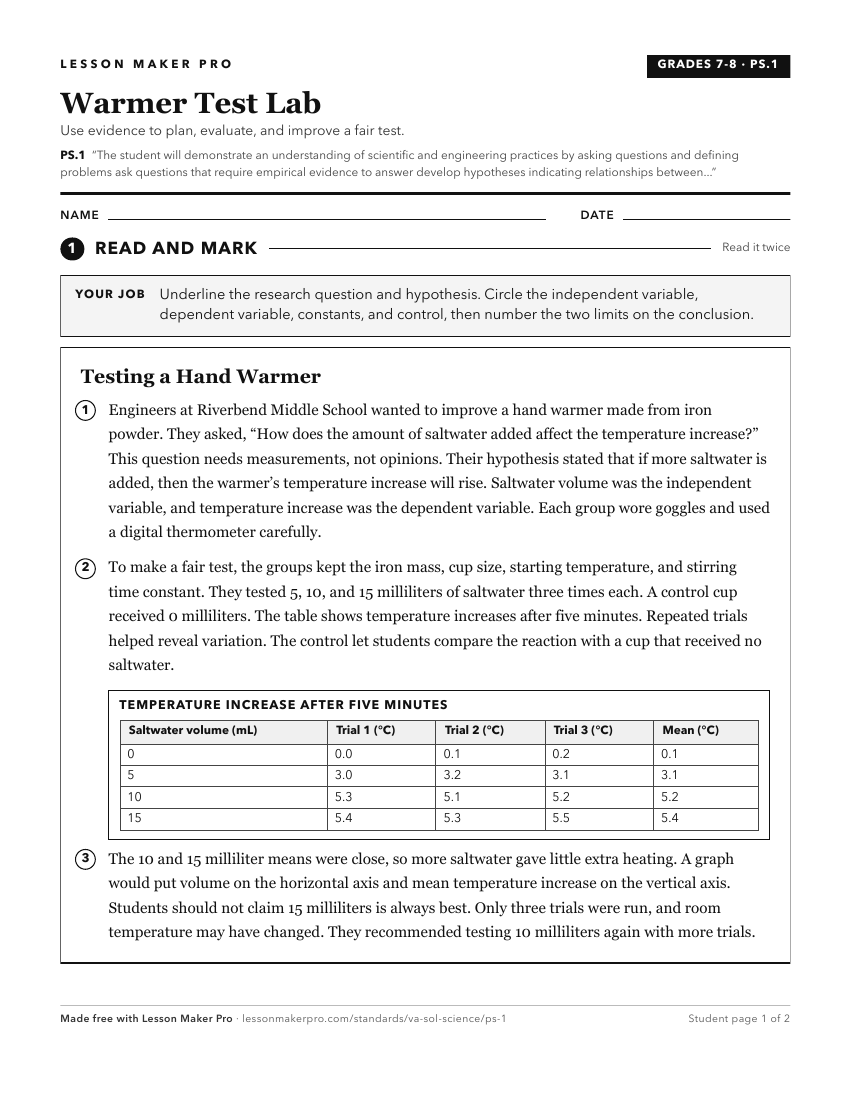
A ready-to-print activity worksheet aligned to PS.1, with an answer key for the teacher on its own page. No account needed.
PDF, US Letter, prints cleanly in black and white.
Download the worksheetKeep exploring
Related Standards
- 1.1
The student will demonstrate an understanding of scientific and engineering practices by
- K.1
The student will demonstrate an understanding of scientific and engineering practices by
- 5.1
The student will demonstrate an understanding of scientific and engineering practices by
- 2.1
The student will demonstrate an understanding of scientific and engineering practices by
Turn this cluster into a lesson
Grade, subject, topic, and the complete cluster are prefilled. Create one free, no account needed.
Also for this cluster:Make a WorksheetMake a QuizMake a Sub Lesson