Virginia SOL PS.1.d
SOL Standard (Key Ideas Cluster)
- PS.1
- The student will demonstrate an understanding of scientific and engineering practices by
constructing and critiquing conclusions and explanations construct scientific explanations based on valid and reliable evidence obtained from sources (including the students’ own investigations) construct arguments supported by empirical evidence and scientific reasoning generate and compare multiple solutions to problems based on how well they meet the criteria and constraints differentiate between a scientific hypothesis, theory, and law
Virginia Standards of Learning for Science · The student will demonstrate an understanding of scientific and engineering practices by
Cluster contents
Key Ideas in This Standard
PS.1.d is a Standards of Learning science standard. These are the key ideas and practices under it.
- PS.1.d.i
construct scientific explanations based on valid and reliable evidence obtained from sources (including the students' own investigations)
- PS.1.d.ii
construct arguments supported by empirical evidence and scientific reasoning
- PS.1.d.iii
generate and compare multiple solutions to problems based on how well they meet the criteria and constraints
- PS.1.d.iv
differentiate between a scientific hypothesis, theory, and law
Teacher's field guide
What This Cluster Means
What Students Need to Do
- Students use reliable evidence from investigations and other sources to explain results and defend claims with scientific reasoning. They compare possible solutions against stated criteria and constraints. They also distinguish hypotheses, theories, and laws by purpose and evidence.
What Mastery Looks Like
- Students connect each claim to specific data and explain why the evidence supports it. They can critique weak reasoning, rank solutions using clear criteria, and correctly label examples as hypotheses, theories, or laws.
Common Misconceptions
- Students may treat opinions as evidence or assume one successful trial proves a claim. They often think theories are unproven guesses that become laws after enough testing. They may choose a solution without checking every criterion and constraint.
How to Assess It
- Give students a short data table and two proposed solutions with cost and performance limits. Ask them to write a conclusion, cite two data points, choose the better solution, and classify a sample statement as hypothesis, theory, or law.
Lesson moves
Ways to Teach It
Test three paper bridge designs with washers, then use load data and material limits to select and defend the best design.
Present two explanations for unexpected lab results and ask students to identify which claim has stronger evidence and reasoning.
Play a card sort matching claims, evidence, reasoning, hypotheses, theories, and laws, then require partners to justify each placement.
Compare home insulation options using cost, heat-loss data, and installation limits, then recommend one option in a short written argument.
Free download
Printable PS.1.d Worksheet
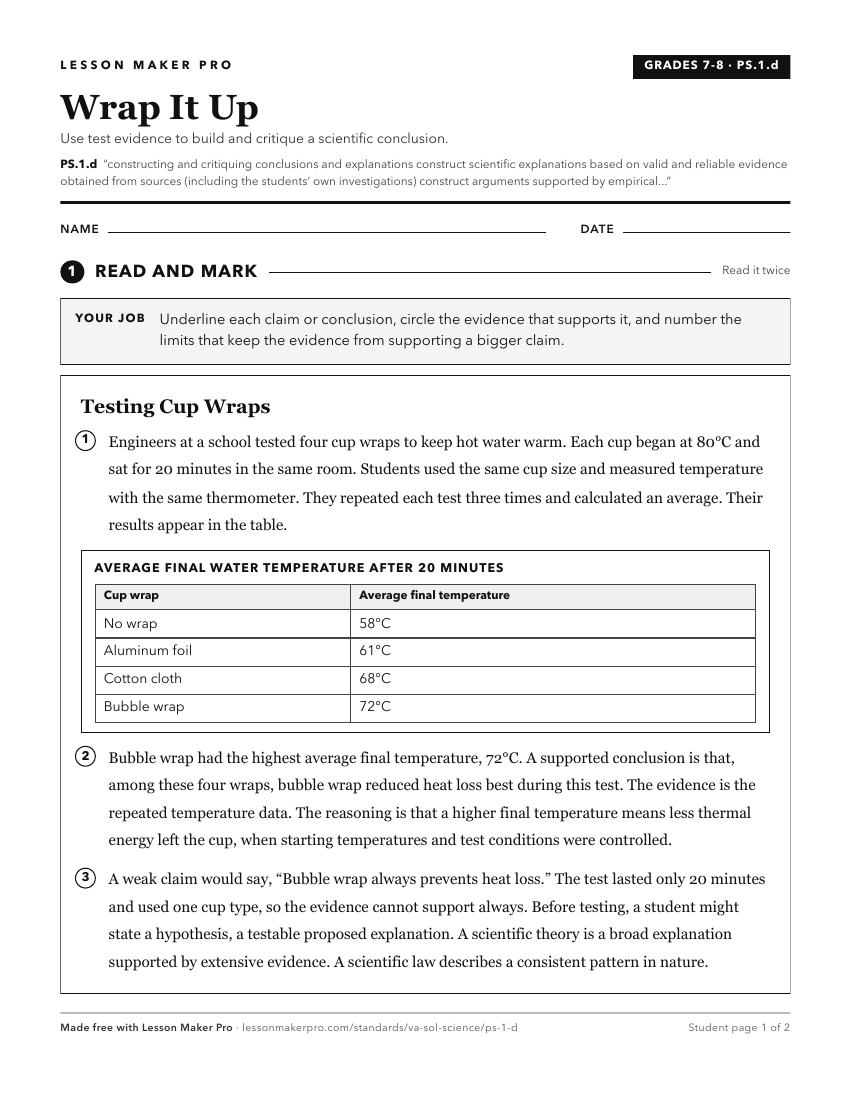
A ready-to-print activity worksheet aligned to PS.1.d, with an answer key for the teacher on its own page. No account needed.
PDF, US Letter, prints cleanly in black and white.
Download the worksheetKeep exploring
Related Standards
Turn this cluster into a lesson
Grade, subject, topic, and the complete cluster are prefilled. Create one free, no account needed.
Also for this cluster:Make a WorksheetMake a QuizMake a Sub Lesson