Virginia SOL PS.1.d.iv
The Standard
- PS.1
- The student will demonstrate an understanding of scientific and engineering practices by
constructing and critiquing conclusions and explanations differentiate between a scientific hypothesis, theory, and law
Virginia Standards of Learning for Science · The student will demonstrate an understanding of scientific and engineering practices by
Teacher's field guide
What This Standard Means
What Students Need to Do
- Students classify scientific claims by the role each claim plays. They distinguish a testable proposed answer, a supported explanation, and a description of a consistent pattern.
What Mastery Looks Like
- Students correctly label examples and justify each choice using evidence, explanation, prediction, or pattern. They explain that theories do not become laws as evidence grows.
Common Misconceptions
- Students may think a theory is only a guess or that hypotheses become theories and then laws. They may also think laws explain why something happens or can never be revised.
How to Assess It
- Ask students to classify a plant growth prediction, kinetic molecular theory, and Boyle's law. Have them give one reason for each classification.
Lesson moves
Ways to Teach It
Give groups claim cards to sort into hypothesis, theory, and law columns, then require a written reason beside each card.
Ask students to write a response to: Why does a scientific theory not graduate into a law?
Play Four Corners with hypothesis, theory, law, and insufficient information signs, reading one scientific claim per round.
Compare germ theory, a prediction about handwashing, and a measured infection pattern to show how each serves a different purpose.
Free download
Printable PS.1.d.iv Worksheet
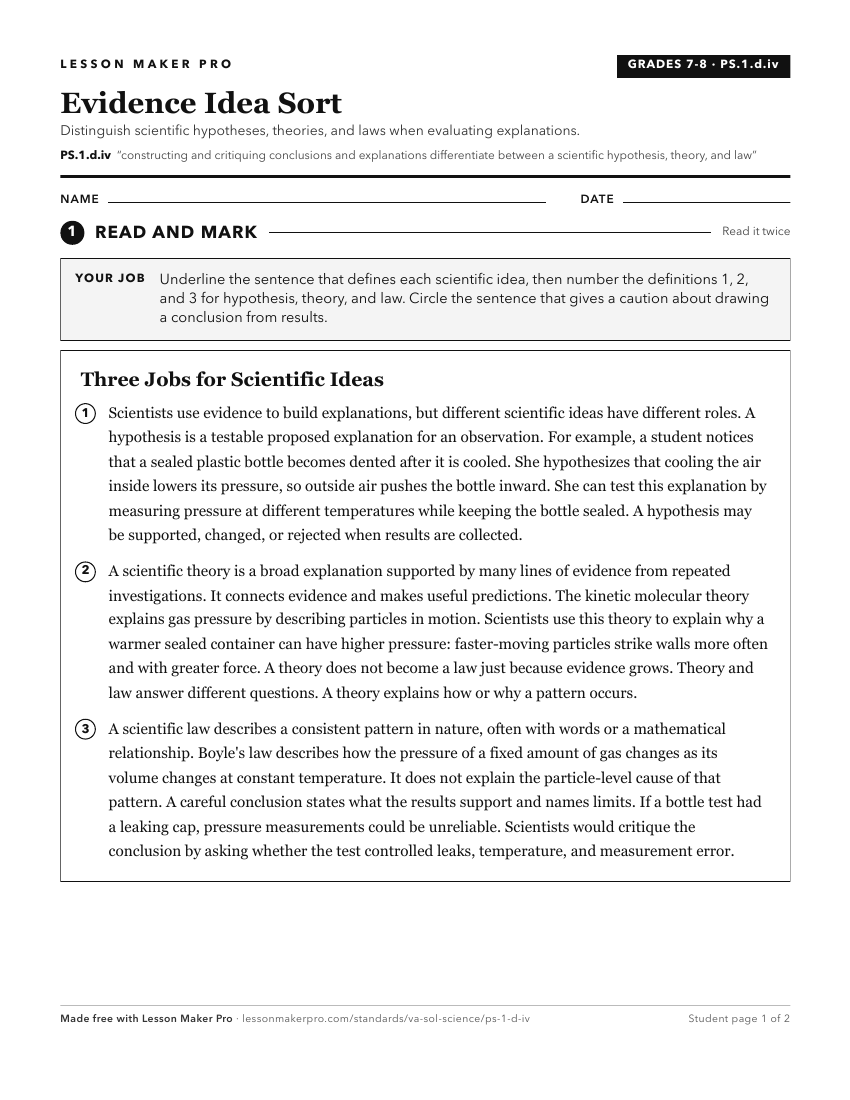
A ready-to-print activity worksheet aligned to PS.1.d.iv, with an answer key for the teacher on its own page. No account needed.
PDF, US Letter, prints cleanly in black and white.
Download the worksheetKeep exploring
Related Standards
Turn this exact standard into a lesson
Grade, subject, topic, and the complete standard are prefilled. Create one free, no account needed.
Also for this standard:Make a WorksheetMake a QuizMake a Sub Lesson