Florida SS.6.W.3
Florida Standard (Benchmark Cluster)
Recognize significant events, figures, and contributions of classical civilizations (i.e., Phoenicia, Greece, Rome, Axum).
Florida Next Generation Sunshine State Standards for Social Studies
Cluster contents
Benchmarks in This Standard
SS.6.W.3 is a Florida social studies standard. These are the benchmarks under it.
- SS.6.W.3.1
Analyze the cultural impact the ancient Phoenicians had on the Mediterranean world with regard to colonization (Carthage), exploration, maritime commerce (purpl...
- SS.6.W.3.2
Explain the democratic concepts (i.e., polis, civic participation and voting rights, legislative bodies, written constitutions, rule of law) developed in ancien...
- SS.6.W.3.3
Compare life in Athens and Sparta (e.g., government and the status of citizens, women and children, foreigners, helots).
- SS.6.W.3.4
Explain the causes and effects of the Persian and Peloponnesian Wars.
- SS.6.W.3.5
Summarize the important achievements and contributions of ancient Greek civilization.
- SS.6.W.3.6
Determine the impact of key figures from ancient Greece.
- SS.6.W.3.7
Summarize the key achievements, contributions, and figures associated with The Hellenistic Period.
- SS.6.W.3.8
Determine the impact of significant figures associated with ancient Rome.
- SS.6.W.3.9
Explain the impact of the Punic Wars on the development of the Roman Empire.
- SS.6.W.3.10
Describe the government of the Roman Republic and its contribution to the development of democratic principles (i.e., separation of powers, rule of law, represe...
- SS.6.W.3.11
Explain the transition from Roman Republic to empire and Imperial Rome and compare Roman life and culture under each one.
- SS.6.W.3.12
Explain the causes for the growth and longevity of the Roman Empire.
- SS.6.W.3.13
Identify key figures and the basic beliefs of early Christianity and how these beliefs impacted the Roman Empire.
- SS.6.W.3.14
Describe the key achievements and contributions of Roman civilization.
- SS.6.W.3.15
Explain the reasons for the gradual decline of the Western Roman Empire after the Pax Romana.
- SS.6.W.3.16
Compare life in the Roman Republic for patricians, plebeians, women, children, and slaves.
- SS.6.W.3.17
Explain the spread and influence of the Latin language on Western Civilization.
- SS.6.W.3.18
Describe the rise and fall of the ancient east African kingdoms of Kush and Axum and Christianity's development in Ethiopia.
Teacher's field guide
What This Cluster Means
What Students Need to Do
- Students identify key people, events, and contributions from Phoenicia, Greece, Rome, and Axum. They explain how trade, government, writing, and religion shaped these civilizations.
What Mastery Looks Like
- A student can place each civilization on a map and match it with an example, such as the Phoenician alphabet or Roman roads. They can explain a connection, such as how Axum's Red Sea location supported trade.
Common Misconceptions
- Students may think the Phoenicians invented all writing, rather than an alphabet that influenced later ones. They may also mix up Greek democracy with Roman government or assume Axum was cut off from other civilizations.
How to Assess It
- Give students a blank map and four cards labeled Phoenicia, Greece, Rome, and Axum. Ask them to place each card and write one contribution or event for each civilization.
Lesson moves
Ways to Teach It
Give pairs a Mediterranean and Red Sea map, then have them place four civilization labels and draw two likely trade routes.
Ask students to write which spread farther through trade, the Phoenician alphabet or Axum's goods, and support their choice with evidence.
Play a card sort matching Athens, Roman roads, the Phoenician alphabet, and Axum's adoption of Christianity to their civilizations.
Show a photo of a modern road and a map of Roman roads, then ask how roads helped move people and goods.
Free download
Printable SS.6.W.3 Worksheet
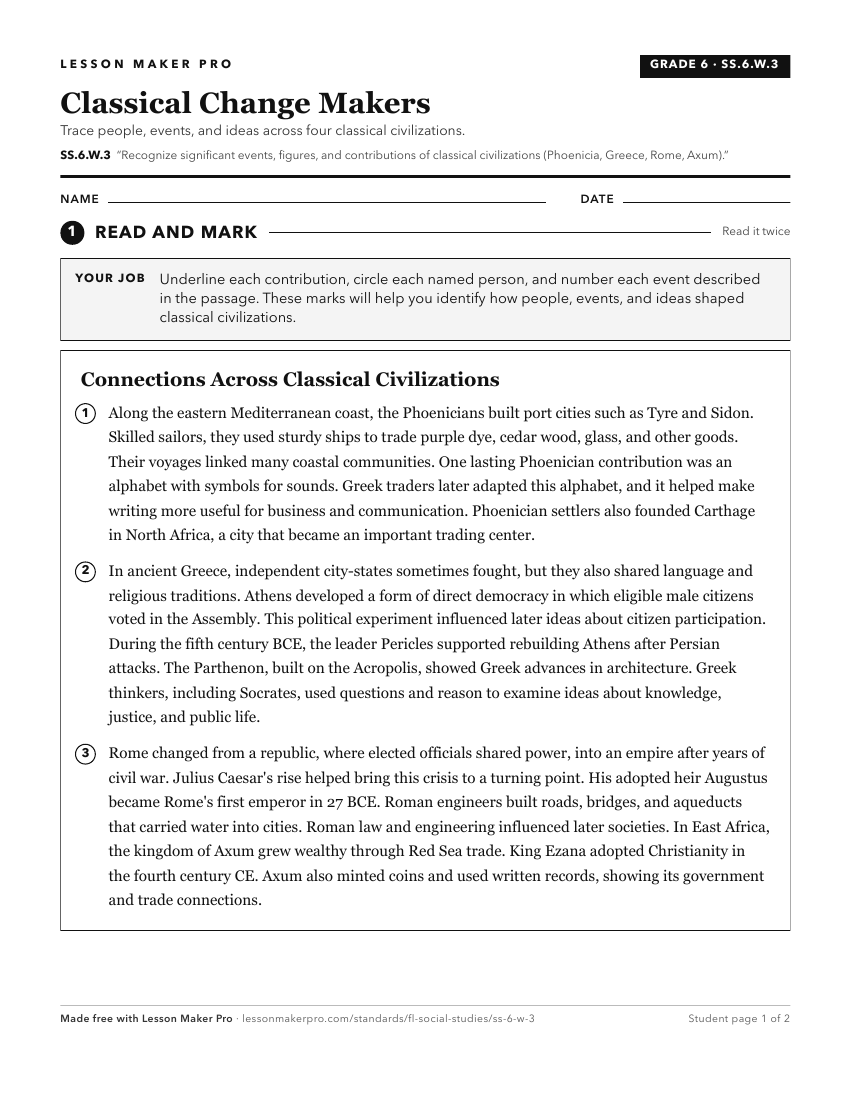
A ready-to-print activity worksheet aligned to SS.6.W.3, with an answer key for the teacher on its own page. No account needed.
PDF, US Letter, prints cleanly in black and white.
Download the worksheetKeep exploring
Related Standards
Turn this cluster into a lesson
Grade, subject, topic, and the complete cluster are prefilled. Create one free, no account needed.
Also for this cluster:Make a WorksheetMake a QuizMake a Sub Lesson