Florida SS.6.W.4
Florida Standard (Benchmark Cluster)
Recognize significant events, figures, and contributions of classical Asian civilizations (i.e., China, India).
Florida Next Generation Sunshine State Standards for Social Studies
Cluster contents
Benchmarks in This Standard
SS.6.W.4 is a Florida social studies standard. These are the benchmarks under it.
- SS.6.W.4.1
Discuss the significance of Aryan and other tribal migrations on Indian civilization.
- SS.6.W.4.2
Explain the major beliefs and practices associated with Hinduism and the social structure of the caste system in ancient India.
- SS.6.W.4.3
Recognize the political and cultural achievements of the Mauryan and Gupta empires.
- SS.6.W.4.4
Explain the teachings of Buddha, the importance of Asoka, and how Buddhism spread in India, Ceylon, and other parts of Asia.
- SS.6.W.4.5
Summarize the important achievements and contributions of ancient Indian civilization.
- SS.6.W.4.6
Describe the concept of the Mandate of Heaven and its connection to the Zhou and later dynasties.
- SS.6.W.4.7
Explain the basic teachings of Laozi, Confucius, and Han Fei Zi.
- SS.6.W.4.8
Describe the contributions of classical and post classical China.
- SS.6.W.4.9
Identify key figures from classical and post classical China.
- SS.6.W.4.10
Explain the significance of the silk roads and maritime routes across the Indian Ocean to the movement of goods and ideas among Asia, East Africa, and the Medit...
- SS.6.W.4.11
Explain the rise and expansion of the Mongol empire and its effects on peoples of Asia and Europe including the achievements of Genghis and Kublai Khan.
- SS.6.W.4.12
Identify the causes and effects of Chinese isolation and the decision to limit foreign trade in the 15th century.
Teacher's field guide
What This Cluster Means
What Students Need to Do
- Students identify major rulers, events, beliefs, inventions, and achievements from early China and India. They connect each example to its civilization and explain its lasting influence.
What Mastery Looks Like
- Students correctly link figures such as Ashoka and Qin Shi Huang to their civilizations and actions. They explain how contributions such as zero, paper, Buddhism, and civil service shaped later societies.
Common Misconceptions
- Students may place Ashoka in China or Qin Shi Huang in India. They may treat the Silk Road as one road or credit one ruler with building the entire Great Wall. They may also confuse Buddhism with Hinduism.
How to Assess It
- Give an exit ticket listing Ashoka, zero, paper, and the Silk Road. Students name the civilization linked to each and explain one contribution in a sentence.
Lesson moves
Ways to Teach It
Have pairs sort figure, event, belief, and invention cards onto labeled China and India timeline mats.
Ask students to write which contribution from China or India had the greatest lasting effect and support their choice with two facts.
Play a clue game where teams identify a figure, event, or contribution from three facts, then name its civilization.
Have students trace the Asian origins of paper, numerals, cotton, or spices found in their classroom or homes.
Free download
Printable SS.6.W.4 Worksheet
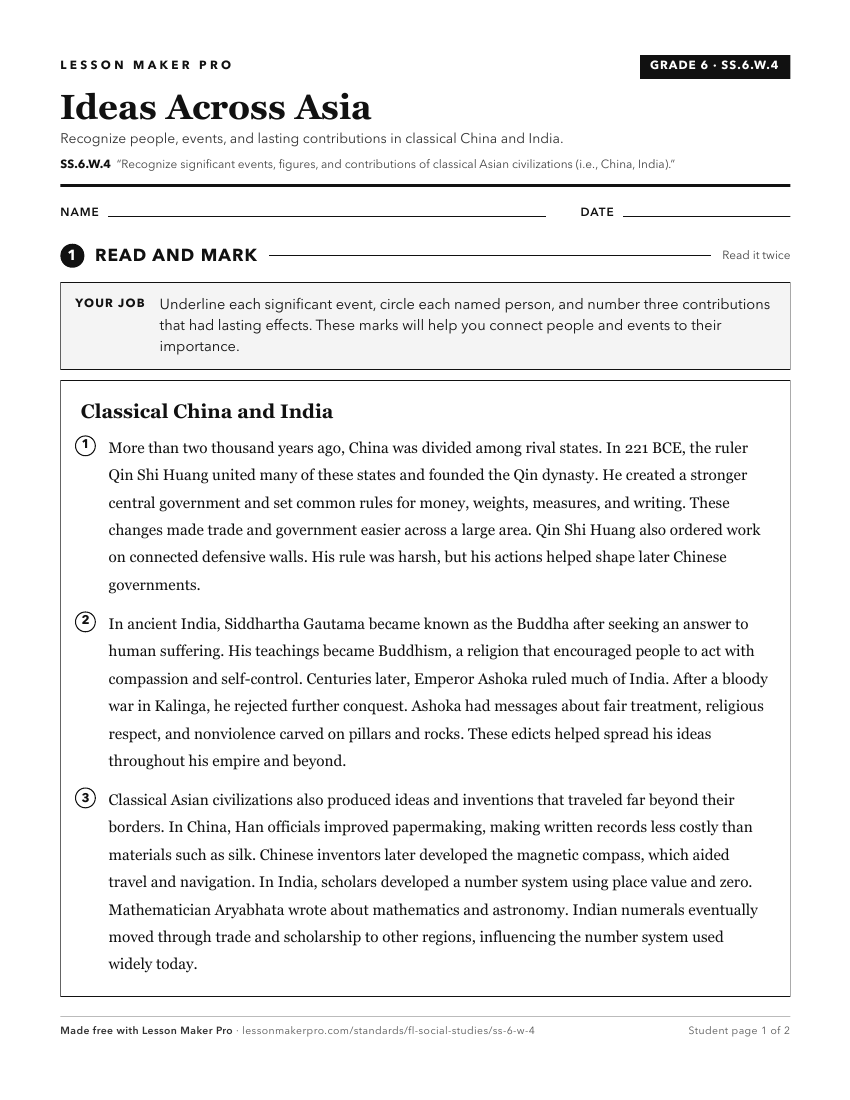
A ready-to-print activity worksheet aligned to SS.6.W.4, with an answer key for the teacher on its own page. No account needed.
PDF, US Letter, prints cleanly in black and white.
Download the worksheetKeep exploring
Related Standards
Turn this cluster into a lesson
Grade, subject, topic, and the complete cluster are prefilled. Create one free, no account needed.
Also for this cluster:Make a WorksheetMake a QuizMake a Sub Lesson