Florida SS.6.W.3.1
The Standard
- SS.6.W.3
- Recognize significant events, figures, and contributions of classical civilizations (i.e., Phoenicia, Greece, Rome, Axum).
Analyze the cultural impact the ancient Phoenicians had on the Mediterranean world with regard to colonization (Carthage), exploration, maritime commerce (purple dye, tin), and written communication (alphabet).
Florida Next Generation Sunshine State Standards for Social Studies
Teacher's field guide
What This Standard Means
What Students Need to Do
- Students use maps and evidence to trace how a seafaring network moved goods, people, and ideas between distant ports. They explain how Carthage, valuable trade goods, and simpler letter writing extended Phoenician influence.
What Mastery Looks Like
- A student can locate Phoenicia, major sea routes, and Carthage on a map. The student can make a clear cause-and-effect claim about trade or writing and support it with two accurate details.
Common Misconceptions
- Students may think Carthage was Greek or Roman from its founding, rather than a Phoenician colony. They often treat colonization as only military conquest and assume Phoenicians invented writing itself. Some confuse goods they traded, such as tin, with goods they produced locally.
How to Assess It
- Exit ticket: Choose Carthage, exploration, maritime trade, or the alphabet. In two sentences, explain how it affected Mediterranean societies.
Lesson moves
Ways to Teach It
Give pairs a blank Mediterranean map, trade-good cards, and yarn to build sea routes and mark Phoenicia and Carthage.
Ask students to write: Which Phoenician contribution had the widest effect, and what two pieces of evidence support your claim?
Run a matching relay using cards for Carthage, purple dye, tin, exploration, alphabet, and each contribution's Mediterranean effect.
Have students inspect product shipping labels, then compare modern trade networks with Phoenician ports, ships, colonies, and shared writing.
Free download
Printable SS.6.W.3.1 Worksheet
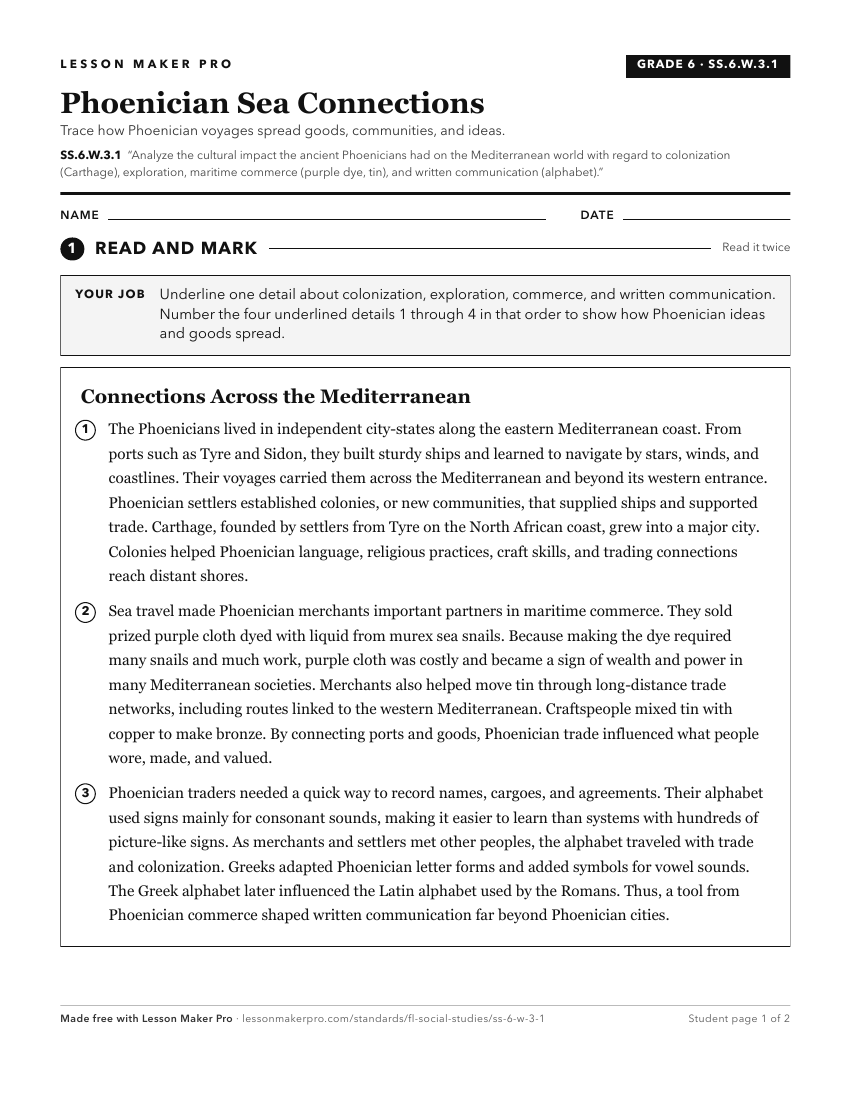
A ready-to-print activity worksheet aligned to SS.6.W.3.1, with an answer key for the teacher on its own page. No account needed.
PDF, US Letter, prints cleanly in black and white.
Download the worksheetKeep exploring
Related Standards
- SS.6.G.5.2
Use geographic terms and tools to explain why ancient civilizations developed networks of highways, waterways, and other transportation linkages.
- SS.6.G.4.4
Map and analyze the impact of the spread of various belief systems in the ancient world.
- SS.6.W.3
Recognize significant events, figures, and contributions of classical civilizations (i.e., Phoenicia, Greece, Rome, Axum).
- SS.6.G.3.2
Analyze the impact of human populations on the ancient world's ecosystems.
Turn this exact standard into a lesson
Grade, subject, topic, and the complete standard are prefilled. Create one free, no account needed.
Also for this standard:Make a WorksheetMake a QuizMake a Sub Lesson