Florida SS.6.G.4.4
The Standard
- SS.6.G.4
- Understand the characteristics, distribution, and migration of human populations.
Map and analyze the impact of the spread of various belief systems in the ancient world.
Florida Next Generation Sunshine State Standards for Social Studies
Teacher's field guide
What This Standard Means
What Students Need to Do
- Students locate where major ancient belief systems began and trace how they moved across regions. They use maps and historical evidence to explain how trade, migration, conquest, and missionaries carried beliefs and changed societies.
What Mastery Looks Like
- Students can create an accurate map with origins, routes, and destination regions for several belief systems. They can connect that spread to a specific change in laws, art, government, customs, or community life.
Common Misconceptions
- Students may confuse a belief system's place of origin with the larger area where it later became common. They may assume beliefs spread only through conquest or that new beliefs completely replaced older local traditions.
How to Assess It
- Give students a blank ancient world map. Ask them to map one belief system's origin and spread, then name one way its spread affected a society.
Lesson moves
Ways to Teach It
Give pairs a blank map, colored pencils, and route cards to trace the spread of Judaism, Hinduism, Buddhism, and Christianity.
Ask students to write: Which moved beliefs farther, trade, migration, conquest, or missionaries, and what map evidence supports your answer?
Run a card sort matching each belief system with its origin, spread routes, carriers, destination regions, and cultural effects.
Compare an ancient spread map with a modern religion map, then have students identify one visible pattern that remains today.
Free download
Printable SS.6.G.4.4 Worksheet
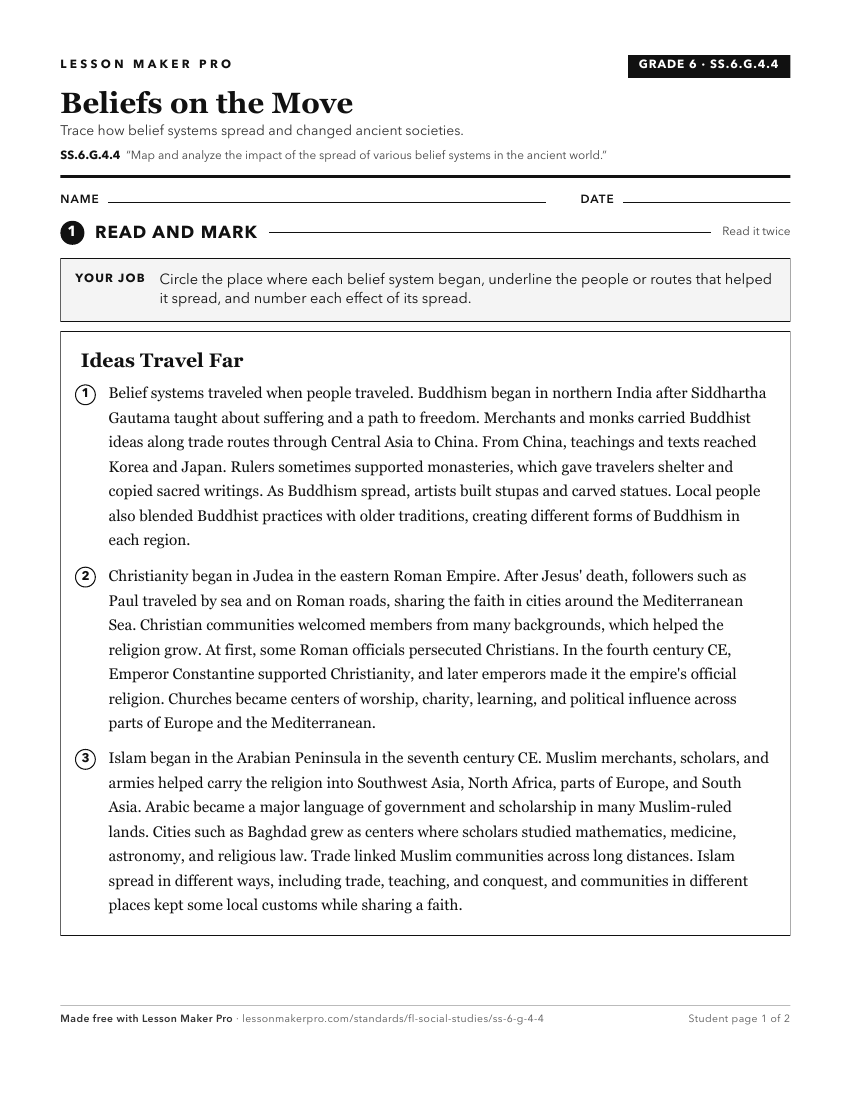
A ready-to-print activity worksheet aligned to SS.6.G.4.4, with an answer key for the teacher on its own page. No account needed.
PDF, US Letter, prints cleanly in black and white.
Download the worksheetKeep exploring
Related Standards
- SS.6.G.1.7
Use maps to identify characteristics and boundaries of ancient civilizations that have shaped the world today.
- SS.6.G.6.2
Compare maps of the world in ancient times with current political maps.
- SS.6.G.2.7
Interpret choropleths or dot-density maps to explain the distribution of population in the ancient world.
- SS.6.G.3.2
Analyze the impact of human populations on the ancient world's ecosystems.
Turn this exact standard into a lesson
Grade, subject, topic, and the complete standard are prefilled. Create one free, no account needed.
Also for this standard:Make a WorksheetMake a QuizMake a Sub Lesson