Florida SS.6.W.3.16
The Standard
- SS.6.W.3
- Recognize significant events, figures, and contributions of classical civilizations (i.e., Phoenicia, Greece, Rome, Axum).
Compare life in the Roman Republic for patricians, plebeians, women, children, and slaves.
Florida Next Generation Sunshine State Standards for Social Studies
Teacher's field guide
What This Standard Means
What Students Need to Do
- Students identify how social status, sex, age, and legal freedom shaped daily life in the Roman Republic. They compare political rights, family roles, work, education, and living conditions. They support comparisons with historical evidence.
What Mastery Looks Like
- Students can complete an accurate comparison chart for each social group. They can explain that rights and experiences differed by wealth, citizenship, sex, age, and freedom. They use specific facts to support each comparison.
Common Misconceptions
- Students often assume every patrician was rich and every plebeian was poor. They may think women had the same rights as male citizens, or that all enslaved people did identical work. They may also view Roman childhood as similar to childhood today.
How to Assess It
- Give students a five-row chart labeled patricians, plebeians, women, children, and enslaved people. Have them add one right or limit and one daily-life detail for each group, then write one supported comparison.
Lesson moves
Ways to Teach It
Give groups role cards and household objects, then have them build a tabletop Roman household showing each person's work, rights, and restrictions.
Ask students to write: Who had the most control over daily life in the Roman Republic, and what evidence proves it?
Play a sorting relay with fact cards; teams place each card under one social group or a shared category.
Examine a modern jury summons and voter registration form, then compare their eligibility rules with political participation in the Roman Republic.
Free download
Printable SS.6.W.3.16 Worksheet
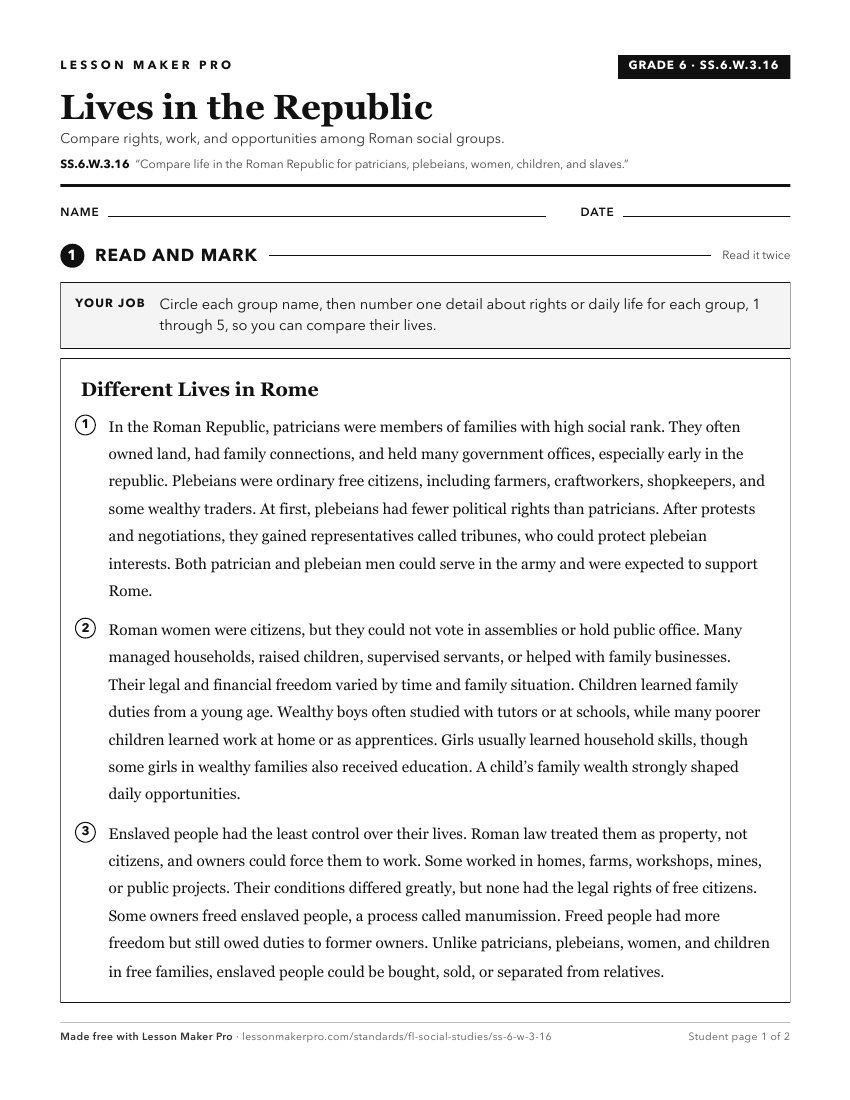
A ready-to-print activity worksheet aligned to SS.6.W.3.16, with an answer key for the teacher on its own page. No account needed.
PDF, US Letter, prints cleanly in black and white.
Download the worksheetKeep exploring
Related Standards
- SS.6.CG.1.4
Examine examples of civic leadership and virtue in ancient Greece and ancient Rome.
- SS.6.W.3.3
Compare life in Athens and Sparta (e.g., government and the status of citizens, women and children, foreigners, helots).
- SS.6.W.3.11
Explain the transition from Roman Republic to empire and Imperial Rome and compare Roman life and culture under each one.
- SS.6.W.3.10
Describe the government of the Roman Republic and its contribution to the development of democratic principles (i.e., separation of powers, rule of law, represe...
Turn this exact standard into a lesson
Grade, subject, topic, and the complete standard are prefilled. Create one free, no account needed.
Also for this standard:Make a WorksheetMake a QuizMake a Sub Lesson