Florida SS.6.W.3.10
The Standard
- SS.6.W.3
- Recognize significant events, figures, and contributions of classical civilizations (i.e., Phoenicia, Greece, Rome, Axum).
Describe the government of the Roman Republic and its contribution to the development of democratic principles (i.e., separation of powers, rule of law, representative government, civic duty).
Florida Next Generation Sunshine State Standards for Social Studies
Teacher's field guide
What This Standard Means
What Students Need to Do
- Students explain how consuls, the Senate, assemblies, and tribunes divided and limited political power. They connect Roman practices to representative decision-making, public laws, and citizens' responsibilities.
What Mastery Looks Like
- Students can label each part of the republic and describe its powers and limits. They can explain how Roman practices influenced later democracies while noting that participation was restricted.
Common Misconceptions
- Students often confuse the Roman Republic with the later empire and place emperors in the republic. They may assume all residents could vote or that Roman institutions worked exactly like modern ones.
How to Assess It
- Give students a diagram with consuls, Senate, assemblies, and tribunes. Ask them to explain how two parts limited power and supported citizen participation.
Lesson moves
Ways to Teach It
Give students consul, senator, tribune, and citizen role cards, then run a mock vote on a proposed Roman law.
Ask students which Roman safeguard best limited one person's power, using two facts from a class diagram.
Play a card sort matching Roman offices and institutions to their powers, limits, and related democratic principles.
Compare a city council meeting agenda with a Roman assembly, noting representation, voting, public laws, and civic participation.
Free download
Printable SS.6.W.3.10 Worksheet
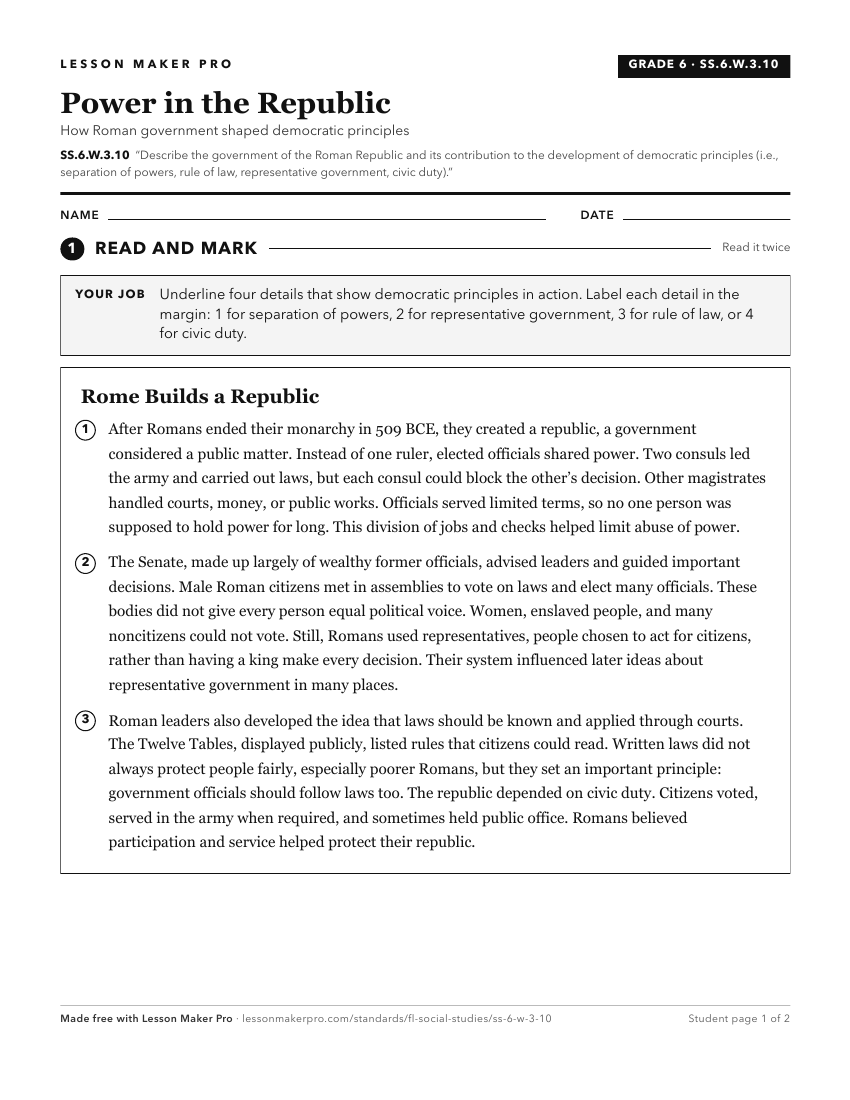
A ready-to-print activity worksheet aligned to SS.6.W.3.10, with an answer key for the teacher on its own page. No account needed.
PDF, US Letter, prints cleanly in black and white.
Download the worksheetKeep exploring
Related Standards
- SS.6.W.3.2
Explain the democratic concepts (i.e., polis, civic participation and voting rights, legislative bodies, written constitutions, rule of law) developed in ancien...
- SS.6.CG.1.2
Analyze the influence of ancient Rome on the United States' constitutional republic.
- SS.6.W.3.14
Describe the key achievements and contributions of Roman civilization.
- SS.6.CG.1.1
Analyze how democratic concepts developed in ancient Greece served as a foundation for the United States' constitutional republic.
Turn this exact standard into a lesson
Grade, subject, topic, and the complete standard are prefilled. Create one free, no account needed.
Also for this standard:Make a WorksheetMake a QuizMake a Sub Lesson