Florida SS.6.W.3.3
The Standard
- SS.6.W.3
- Recognize significant events, figures, and contributions of classical civilizations (i.e., Phoenicia, Greece, Rome, Axum).
Compare life in Athens and Sparta (e.g., government and the status of citizens, women and children, foreigners, helots).
Florida Next Generation Sunshine State Standards for Social Studies
Teacher's field guide
What This Standard Means
What Students Need to Do
- Students identify who held power and how daily life differed in Athens and Sparta. They examine the roles and rights of male citizens, women, children, foreigners, enslaved people, and helots.
What Mastery Looks Like
- Students can organize accurate similarities and differences by social group and support each claim with historical evidence. They explain that rights depended on city, sex, citizenship, age, and social status.
Common Misconceptions
- Students may think Athenian democracy included everyone, or that Spartan women had the same political rights as men. They may call helots ordinary slaves without recognizing their forced labor and control by the Spartan state. They may also assume every Greek lived like an Athenian or Spartan citizen.
How to Assess It
- Give students a chart labeled male citizens, women, children, foreigners, enslaved people, and helots. Ask them to write one accurate Athens versus Sparta comparison in four rows.
Lesson moves
Ways to Teach It
Give pairs role cards for an Athenian citizen, metic, enslaved person, Spartan woman, Spartan boy, and helot, then sort them by rights and duties.
Students answer the prompt, “Which city offered more freedom, and for whom?” using evidence from three social groups.
Run a clue game where teams identify Athens or Sparta and name the affected social group before earning a point.
Have students compare each city’s access to decision making with local voting eligibility rules, noting one limit of the comparison.
Free download
Printable SS.6.W.3.3 Worksheet
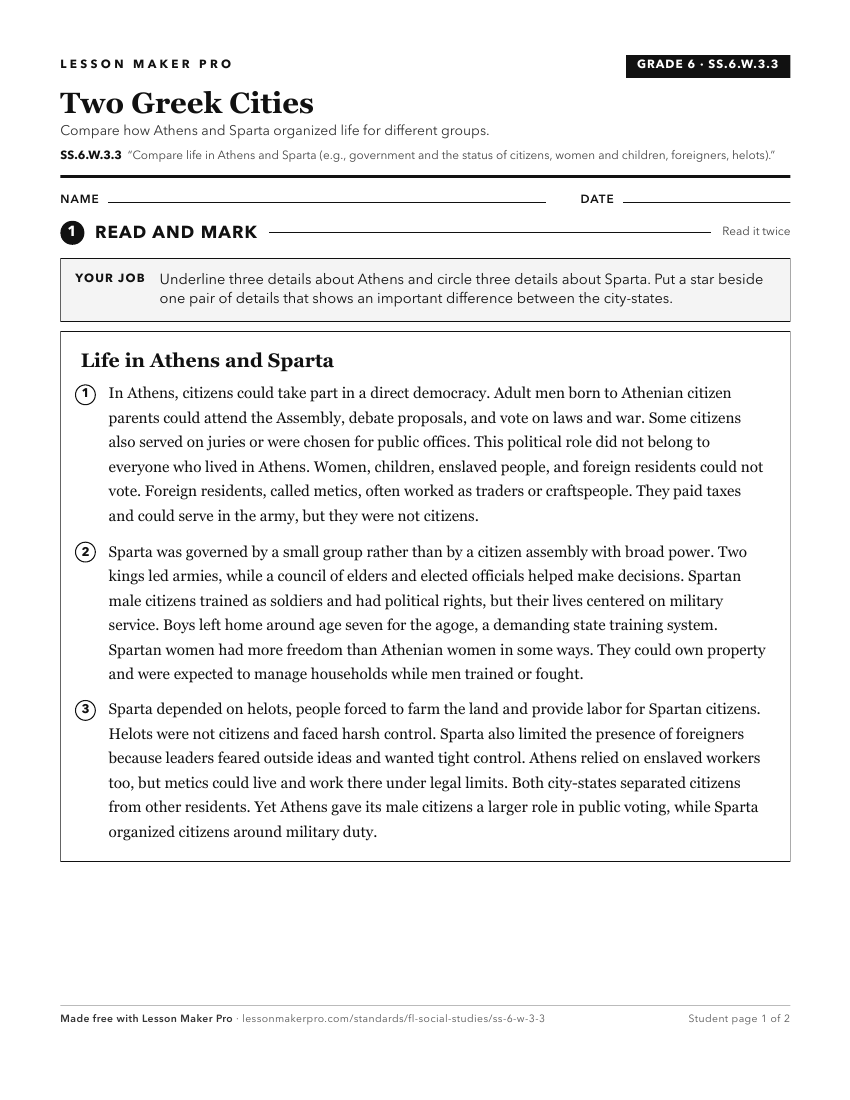
A ready-to-print activity worksheet aligned to SS.6.W.3.3, with an answer key for the teacher on its own page. No account needed.
PDF, US Letter, prints cleanly in black and white.
Download the worksheetKeep exploring
Related Standards
- SS.6.W.3.2
Explain the democratic concepts (i.e., polis, civic participation and voting rights, legislative bodies, written constitutions, rule of law) developed in ancien...
- SS.6.CG.1.4
Examine examples of civic leadership and virtue in ancient Greece and ancient Rome.
- SS.6.W.3.16
Compare life in the Roman Republic for patricians, plebeians, women, children, and slaves.
- SS.6.W.3.6
Determine the impact of key figures from ancient Greece.
Turn this exact standard into a lesson
Grade, subject, topic, and the complete standard are prefilled. Create one free, no account needed.
Also for this standard:Make a WorksheetMake a QuizMake a Sub Lesson