Florida SS.6.W.3.4
The Standard
- SS.6.W.3
- Recognize significant events, figures, and contributions of classical civilizations (i.e., Phoenicia, Greece, Rome, Axum).
Explain the causes and effects of the Persian and Peloponnesian Wars.
Florida Next Generation Sunshine State Standards for Social Studies
Teacher's field guide
What This Standard Means
What Students Need to Do
- Students identify the main causes of each war and connect major events to their results. They explain how the Persian Wars increased Athenian power and how conflict with Sparta weakened the Greek city-states.
What Mastery Looks Like
- Students place both wars in order and distinguish who fought in each one. They build accurate cause and effect chains using details such as the Ionian Revolt, the Delian League, rival alliances, and Athens’s defeat.
Common Misconceptions
- Students often mix up the two wars or treat Greece as one united country. They may think Persia was the main enemy in both conflicts or miss how Athens’s growing power led to war with Sparta.
How to Assess It
- Give students a two-row exit ticket, one row per war. Ask them to write one cause, one effect, and a sentence explaining the connection.
Lesson moves
Ways to Teach It
Give pairs event cards to sort by war, then arrange each set into a cause and effect chain.
Ask students to write: Was growing Athenian power more helpful or harmful to Greece? Use two facts.
Run a card relay where teams match causes, events, and effects, earning a point only when they explain each link.
Show a current NATO map, then have students name one similarity and one difference between mutual-defense alliances and Greek leagues.
Free download
Printable SS.6.W.3.4 Worksheet
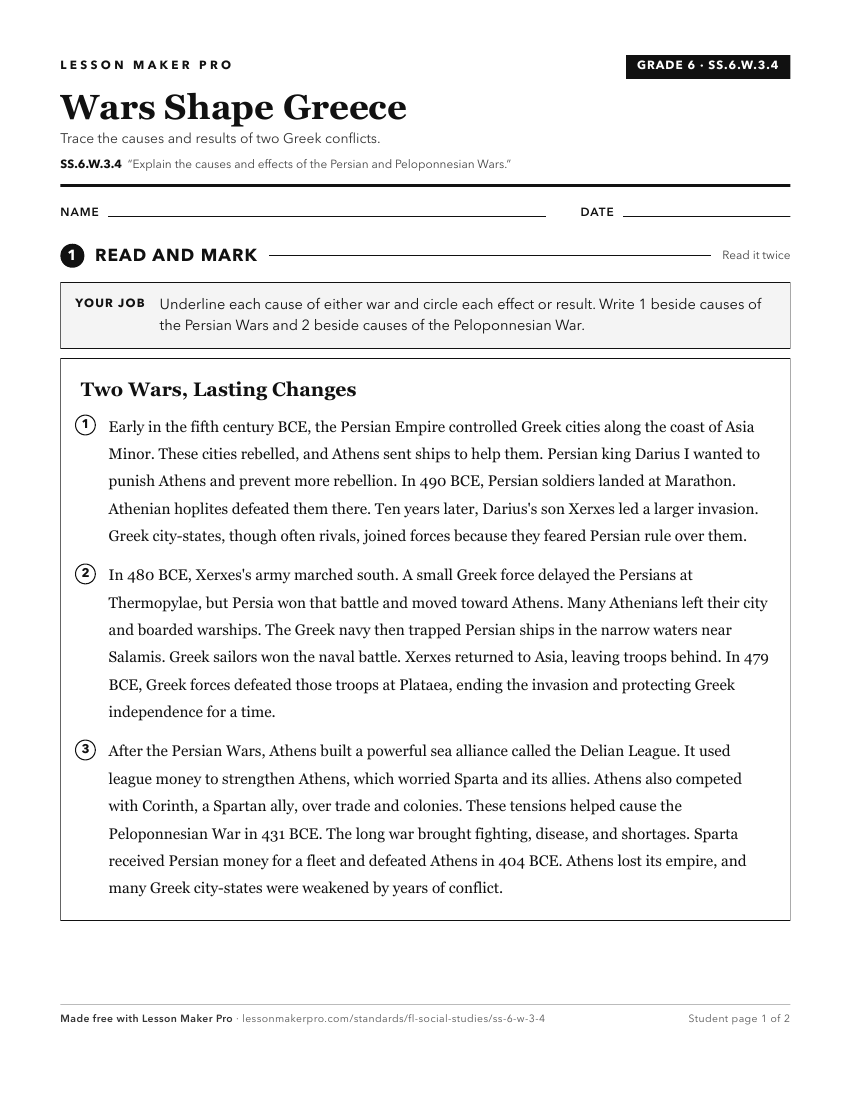
A ready-to-print activity worksheet aligned to SS.6.W.3.4, with an answer key for the teacher on its own page. No account needed.
PDF, US Letter, prints cleanly in black and white.
Download the worksheetKeep exploring
Related Standards
Turn this exact standard into a lesson
Grade, subject, topic, and the complete standard are prefilled. Create one free, no account needed.
Also for this standard:Make a WorksheetMake a QuizMake a Sub Lesson