Florida SS.7.CG.3
Florida Standard (Benchmark Cluster)
- SS.7.CG
- Civics and Government
Demonstrate an understanding of the principles, functions, and organization of government.
Florida Next Generation Sunshine State Standards for Social Studies
Cluster contents
Benchmarks in This Standard
SS.7.CG.3 is a Florida social studies standard. These are the benchmarks under it.
- SS.7.CG.3.1
Analyze the advantages of the United States’ constitutional republic over other forms of government in safeguarding liberty, freedom, and a representative gover...
- SS.7.CG.3.2
Explain the advantages of a federal system of government over other systems in balancing local sovereignty with national unity and protecting against authoritar...
- SS.7.CG.3.3
Describe the structure and function of the three branches of government established in the U.S. Constitution.
- SS.7.CG.3.4
Explain the relationship between state and national governments as written in Article IV of the U.S. Constitution and the 10th Amendment.
- SS.7.CG.3.5
Explain the amendment process outlined in Article V of the U.S. Constitution.
- SS.7.CG.3.6
Analyze how the 13th, 14th, 15th, 19th, 24th, and 26th Amendments broadened participation in the political process.
- SS.7.CG.3.7
Explain the structure, functions, and processes of the legislative branch of government.
- SS.7.CG.3.8
Explain the structure, functions, and processes of the executive branch of government.
- SS.7.CG.3.9
Explain the structure, functions, and processes of the judicial branch of government.
- SS.7.CG.3.10
Identify sources and types of law.
- SS.7.CG.3.11
Analyze the effects of landmark Supreme Court decisions on law, liberty, and the interpretation of the U.S. Constitution.
- SS.7.CG.3.12
Compare the U.S. and Florida constitutions.
- SS.7.CG.3.13
Explain government obligations to its citizens and the services provided at the local, state, and national levels.
- SS.7.CG.3.14
Explain the purpose and function of the Electoral College in electing the President of the United States.
- SS.7.CG.3.15
Analyze the advantages of capitalism and the free market in the United States over government-controlled economic systems (e.g., socialism and communism) in reg...
Teacher's field guide
What This Cluster Means
What Students Need to Do
- Students explain why governments exist and how principles such as rule of law, limited government, and consent shape public decisions. They identify the roles of each branch and level of government.
What Mastery Looks Like
- Students can match government powers and responsibilities to the correct branch and level. They can use a short scenario to explain which principle is involved and why.
Common Misconceptions
- Students often confuse branches of government with federal, state, and local levels. They may think one branch controls the others or that individual rights cannot be limited by law.
How to Assess It
- Give students three scenarios involving a new law, a court ruling, and a city service. Ask them to name the branch or level involved and explain its function.
Lesson moves
Ways to Teach It
Give groups branch, power, and responsibility cards to sort into a three-column government chart, then correct mismatches using a reference sheet.
Ask students to write which principle best prevents government abuse, then defend their choice with one specific example.
Run a scenario relay where teams match government actions to the correct branch, level, function, or principle.
Use a local road repair request to trace how residents, city officials, budgets, laws, and public services connect.
Free download
Printable SS.7.CG.3 Worksheet
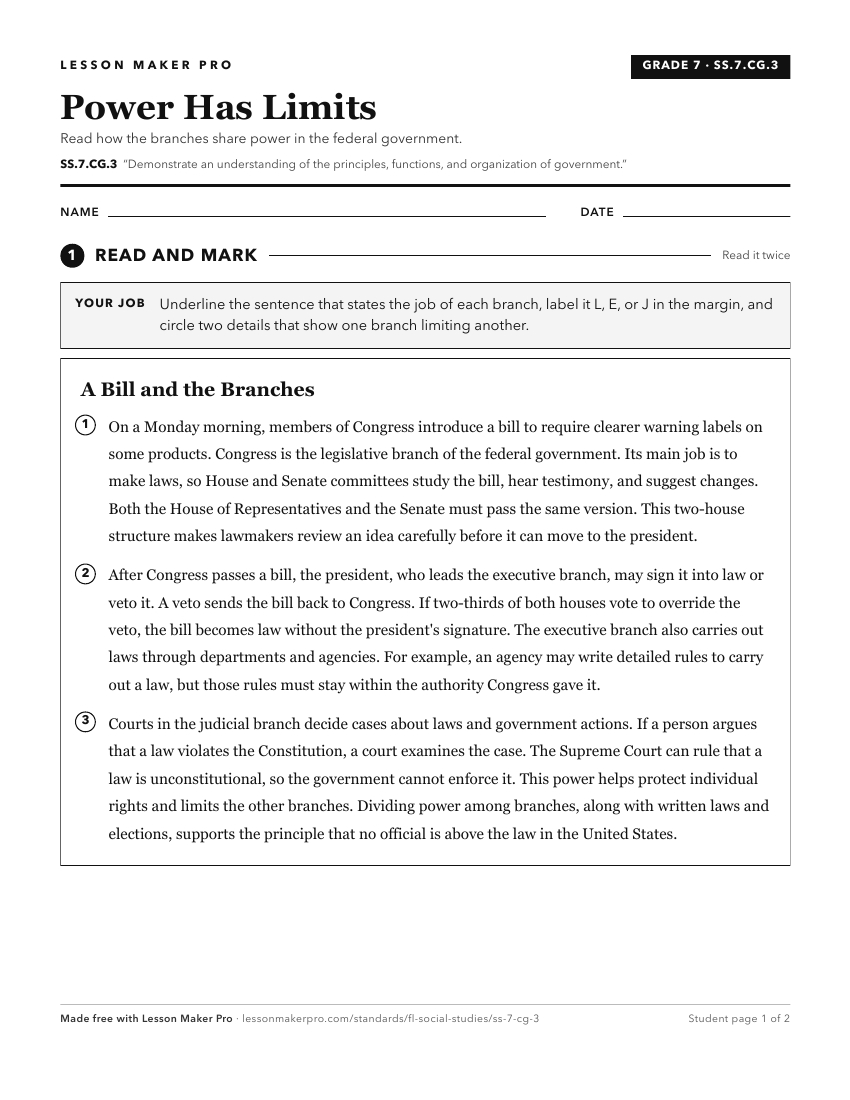
A ready-to-print activity worksheet aligned to SS.7.CG.3, with an answer key for the teacher on its own page. No account needed.
PDF, US Letter, prints cleanly in black and white.
Download the worksheetKeep exploring
Related Standards
- SS.6.CG.1
Demonstrate an understanding of the origins and purposes of government, law, and the American political system.
- SS.8.CG.1
Demonstrate an understanding of the origins and purposes of government, law, and the American political system.
- SS.8.CG.3
The 8th Grade version of this standard.
- SS.7.CG.1
Demonstrate an understanding of the origins and purposes of government, law, and the American political system.
Turn this cluster into a lesson
Grade, subject, topic, and the complete cluster are prefilled. Create one free, no account needed.
Also for this cluster:Make a WorksheetMake a QuizMake a Sub Lesson