Florida SS.7.CG.1
Florida Standard (Benchmark Cluster)
- SS.7.CG
- Civics and Government
Demonstrate an understanding of the origins and purposes of government, law, and the American political system.
Florida Next Generation Sunshine State Standards for Social Studies
Cluster contents
Benchmarks in This Standard
SS.7.CG.1 is a Florida social studies standard. These are the benchmarks under it.
- SS.7.CG.1.1
Analyze the influences of ancient Greece, ancient Rome and the Judeo-Christian tradition on America’s constitutional republic.
- SS.7.CG.1.2
Trace the principles underlying America's founding ideas on law and government.
- SS.7.CG.1.3
Trace the impact that the Magna Carta, Mayflower Compact, English Bill of Rights and Thomas Paine's Common Sense had on colonists' views of government.
- SS.7.CG.1.4
Analyze how Enlightenment ideas, including Montesquieu's view of separation of powers and John Locke's theories related to natural law and Locke's social contra...
- SS.7.CG.1.5
Describe how British policies and responses to colonial concerns led to the writing of the Declaration of Independence.
- SS.7.CG.1.6
Analyze the ideas and grievances set forth in the Declaration of Independence.
- SS.7.CG.1.7
Explain how the weaknesses of the Articles of Confederation led to the writing of the U.S. Constitution.
- SS.7.CG.1.8
Explain the purpose of the Preamble to the U.S. Constitution.
- SS.7.CG.1.9
Describe how the U.S. Constitution limits the powers of government through separation of powers, checks and balances, individual rights, rule of law, and due pr...
- SS.7.CG.1.10
Compare the viewpoints of the Federalists and the Anti-Federalists regarding ratification of the U.S. Constitution and including a bill of rights.
- SS.7.CG.1.11
Define the rule of law and recognize its influence on the development of legal, political, and governmental systems in the United States.
Teacher's field guide
What This Cluster Means
What Students Need to Do
- Students explain why societies create governments and laws. They connect natural rights, the social contract, English legal traditions, and colonial experience to the American political system.
What Mastery Looks Like
- Students can explain how founding ideas shaped documents such as the Declaration of Independence and Constitution. They support claims with details from short primary sources.
Common Misconceptions
- Students may think democracy allows the majority to do anything it wants or that government grants all rights. They may also think separated powers mean branches never work together.
How to Assess It
- Exit ticket: Name one founding idea and explain how it appears in an American founding document. Include one quoted or paraphrased detail.
Lesson moves
Ways to Teach It
Give groups source cards from Locke, Magna Carta, and colonial governments, then have them match each source to a founding principle.
Ask students to write: Which purpose of government best protects individual freedom, and what evidence supports your answer?
Play a matching game that pairs terms such as natural rights and consent of the governed with examples and founding documents.
Present a city curfew proposal, then have students identify its purpose, legal limits, and effects on individual rights.
Free download
Printable SS.7.CG.1 Worksheet
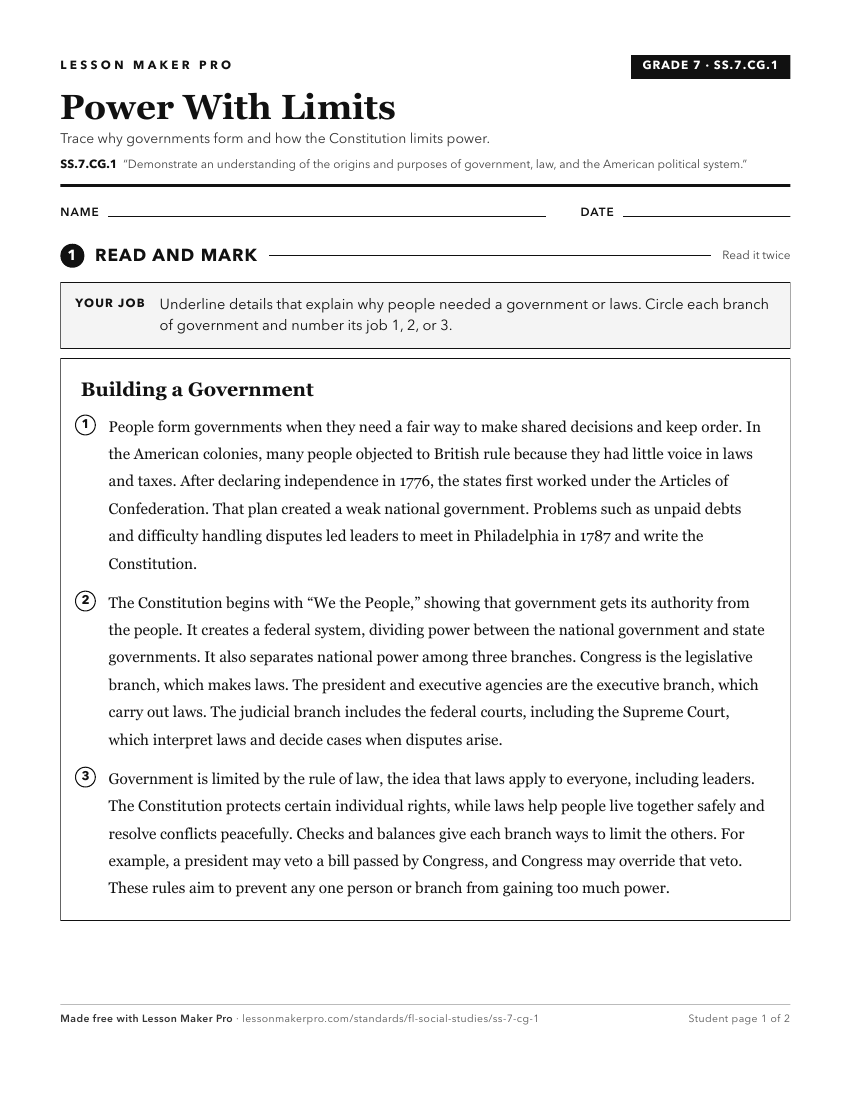
A ready-to-print activity worksheet aligned to SS.7.CG.1, with an answer key for the teacher on its own page. No account needed.
PDF, US Letter, prints cleanly in black and white.
Download the worksheetKeep exploring
Related Standards
Turn this cluster into a lesson
Grade, subject, topic, and the complete cluster are prefilled. Create one free, no account needed.
Also for this cluster:Make a WorksheetMake a QuizMake a Sub Lesson