Florida SS.7.CG.3.4
The Standard
- SS.7.CG
- Civics and Government
- SS.7.CG.3
- Demonstrate an understanding of the principles, functions, and organization of government.
Explain the relationship between state and national governments as written in Article IV of the U.S. Constitution and the 10th Amendment.
Florida Next Generation Sunshine State Standards for Social Studies
Teacher's field guide
What This Standard Means
What Students Need to Do
- Students explain what states owe one another and what the national government owes the states. They also distinguish delegated national powers from powers reserved to states or the people.
What Mastery Looks Like
- Students can match constitutional rules to scenarios involving court judgments, extradition, new states, protection, and reserved powers. They can explain which government acts and why.
Common Misconceptions
- Students may think the national government controls every state decision or that states can ignore federal constitutional duties. They may also think every power not listed for Congress belongs only to state governments, leaving out the people.
How to Assess It
- Give students two scenarios: one state refuses another state's court judgment, and Congress regulates a power not assigned to it. Ask who has authority and require one constitutional reason for each answer.
Lesson moves
Ways to Teach It
Use labeled state and federal role cards to build a two-column chart, then connect each duty or reserved power with yarn.
Write a response to this prompt: Why can states govern differently while still owing duties to one another?
Play a scenario sort where teams place cards under state duty, national duty, reserved power, or shared relationship.
Examine a news report about extradition or disaster aid, then identify the responsibilities of the state and national governments.
Free download
Printable SS.7.CG.3.4 Worksheet
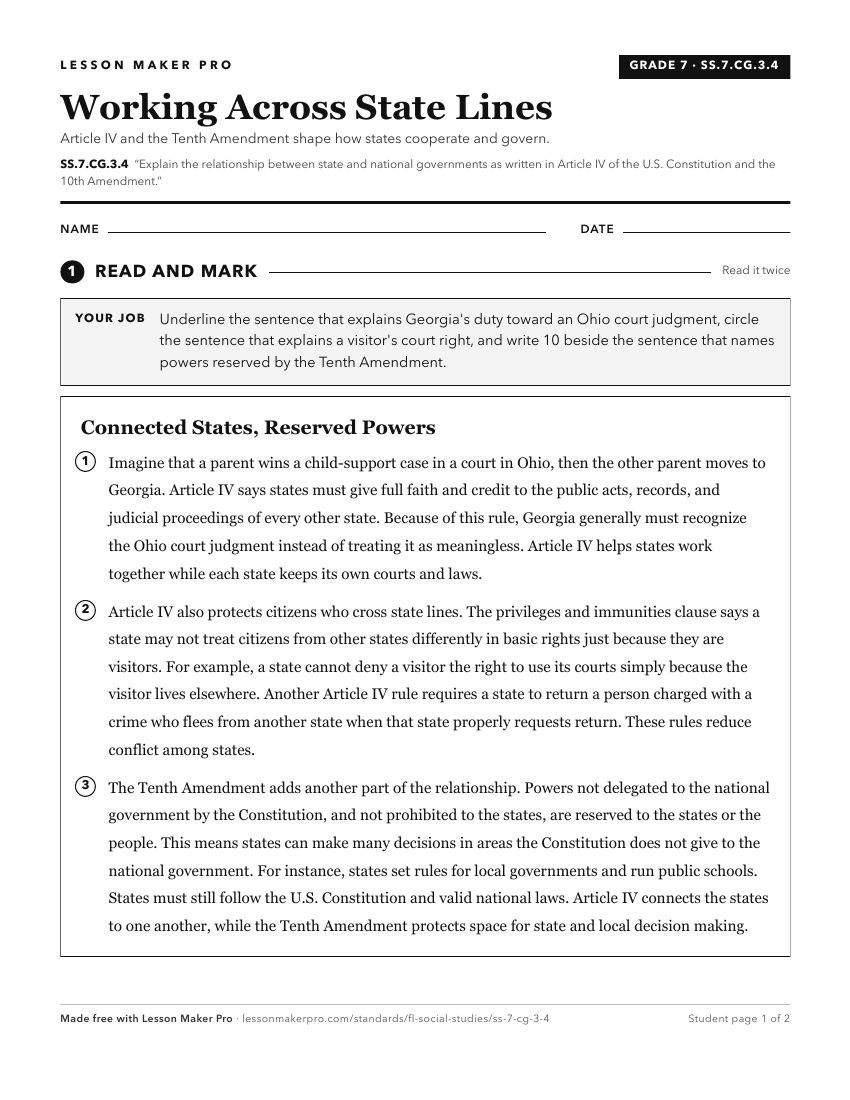
A ready-to-print activity worksheet aligned to SS.7.CG.3.4, with an answer key for the teacher on its own page. No account needed.
PDF, US Letter, prints cleanly in black and white.
Download the worksheetKeep exploring
Related Standards
- SS.5.CG.3.1
Describe the organizational structure and powers of the national government as defined in Articles I, II, and III of the U.S. Constitution.
- SS.7.CG.1.9
Describe how the U.S. Constitution limits the powers of government through separation of powers, checks and balances, individual rights, rule of law, and due pr...
- SS.5.CG.3.6
Explain the relationship between the state and national governments.
- SS.3.CG.3.1
Explain how the U.S. and Florida Constitutions establish the structure, function, powers, and limits of government.
Turn this exact standard into a lesson
Grade, subject, topic, and the complete standard are prefilled. Create one free, no account needed.
Also for this standard:Make a WorksheetMake a QuizMake a Sub Lesson