Florida SS.5.CG.3.1
The Standard
- SS.5.CG.3
- Structure and Functions of Government
Describe the organizational structure and powers of the national government as defined in Articles I, II, and III of the U.S. Constitution.
Florida Next Generation Sunshine State Standards for Social Studies
Teacher's field guide
What This Standard Means
What Students Need to Do
- Students connect Articles I, II, and III to the legislative, executive, and judicial branches. They describe each branch’s main parts and constitutional powers.
What Mastery Looks Like
- Students explain that Congress makes laws, the president carries them out, and federal courts interpret them. They also identify the House and Senate, executive leadership, and the federal court system.
Common Misconceptions
- Students may think the president makes laws or the Supreme Court enforces them. They may also confuse constitutional articles with amendments or overlook that Congress has two chambers.
How to Assess It
- Give an exit ticket with three columns labeled Article I, Article II, and Article III. Students add the branch, its structure, and one power.
Lesson moves
Ways to Teach It
Give groups short constitutional excerpt cards, then have them build a three-column chart showing each branch’s offices and powers.
Ask students to write: Why did the Constitution assign lawmaking, enforcement, and interpretation to different branches?
Play a sorting relay with cards such as veto a bill, declare war, and decide federal court cases.
Use a current federal news story and have students name the branch involved, its action, and the article connected to that role.
Free download
Printable SS.5.CG.3.1 Worksheet
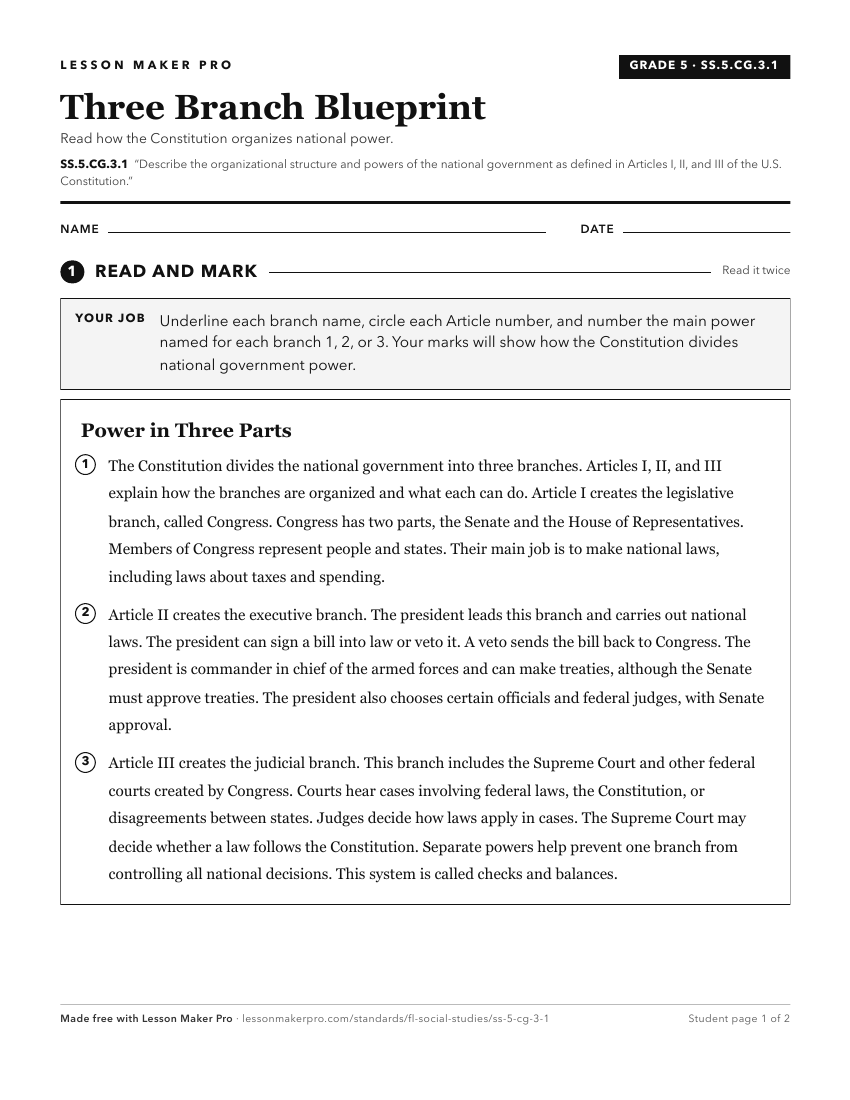
A ready-to-print activity worksheet aligned to SS.5.CG.3.1, with an answer key for the teacher on its own page. No account needed.
PDF, US Letter, prints cleanly in black and white.
Download the worksheetKeep exploring
Related Standards
- SS.7.CG.3.4
Explain the relationship between state and national governments as written in Article IV of the U.S. Constitution and the 10th Amendment.
- SS.7.CG.3.3
Describe the structure and function of the three branches of government established in the U.S. Constitution.
- SS.7.CG.1.9
Describe how the U.S. Constitution limits the powers of government through separation of powers, checks and balances, individual rights, rule of law, and due pr...
- SS.3.CG.3.1
Explain how the U.S. and Florida Constitutions establish the structure, function, powers, and limits of government.
Turn this exact standard into a lesson
Grade, subject, topic, and the complete standard are prefilled. Create one free, no account needed.
Also for this standard:Make a WorksheetMake a QuizMake a Sub Lesson