Florida SS.7.CG.3.3
The Standard
- SS.7.CG
- Civics and Government
- SS.7.CG.3
- Demonstrate an understanding of the principles, functions, and organization of government.
Describe the structure and function of the three branches of government established in the U.S. Constitution.
Florida Next Generation Sunshine State Standards for Social Studies
Teacher's field guide
What This Standard Means
What Students Need to Do
- Students identify the legislative, executive, and judicial branches and the main institutions within each. They explain how Congress makes laws, the president and agencies carry them out, and federal courts interpret them.
What Mastery Looks Like
- A student can place the House, Senate, president, executive departments, Supreme Court, and lower federal courts in the correct branch. Given a government action, the student can identify the responsible branch and explain its role accurately.
Common Misconceptions
- Students often say the president makes laws alone or that courts enforce laws. They may place the Senate in the executive branch or confuse federal institutions with state institutions.
How to Assess It
- Exit ticket: Sort Congress, president, federal agencies, Supreme Court, and lower federal courts by branch. Then write one sentence explaining each branch's main job.
Lesson moves
Ways to Teach It
Give groups institution and power cards to sort under legislative, executive, or judicial headings, then have them explain each match.
Ask students which branch should act in three government scenarios, then have them defend each choice with that branch's responsibility.
Play Branch Match, where teams pair power cards with branch headings and correct another team's mismatches for points.
Use a recent bill signing or federal court ruling to identify which branches acted and what each branch did.
Free download
Printable SS.7.CG.3.3 Worksheet
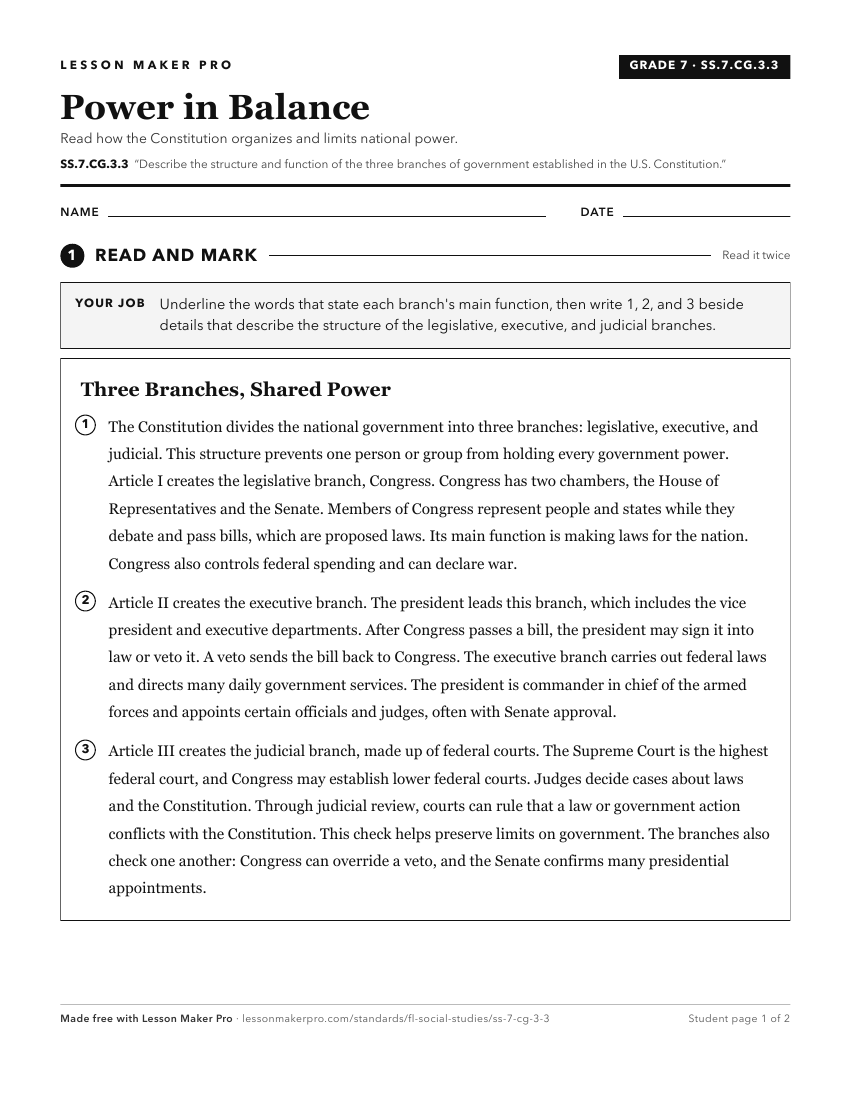
A ready-to-print activity worksheet aligned to SS.7.CG.3.3, with an answer key for the teacher on its own page. No account needed.
PDF, US Letter, prints cleanly in black and white.
Download the worksheetKeep exploring
Related Standards
Turn this exact standard into a lesson
Grade, subject, topic, and the complete standard are prefilled. Create one free, no account needed.
Also for this standard:Make a WorksheetMake a QuizMake a Sub Lesson