Florida SS.7.CG.3.12
The Standard
- SS.7.CG
- Civics and Government
- SS.7.CG.3
- Demonstrate an understanding of the principles, functions, and organization of government.
Compare the U.S. and Florida constitutions.
Florida Next Generation Sunshine State Standards for Social Studies
Teacher's field guide
What This Standard Means
What Students Need to Do
- Students identify similarities and differences in the purposes, rights, government structures, and amendment processes of the two documents. They support each comparison with details from the texts.
What Mastery Looks Like
- Students can explain that both documents limit government and establish branches, but each governs a different level. They can cite features unique to Florida, such as its Declaration of Rights and state-specific provisions.
Common Misconceptions
- Students may assume the documents have identical rights, structures, and amendment rules. They may also think Florida law can override the national constitution or confuse state responsibilities with federal powers.
How to Assess It
- Give students one excerpt from each document. Ask them to name one similarity, one difference, and which document controls if the two conflict.
Lesson moves
Ways to Teach It
Give pairs color-coded copies of both tables of contents, then have them sort headings into shared, federal-only, and Florida-only groups.
Ask students to write which document affects their school day more directly, using two specific provisions as evidence.
Play a matching game where students connect constitutional features to U.S., Florida, or both.
Examine a Florida ballot amendment and compare its path to approval with the national amendment process.
Free download
Printable SS.7.CG.3.12 Worksheet
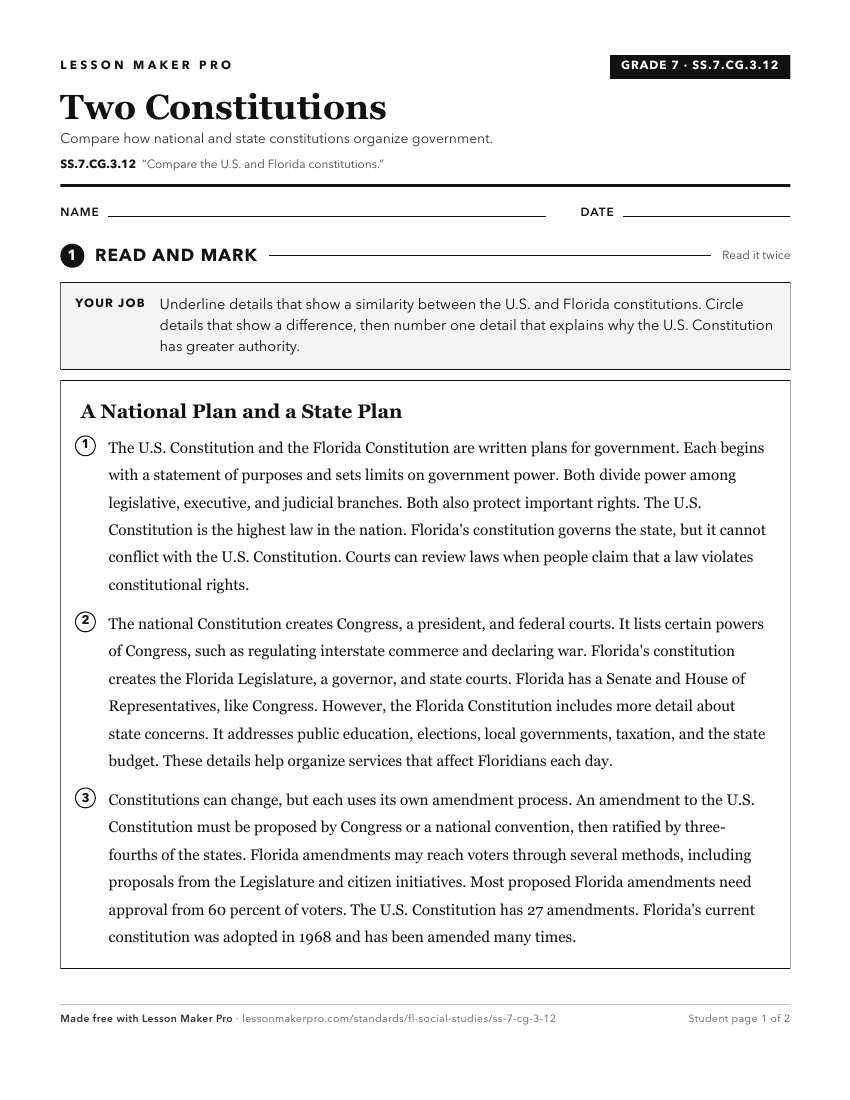
A ready-to-print activity worksheet aligned to SS.7.CG.3.12, with an answer key for the teacher on its own page. No account needed.
PDF, US Letter, prints cleanly in black and white.
Download the worksheetKeep exploring
Related Standards
- SS.3.CG.3.1
Explain how the U.S. and Florida Constitutions establish the structure, function, powers, and limits of government.
- SS.1.CG.3.1
Recognize that the United States and Florida have Constitutions.
- SS.8.CG.1.2
Compare and contrast the 1838 Florida Constitution and 1868 Florida Constitution.
- SS.5.CG.3.5
Explain how the U.S. Constitution influenced the Florida Constitution.
Turn this exact standard into a lesson
Grade, subject, topic, and the complete standard are prefilled. Create one free, no account needed.
Also for this standard:Make a WorksheetMake a QuizMake a Sub Lesson