Florida SS.7.CG.3.5
The Standard
- SS.7.CG
- Civics and Government
- SS.7.CG.3
- Demonstrate an understanding of the principles, functions, and organization of government.
Explain the amendment process outlined in Article V of the U.S. Constitution.
Florida Next Generation Sunshine State Standards for Social Studies
Teacher's field guide
What This Standard Means
What Students Need to Do
- Students identify proposal and ratification as the two stages for changing the Constitution. They explain both routes for each stage, including the required fractions and the roles of Congress and the states.
What Mastery Looks Like
- Students can diagram all four possible paths from proposal to ratification. Given a voting scenario, they can decide whether the requirements were met and explain why.
Common Misconceptions
- Students often think a simple majority, a national popular vote, or the president’s signature can amend the Constitution. They may confuse the two-thirds proposal threshold with the three-fourths ratification threshold.
How to Assess It
- Exit ticket: Draw a two-stage flowchart showing both proposal methods and both ratification methods. Label each method with the correct fraction and government body.
Lesson moves
Ways to Teach It
Use 50 state cards and House and Senate vote cards to model each proposal and ratification threshold.
Ask students to write: Why did the framers require more than a simple majority to change the Constitution?
Run a card sort where pairs place process steps, vote thresholds, and government actors under proposal or ratification.
Compare the Equal Rights Amendment with the Twenty-Seventh Amendment, then identify where each moved forward or stalled in the process.
Free download
Printable SS.7.CG.3.5 Worksheet
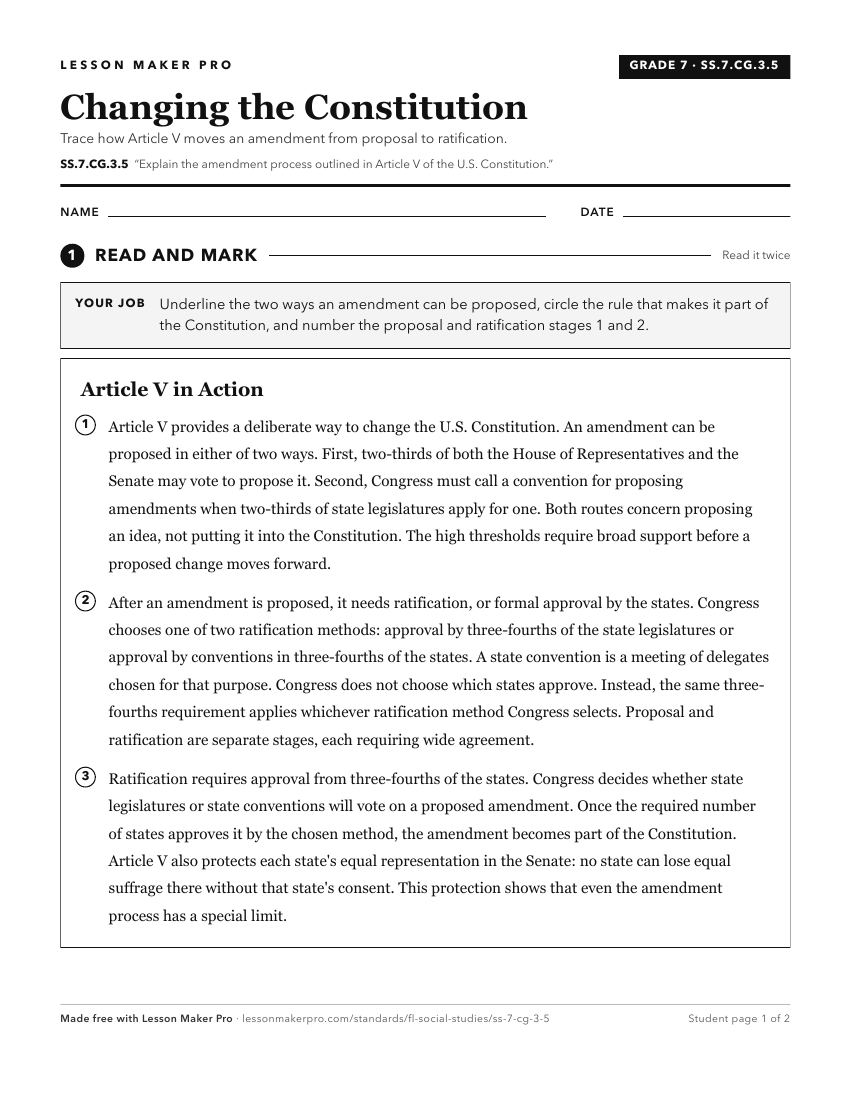
A ready-to-print activity worksheet aligned to SS.7.CG.3.5, with an answer key for the teacher on its own page. No account needed.
PDF, US Letter, prints cleanly in black and white.
Download the worksheetKeep exploring
Related Standards
- SS.5.CG.3.4
Describe the process for amending the U.S. Constitution.
- SS.7.CG.2.3
Identify and apply the rights contained in the Bill of Rights and other amendments to the U.S. Constitution.
- SS.7.CG.1.7
Explain how the weaknesses of the Articles of Confederation led to the writing of the U.S. Constitution.
- SS.7.CG.1.9
Describe how the U.S. Constitution limits the powers of government through separation of powers, checks and balances, individual rights, rule of law, and due pr...
Turn this exact standard into a lesson
Grade, subject, topic, and the complete standard are prefilled. Create one free, no account needed.
Also for this standard:Make a WorksheetMake a QuizMake a Sub Lesson