Florida SS.5.CG.3.4
The Standard
- SS.5.CG.3
- Structure and Functions of Government
Describe the process for amending the U.S. Constitution.
Florida Next Generation Sunshine State Standards for Social Studies
Teacher's field guide
What This Standard Means
What Students Need to Do
- Students explain that an amendment must be proposed and then ratified. They identify the two proposal methods, the two ratification methods, and the required fractions for each step.
What Mastery Looks Like
- Students can draw a correct flowchart showing every path from proposal to ratification. Given a voting scenario, they can decide whether the amendment advances and explain why.
Common Misconceptions
- Students may think a simple majority is enough or that the president signs amendments. They may assume citizens vote directly on amendments nationwide. Some confuse amendments with regular federal laws.
How to Assess It
- Exit ticket: Draw and label one complete path for adding an amendment, including who acts and the fraction required at each step. Then name one alternate method.
Lesson moves
Ways to Teach It
Give groups labeled cards for Congress, states, conventions, and vote fractions, then have them build all four possible amendment paths.
Ask students to write why changing the Constitution requires more agreement than passing an ordinary law.
Run a threshold game where teams examine vote totals and decide whether each proposed amendment advances or fails.
Read a short account of the Twenty-sixth Amendment, then trace how lowering the voting age moved through proposal and ratification.
Free download
Printable SS.5.CG.3.4 Worksheet
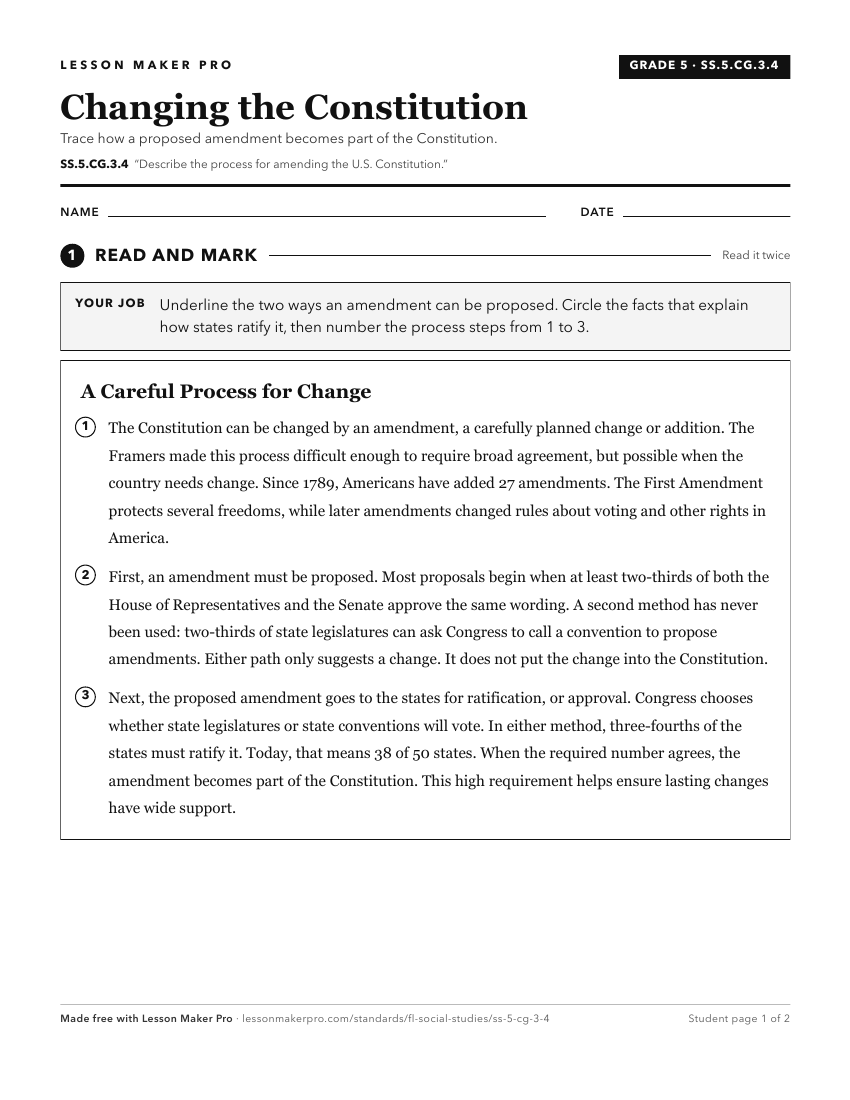
A ready-to-print activity worksheet aligned to SS.5.CG.3.4, with an answer key for the teacher on its own page. No account needed.
PDF, US Letter, prints cleanly in black and white.
Download the worksheetKeep exploring
Related Standards
- SS.5.CG.1.2
Explain how and why the U.S. government was created by the U.S. Constitution.
- SS.5.CG.2.3
Analyze how the U.S. Constitution expanded civic participation over time.
- SS.7.CG.3.5
Explain the amendment process outlined in Article V of the U.S. Constitution.
- SS.7.CG.1.9
Describe how the U.S. Constitution limits the powers of government through separation of powers, checks and balances, individual rights, rule of law, and due pr...
Turn this exact standard into a lesson
Grade, subject, topic, and the complete standard are prefilled. Create one free, no account needed.
Also for this standard:Make a WorksheetMake a QuizMake a Sub Lesson