Florida SS.5.CG.2.3
The Standard
- SS.5.CG.2
- Civic and Political Participation
Analyze how the U.S. Constitution expanded civic participation over time.
Florida Next Generation Sunshine State Standards for Social Studies
Teacher's field guide
What This Standard Means
What Students Need to Do
- Students trace how amendments changed who could vote and how senators were chosen. They compare participation before and after each change. They use amendment evidence to explain which groups gained a stronger voice in government.
What Mastery Looks Like
- A student can sequence the 15th, 17th, 19th, 24th, and 26th Amendments and explain each effect. The student can analyze a voter scenario and name the constitutional change that applies. The student also recognizes that legal protection did not end every barrier in practice.
Common Misconceptions
- Students may assume all adults could vote when the Constitution was ratified. They often mix up the 15th and 19th Amendments or forget that the 17th changed Senate elections. Some think amendments ended discrimination immediately, ignoring intimidation, unfair tests, and uneven enforcement.
How to Assess It
- Give students brief summaries of the five amendments. Ask them to choose two and explain who gained a voice and how participation changed.
Lesson moves
Ways to Teach It
Give pairs amendment cards and voter profile cards, then have them build a floor timeline showing when each person received constitutional voting protection.
Students answer: Which constitutional change widened participation most, and why; require one amendment detail and one example of people affected.
Play Amendment Match: teams pair five amendment cards with changes in participation and justify each match before earning a point.
Compare a local voter registration form with eligibility rules from 1800, then list which constitutional changes explain the differences.
Free download
Printable SS.5.CG.2.3 Worksheet
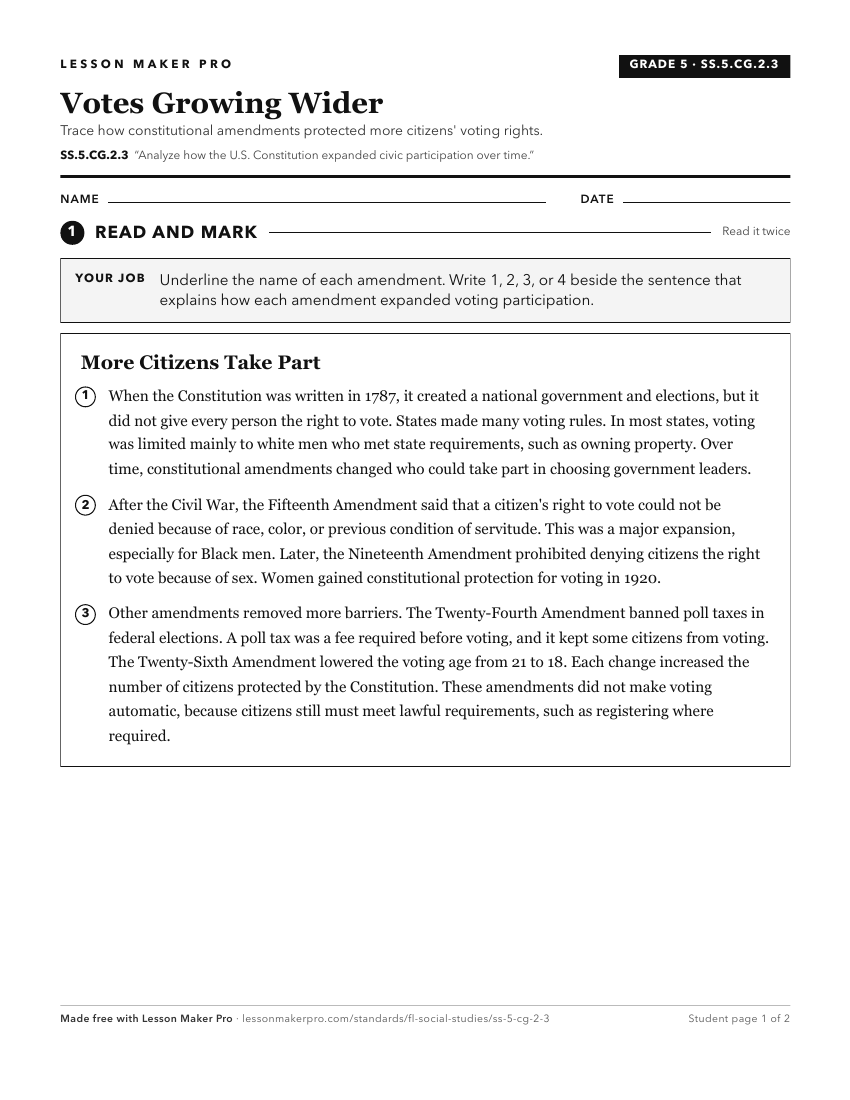
A ready-to-print activity worksheet aligned to SS.5.CG.2.3, with an answer key for the teacher on its own page. No account needed.
PDF, US Letter, prints cleanly in black and white.
Download the worksheetKeep exploring
Related Standards
- SS.5.CG.2.4
Evaluate the importance of civic duties and responsibilities to the preservation of the United States' constitutional republic.
- SS.7.CG.3.6
Analyze how the 13th, 14th, 15th, 19th, 24th, and 26th Amendments broadened participation in the political process.
- SS.6.CG.1.1
Analyze how democratic concepts developed in ancient Greece served as a foundation for the United States' constitutional republic.
- SS.8.CG.2.6
Evaluate how amendments to the U.S. Constitution expanded opportunities for civic participation through Reconstruction.
Turn this exact standard into a lesson
Grade, subject, topic, and the complete standard are prefilled. Create one free, no account needed.
Also for this standard:Make a WorksheetMake a QuizMake a Sub Lesson