Florida SS.5.CG.2.4
The Standard
- SS.5.CG.2
- Civic and Political Participation
Evaluate the importance of civic duties and responsibilities to the preservation of the United States’ constitutional republic.
Florida Next Generation Sunshine State Standards for Social Studies
Teacher's field guide
What This Standard Means
What Students Need to Do
- Students distinguish required civic duties from voluntary civic responsibilities. They explain how actions such as obeying laws, serving on juries, voting, staying informed, and respecting others’ rights support representative government.
What Mastery Looks Like
- Students correctly classify civic actions as duties or responsibilities and support each choice with a reason. They can explain what may happen to representative government when people ignore those actions.
Common Misconceptions
- Students may think every civic action is required by law or that voting is a legal duty. They may also think children have no civic responsibilities or that good citizens must agree with government leaders.
How to Assess It
- Give students this exit prompt: Choose one civic duty and one civic responsibility, then explain how each helps protect representative government.
Lesson moves
Ways to Teach It
Have pairs sort action cards into legal duties, voluntary responsibilities, and nonexamples, then defend two placements.
Ask students to write: Which civic action would cause the most harm if most citizens stopped doing it, and why?
Play a scenario game where teams identify the missing civic action and predict its effect on rights, laws, or representation.
Use a local election guide to identify offices, ballot questions, and information a responsible voter should check before voting.
Free download
Printable SS.5.CG.2.4 Worksheet
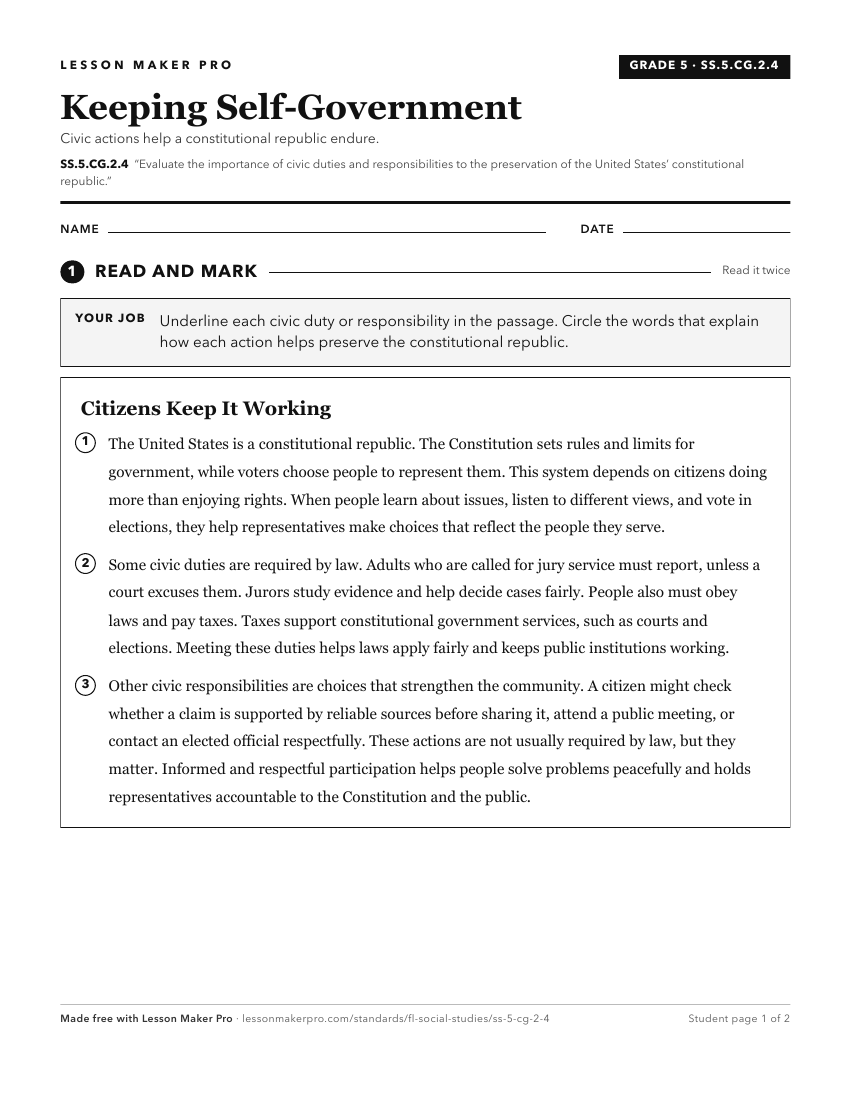
A ready-to-print activity worksheet aligned to SS.5.CG.2.4, with an answer key for the teacher on its own page. No account needed.
PDF, US Letter, prints cleanly in black and white.
Download the worksheetKeep exploring
Related Standards
- SS.5.A.5.10
Examine the significance of the Constitution including its key political concepts, origins of those concepts, and their role in American democracy.
- SS.8.CG.2
Evaluate the roles, rights, and responsibilities of U.S. citizens and determine methods of active participation in society, government, and the political system...
- SS.7.CG.2
Evaluate the roles, rights, and responsibilities of United States citizens, and determine methods of active participation in society, government, and the politi...
- SS.7.CG.2.2
Differentiate between obligations and responsibilities of U.S. citizenship and evaluate their impact on society.
Turn this exact standard into a lesson
Grade, subject, topic, and the complete standard are prefilled. Create one free, no account needed.
Also for this standard:Make a WorksheetMake a QuizMake a Sub Lesson