Florida SS.7.CG.2
Florida Standard (Benchmark Cluster)
- SS.7.CG
- Civics and Government
Evaluate the roles, rights, and responsibilities of United States citizens, and determine methods of active participation in society, government, and the political system.
Florida Next Generation Sunshine State Standards for Social Studies
Cluster contents
Benchmarks in This Standard
SS.7.CG.2 is a Florida social studies standard. These are the benchmarks under it.
- SS.7.CG.2.1
Define the term “citizen,” and explain the constitutional means of becoming a U.S. citizen.
- SS.7.CG.2.2
Differentiate between obligations and responsibilities of U.S. citizenship and evaluate their impact on society.
- SS.7.CG.2.3
Identify and apply the rights contained in the Bill of Rights and other amendments to the U.S. Constitution.
- SS.7.CG.2.4
Explain how the U.S. Constitution and the Bill of Rights safeguard individual rights.
- SS.7.CG.2.5
Describe the trial process and the role of juries in the administration of justice at the state and federal levels.
- SS.7.CG.2.6
Examine the election and voting process at the local, state, and national levels.
- SS.7.CG.2.7
Identify the constitutional qualifications required to hold local, state, and national offices.
- SS.7.CG.2.8
Examine the impact of media, individuals, and interest groups on monitoring and influencing government.
- SS.7.CG.2.9
Analyze media and political communications and identify examples of bias, symbolism, and propaganda.
- SS.7.CG.2.10
Explain the process for citizens to address a state or local problem by researching public policy alternatives, identifying appropriate government agencies to a...
Teacher's field guide
What This Cluster Means
What Students Need to Do
- Students explain what citizens may do, what they must do by law, and what they can choose to do for their community. They compare ways to take part in public decisions and decide which action fits a given problem.
What Mastery Looks Like
- A student can distinguish voting from serving on a jury and explain who is eligible for each. Given a local problem, they can choose a specific action, name who has the power to respond, and explain why that action could help.
Common Misconceptions
- Students may call voting a legal duty or assume every resident can vote in federal elections. They may also think posting an opinion online changes a law by itself, or that only elected officials can influence decisions.
How to Assess It
- Exit ticket: The town plans to close a public park. Name one right citizens could use, one action a seventh grader could take, and the local official or board that should hear the concern.
Lesson moves
Ways to Teach It
Sort cards labeled vote, serve on a jury, attend a council meeting, and obey laws into rights, legal duties, and voluntary actions.
Ask students to write three sentences: Should the town add a crosswalk near school, and who should residents contact about it?
Play a matching game pairing local problems with actions such as signing a petition, speaking at a board meeting, or contacting a representative.
Give students a city council agenda and have them find one item they could comment on during the public comment period.
Free download
Printable SS.7.CG.2 Worksheet
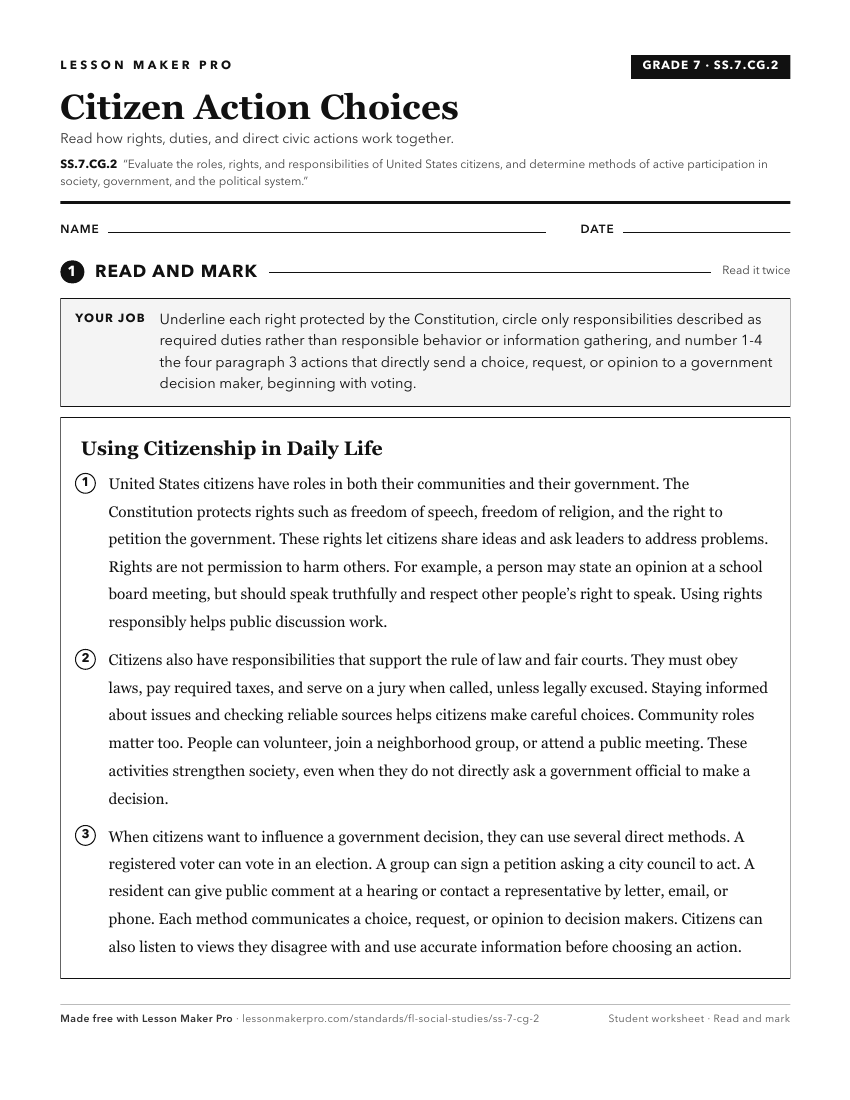
A ready-to-print activity worksheet aligned to SS.7.CG.2, with an answer key for the teacher on its own page. No account needed.
PDF, US Letter, prints cleanly in black and white.
Download the worksheetKeep exploring
Related Standards
- SS.5.CG.2.4
Evaluate the importance of civic duties and responsibilities to the preservation of the United States' constitutional republic.
- SS.7.CG.3
Demonstrate an understanding of the principles, functions, and organization of government.
- SS.8.CG.2
Evaluate the roles, rights, and responsibilities of U.S. citizens and determine methods of active participation in society, government, and the political system...
Turn this cluster into a lesson
Grade, subject, topic, and the complete cluster are prefilled. Create one free, no account needed.
Also for this cluster:Make a WorksheetMake a QuizMake a Sub Lesson