Florida SS.7.CG.2.5
The Standard
- SS.7.CG
- Civics and Government
- SS.7.CG.2
- Evaluate the roles, rights, and responsibilities of United States citizens, and determine methods of active participation in society, government, and the political system.
Describe the trial process and the role of juries in the administration of justice at the state and federal levels.
Florida Next Generation Sunshine State Standards for Social Studies
Teacher's field guide
What This Standard Means
What Students Need to Do
- Students put the main stages of a trial in order, from jury selection through evidence, instructions, deliberation, and verdict. They explain how judges, lawyers, witnesses, and jurors serve different roles in state and federal courts.
What Mastery Looks Like
- Given a courtroom scenario, a student can name the trial stage, identify each person's role, and explain what happens next. The student explains that jurors decide facts while judges manage legal rules and court procedures.
Common Misconceptions
- Students often think juries decide the law or always choose the sentence. They may confuse grand juries, which consider charges, with trial juries, which decide facts. They may also assume every case reaches a jury trial.
How to Assess It
- Exit ticket: Put jury selection, opening statements, witness testimony, closing arguments, jury instructions, deliberation, and verdict in order. Then explain the judge's role and the jury's role.
Lesson moves
Ways to Teach It
Run a mini-trial with role cards, three evidence exhibits, a judge, attorneys, witnesses, and a jury that must explain its verdict.
Ask: Why must jurors decide from courtroom evidence rather than news reports, rumors, or personal experience?
Play a trial-sequence relay using cards labeled selection, openings, testimony, closings, instructions, deliberation, and verdict.
Examine a sample state or federal jury summons, then list the citizen duties, court level, and practical steps it names.
Free download
Printable SS.7.CG.2.5 Worksheet
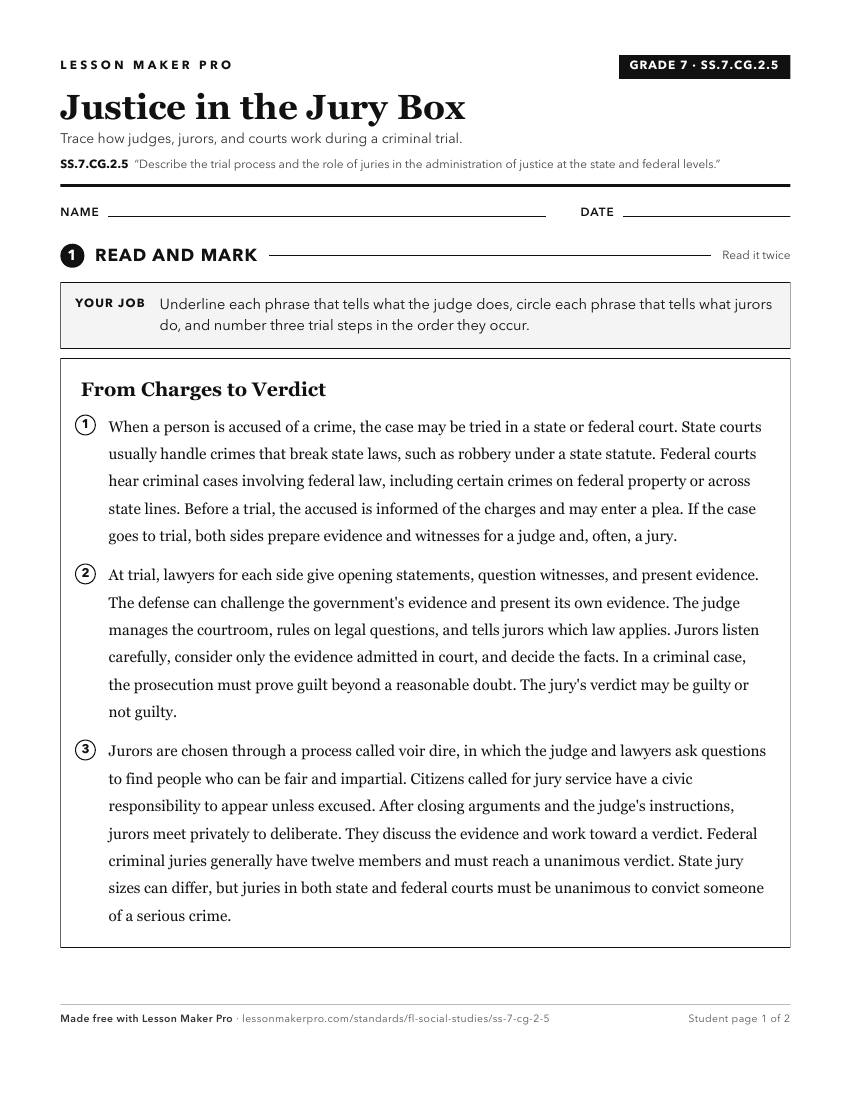
A ready-to-print activity worksheet aligned to SS.7.CG.2.5, with an answer key for the teacher on its own page. No account needed.
PDF, US Letter, prints cleanly in black and white.
Download the worksheetKeep exploring
Related Standards
- SS.7.CG.3.9
Explain the structure, functions, and processes of the judicial branch of government.
- SS.8.CG.1.3
Explain the importance of the rule of law in the United States' constitutional republic.
- SS.7.CG.2.6
Examine the election and voting process at the local, state, and national levels.
- SS.5.CG.3.3
Explain the role of the court system in interpreting law and settling conflicts.
Turn this exact standard into a lesson
Grade, subject, topic, and the complete standard are prefilled. Create one free, no account needed.
Also for this standard:Make a WorksheetMake a QuizMake a Sub Lesson