Florida SS.7.CG.2.6
The Standard
- SS.7.CG
- Civics and Government
- SS.7.CG.2
- Evaluate the roles, rights, and responsibilities of United States citizens, and determine methods of active participation in society, government, and the political system.
Examine the election and voting process at the local, state, and national levels.
Florida Next Generation Sunshine State Standards for Social Studies
Teacher's field guide
What This Standard Means
What Students Need to Do
- Students trace the steps from voter registration and primary elections through ballot counting and certification. They compare offices, ballots, and election results at local, state, and national levels.
What Mastery Looks Like
- Students can place major election steps in order and explain the purpose of each step. They can distinguish elections for mayor, governor, Congress, and president, including the Electoral College.
Common Misconceptions
- Students may think every voter can vote in any party’s Florida primary. They may confuse primary elections with general elections or assume the national popular vote directly elects the president.
How to Assess It
- Exit ticket: Put registration, primary, general election, vote counting, and certification in order, then explain how presidential results differ from governor results.
Lesson moves
Ways to Teach It
Run a mock election with registration forms, poll workers, private ballots, vote counting, and final certification.
Ask students to explain whether primaries should be open to all voters, using one benefit and one drawback.
Play a sorting game matching mayor, governor, senator, and president cards to local, state, or national elections.
Give students a current county sample ballot and have them label each contest as local, state, or national.
Free download
Printable SS.7.CG.2.6 Worksheet
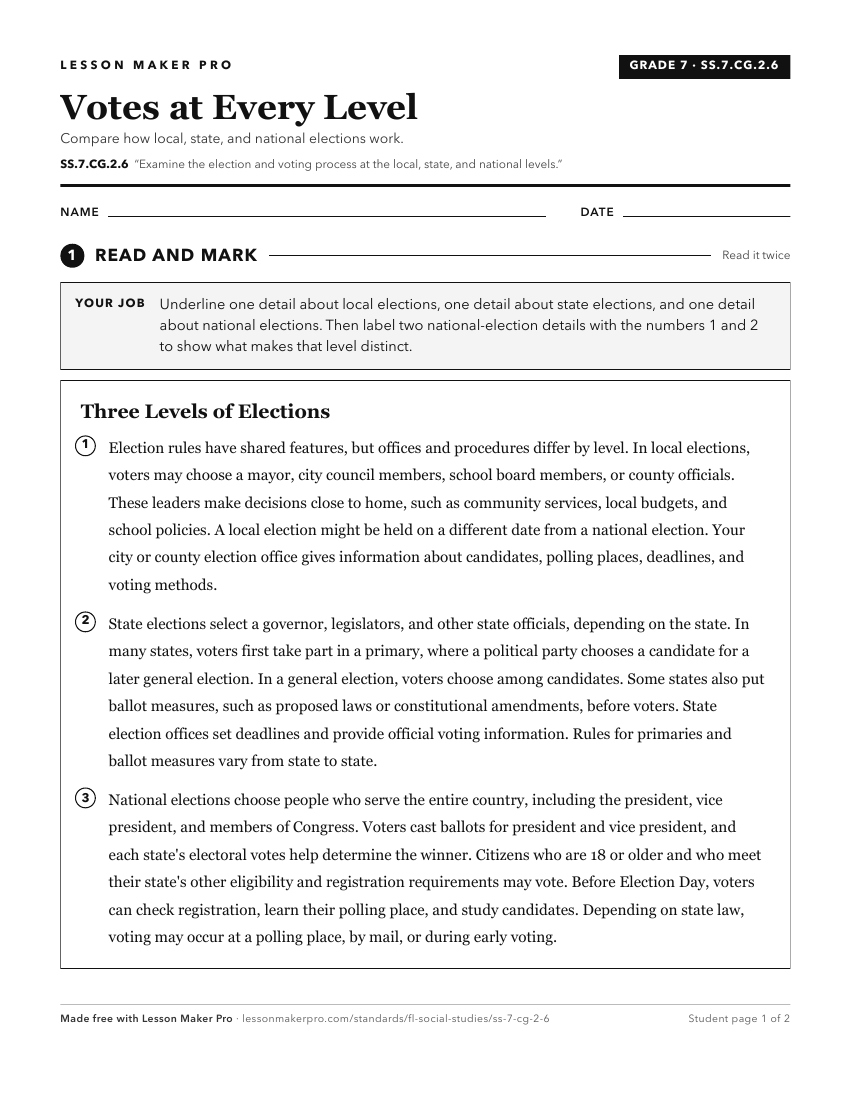
A ready-to-print activity worksheet aligned to SS.7.CG.2.6, with an answer key for the teacher on its own page. No account needed.
PDF, US Letter, prints cleanly in black and white.
Download the worksheetKeep exploring
Related Standards
- SS.8.CG.2
Evaluate the roles, rights, and responsibilities of U.S. citizens and determine methods of active participation in society, government, and the political system...
- SS.8.CG.2.2
Compare the legal obligations of citizens at the local, state, and national levels.
- SS.7.CG.2
Evaluate the roles, rights, and responsibilities of United States citizens, and determine methods of active participation in society, government, and the politi...
- SS.4.CG.3.2
Compare the structure, functions, and processes of local and state government.
Turn this exact standard into a lesson
Grade, subject, topic, and the complete standard are prefilled. Create one free, no account needed.
Also for this standard:Make a WorksheetMake a QuizMake a Sub Lesson