Florida SS.7.CG.3.9
The Standard
- SS.7.CG
- Civics and Government
- SS.7.CG.3
- Demonstrate an understanding of the principles, functions, and organization of government.
Explain the structure, functions, and processes of the judicial branch of government.
Florida Next Generation Sunshine State Standards for Social Studies
Teacher's field guide
What This Standard Means
What Students Need to Do
- Students identify the levels of state and federal courts and explain each court’s role. They trace how cases move through trial and appeal, including judicial review.
What Mastery Looks Like
- Students can place courts in the correct order and distinguish original from appellate jurisdiction. Given a case, they can explain which court hears it, what judges decide, and what may happen next.
Common Misconceptions
- Students may think the Supreme Court holds trials or hears every appeal. They may confuse interpreting laws with making laws, or assume judicial review means reviewing whether a trial was fair.
How to Assess It
- Exit ticket: A defendant loses in federal district court and appeals. Name the next court, explain its job, and describe one possible later step.
Lesson moves
Ways to Teach It
Give pairs court, function, and case-step cards to arrange into state and federal court flowcharts.
Ask students to write which judicial power best limits the legislative or executive branch, then defend their choice with an example.
Run a case-path relay where teams move scenario cards through the correct trial, appeal, and review stages.
Use a local news report about a court ruling to identify the court, dispute, decision, and possible next step.
Free download
Printable SS.7.CG.3.9 Worksheet
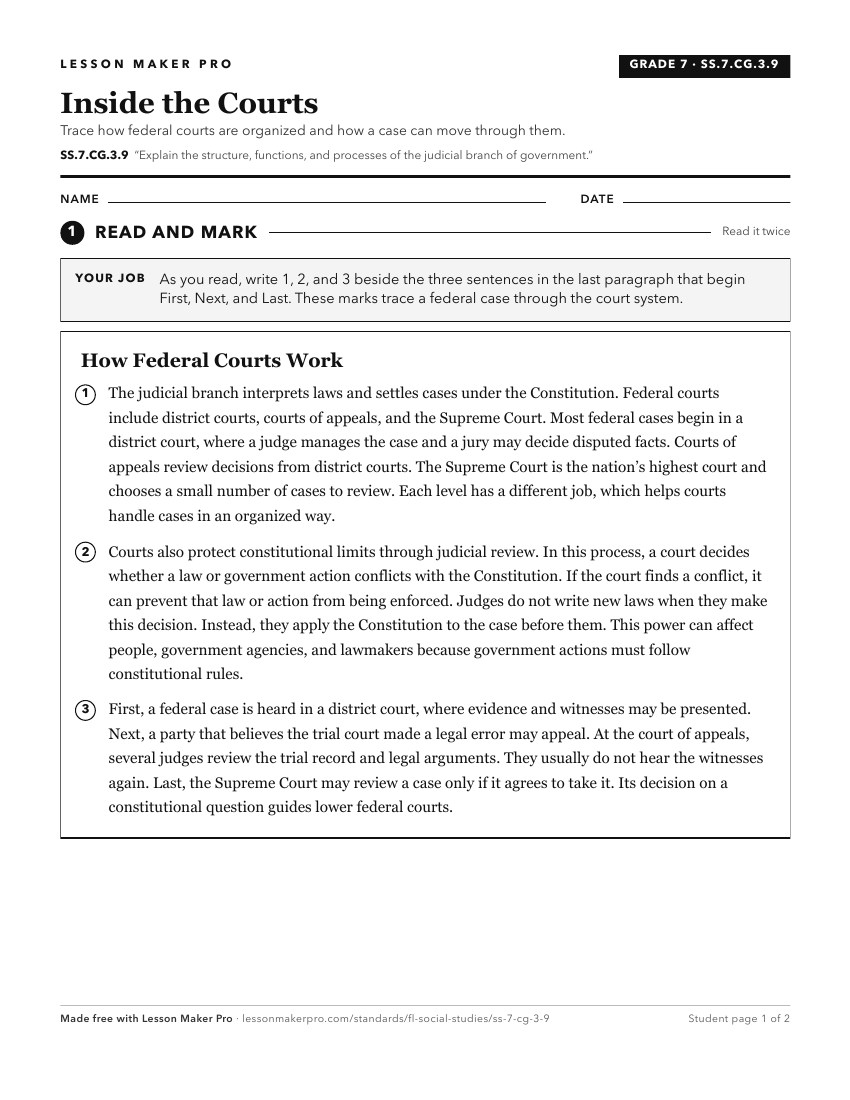
A ready-to-print activity worksheet aligned to SS.7.CG.3.9, with an answer key for the teacher on its own page. No account needed.
PDF, US Letter, prints cleanly in black and white.
Download the worksheetKeep exploring
Related Standards
- SS.7.CG.3.8
Explain the structure, functions, and processes of the executive branch of government.
- SS.7.CG.3.7
Explain the structure, functions, and processes of the legislative branch of government.
- SS.7.CG.3.3
Describe the structure and function of the three branches of government established in the U.S. Constitution.
- SS.4.CG.3.1
Explain the structure and functions of the legislative, executive, and judicial branches of government in Florida.
Turn this exact standard into a lesson
Grade, subject, topic, and the complete standard are prefilled. Create one free, no account needed.
Also for this standard:Make a WorksheetMake a QuizMake a Sub Lesson