Florida SS.7.CG.2.9
The Standard
- SS.7.CG
- Civics and Government
- SS.7.CG.2
- Evaluate the roles, rights, and responsibilities of United States citizens, and determine methods of active participation in society, government, and the political system.
Analyze media and political communications and identify examples of bias, symbolism, and propaganda.
Florida Next Generation Sunshine State Standards for Social Studies
Teacher's field guide
What This Standard Means
What Students Need to Do
- Students examine news stories, campaign ads, speeches, and social media posts for slanted language, selective facts, political symbols, and persuasive techniques. They cite specific details and explain how those choices may shape an audience’s response.
What Mastery Looks Like
- Students can identify bias, symbolism, and propaganda in a political message and support each claim with evidence. They can explain the message’s purpose, intended audience, and likely effect.
Common Misconceptions
- Students may assume that biased information is always false or that every opinion is propaganda. They may identify a flag or slogan without explaining its meaning, or claim bias based only on whether they agree with the message.
How to Assess It
- Give students a short mock campaign post. Ask them to identify one persuasive technique, quote the evidence, and explain how it could influence voters.
Lesson moves
Ways to Teach It
Give pairs printed headlines and campaign images to sort into bias, symbolism, propaganda, or none, then require a written reason for each choice.
Ask students to write: When does persuasion become propaganda, and what evidence would help you decide?
Play Technique Detective by showing brief political messages and awarding points when teams identify a technique and cite exact evidence.
Compare two local news reports on the same public issue, then highlight differences in word choice, images, sources, and omitted details.
Free download
Printable SS.7.CG.2.9 Worksheet
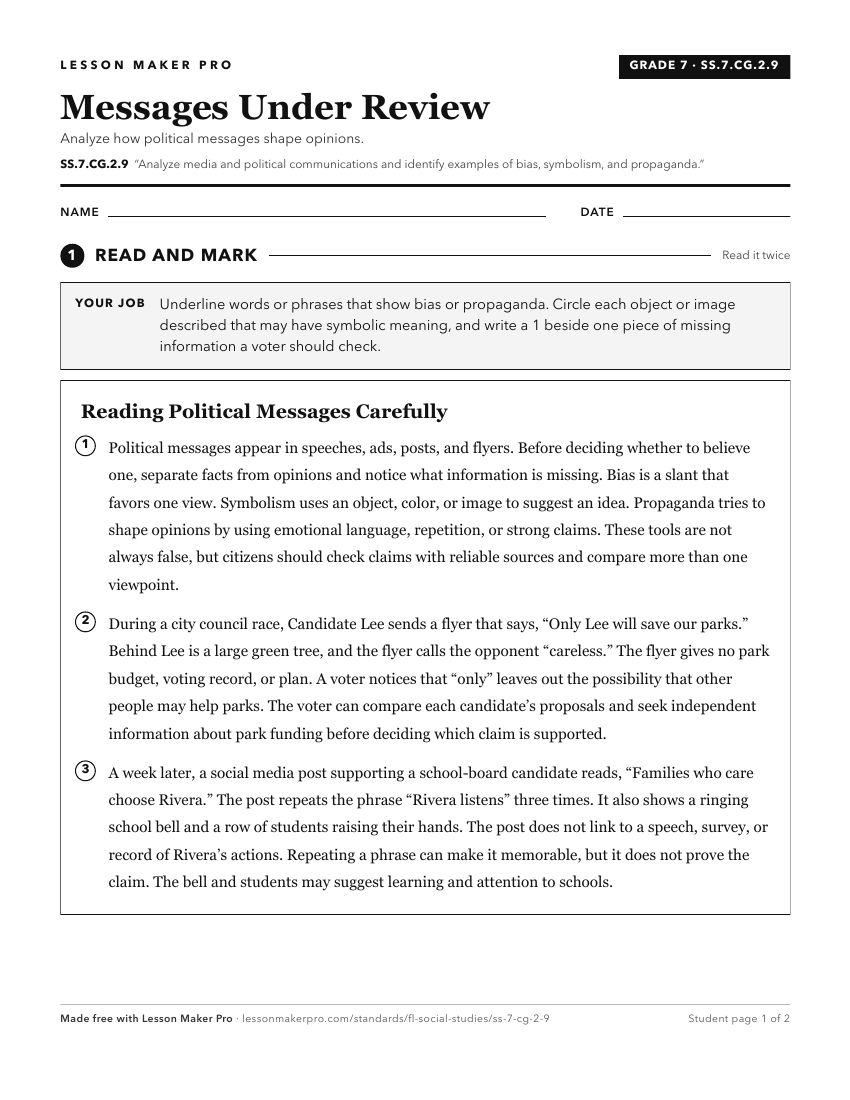
A ready-to-print activity worksheet aligned to SS.7.CG.2.9, with an answer key for the teacher on its own page. No account needed.
PDF, US Letter, prints cleanly in black and white.
Download the worksheetKeep exploring
Related Standards
- SS.7.CG.2.8
Examine the impact of media, individuals, and interest groups on monitoring and influencing government.
- SS.8.A.1.2
Analyze charts, graphs, maps, photographs, and timelines; analyze political cartoons; determine cause and effect.
- SS.8.A.1.3
Analyze current events relevant to American History topics through a variety of electronic and print media resources.
- SS.3.A.1.1
Analyze primary and secondary sources.
Turn this exact standard into a lesson
Grade, subject, topic, and the complete standard are prefilled. Create one free, no account needed.
Also for this standard:Make a WorksheetMake a QuizMake a Sub Lesson