Virginia SOL 8.C
SOL Standard (Knowledge and Skills Cluster)
The student will develop effective oral communication and collaboration skills to build a community of learners that process, understand, and interpret content together.
Virginia Standards of Learning for English
Cluster contents
Knowledge and Skills in This Standard
8.C is a Standards of Learning standard. These are the knowledge and skills expectations under it.
- 8.C.1
Communication, Listening, and Collaboration
- 8.C.1.A.i
Listening actively, offering and seeking ideas, and setting guidelines for presentations and discussions.
- 8.C.1.A.ii
Working effectively and respectfully by actively contributing relevant and wellsupported ideas and opinions and sharing responsibility for the collaborative wor...
- 8.C.1.A.iii
Asking clarifying questions and responding appropriately to others’ questions to encourage discussion, foster understanding, and maintain focus on the topic.
- 8.C.1.A.iv
Communicating agreement or tactful disagreement with others’ ideas, using carefully constructed responses.
- 8.C.1.A.v
Thoughtfully paraphrasing and summarizing ideas made during discussions.
- 8.C.1.A.vi
Acknowledging new insights expressed by others, and, when justified, modifying their own views.
- 8.C.1.A.vii
Valuing contributions made by each group member while exhibiting a willingness to make necessary concessions to accomplish a common goal.
- 8.C.1.A.viii
Using self-reflection to evaluate one’s own role in preparation and participation in small-group activities.
- 8.C.2
Speaking and Presentation of Ideas
- 8.C.2.A.i
Clearly communicating information in an organized and succinct manner.
- 8.C.2.A.ii
Incorporating pertinent descriptions, facts, details, and examples to support the main ideas.
- 8.C.2.A.iii
Using language and vocabulary appropriate to the audience, topic, and purpose, including speaking clearly at an understandable pace with appropriate tone and vo...
- 8.C.2.A.iv
Responding to audience questions and comments with relevant evidence, observations, and ideas.
- 8.C.2.A.v
Referencing source material as appropriate during the presentation.
- 8.C.3
Integrating Multimodal Literacies
- 8.C.3.A
Plan and present a multimodal presentation that
- 8.C.3.A.i
Sequences ideas logically.
- 8.C.3.A.ii
Uses pertinent descriptions, facts, and details.
- 8.C.3.A.iii
Uses two or more communication modes to make meaning (e.g., still or moving images, gestures, spoken language, and written language).
- 8.C.3.A.iv
Emphasizes different points of view.
- 8.C.3.B
Craft and publish audience-specific media messages that present claims and findings with relevant evidence and reasoning.
- 8.C.4
Examining Media Messages
- 8.C.4.A
Examine how the media can influence beliefs, behaviors, and interpretations by using persuasive techniques (e.g., name calling, innuendo, glittering generalitie...
- 8.C.4.B
Analyze how similar information is presented in diverse media formats by examining electronic, print, propaganda, and mass media.
- 8.C.4.C
Evaluate sources for their relationships, motives, intent, and content (e.g., social, emotional, commercial).
Teacher's field guide
What This Cluster Means
What Students Need to Do
- Students prepare for and sustain focused discussions by listening, questioning, paraphrasing, supporting claims, and sharing responsibility. They give organized presentations that use evidence, source references, and multiple modes. They also compare media messages and judge persuasive techniques, purpose, motive, and audience.
What Mastery Looks Like
- Students build on classmates’ ideas, disagree tactfully, revise a view when evidence warrants it, and reflect honestly on their participation. Their presentations are clear, concise, audience aware, and supported by relevant details and sources. They can explain how format and persuasion shape interpretation.
Common Misconceptions
- Students often treat discussion as taking turns speaking rather than listening and responding. They may call any opinion evidence, summarize inaccurately, or disagree with the person instead of the idea. In presentations, they may add images that do not clarify meaning or identify bias without citing specific words, images, or omissions.
How to Assess It
- Show one print ad and ask groups, “What claim is made, which persuasive technique is used, and what evidence supports your answer?” Collect a three-sentence exit slip that paraphrases one peer’s idea, responds tactfully, and names one detail from the ad.
Lesson moves
Ways to Teach It
Give groups printed ads, sticky notes, and technique cards to label claims, evidence, emotional appeals, intended audiences, and missing information.
Discuss whether a school phone policy should change, requiring each student to paraphrase a peer before adding evidence or disagreeing.
Run a paraphrase relay where teams earn points for accurate summaries, clarifying questions, relevant evidence, and tactful disagreement.
Compare a local news report, social post, and advertisement about one event, then create a text and image message for families.
Free download
Printable 8.C Worksheet
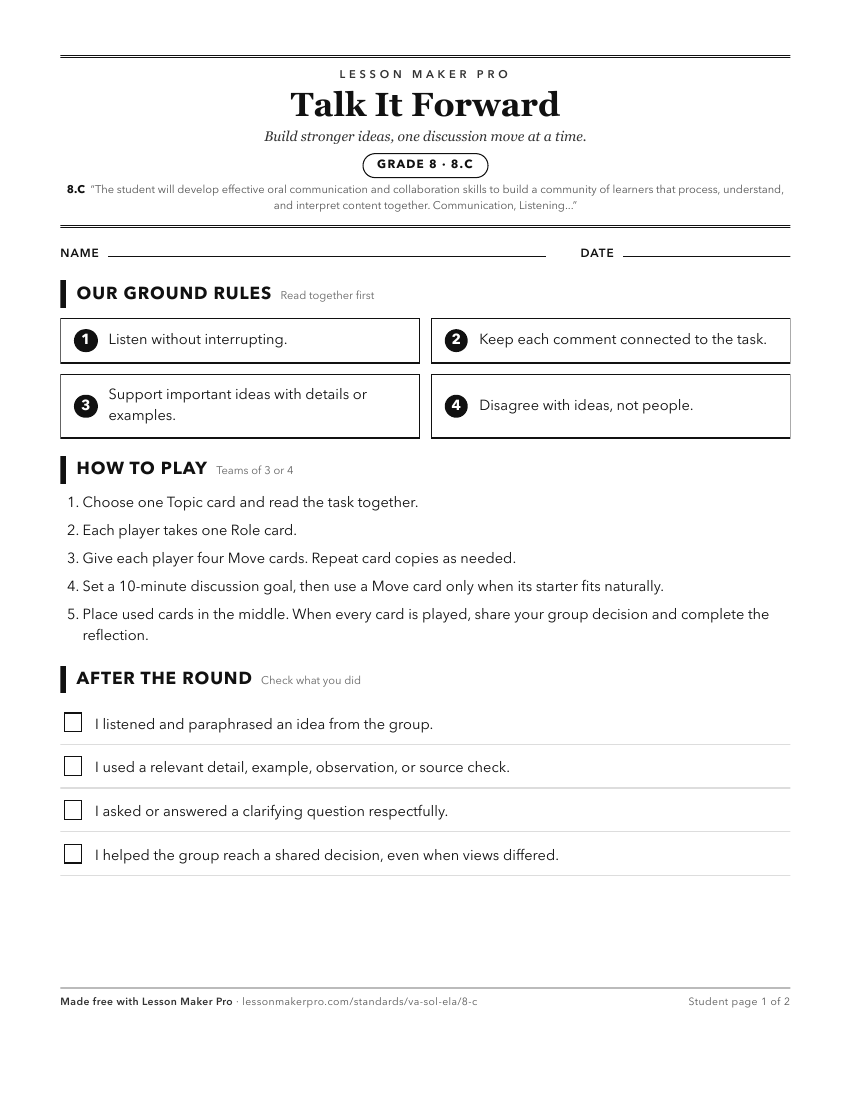
A ready-to-print activity worksheet aligned to 8.C, with an answer key for the teacher on its own page. No account needed.
PDF, US Letter, prints cleanly in black and white.
Download the worksheetKeep exploring
Related Standards
Turn this cluster into a lesson
Grade, subject, topic, and the complete cluster are prefilled. Create one free, no account needed.
Also for this cluster:Make a WorksheetMake a QuizMake a Sub Lesson