Virginia SOL 8.C.4.C
The Standard
Evaluate sources for their relationships, motives, intent, and content (e.g., social, emotional, commercial).
Virginia Standards of Learning for English · Examining Media Messages
Teacher's field guide
What This Standard Means
What Students Need to Do
- Students examine who created a message, who is connected to it, and who may benefit from it. They use words, images, evidence, and source information to judge social, emotional, or commercial purposes.
What Mastery Looks Like
- Students accurately summarize a source’s claim and supporting content. They explain who is connected to the source, who benefits from it, and how words or images reveal its purpose.
Common Misconceptions
- Students may treat a polished design, high view count, or familiar logo as proof of trustworthiness. They often confuse the topic with the creator’s purpose or overlook sponsors and shared ownership. They may also assume that emotional or commercial content is automatically false.
How to Assess It
- Give students a short sponsored post with an author bio. Ask them to identify the creator-sponsor relationship, motive, intended response, and one content detail supporting each judgment.
Lesson moves
Ways to Teach It
Give pairs printed news posts and three colors of sticky notes to mark ownership links, emotional appeals, and sales motives.
Ask, “Who benefits if this message succeeds?” and have students defend their answer with two details from the source.
Run a source detective game where teams earn points for finding sponsors, linked organizations, loaded words, and unsupported claims.
Compare a product review, an influencer post, and the company advertisement, then trace who gains money or attention from each.
Free download
Printable 8.C.4.C Worksheet
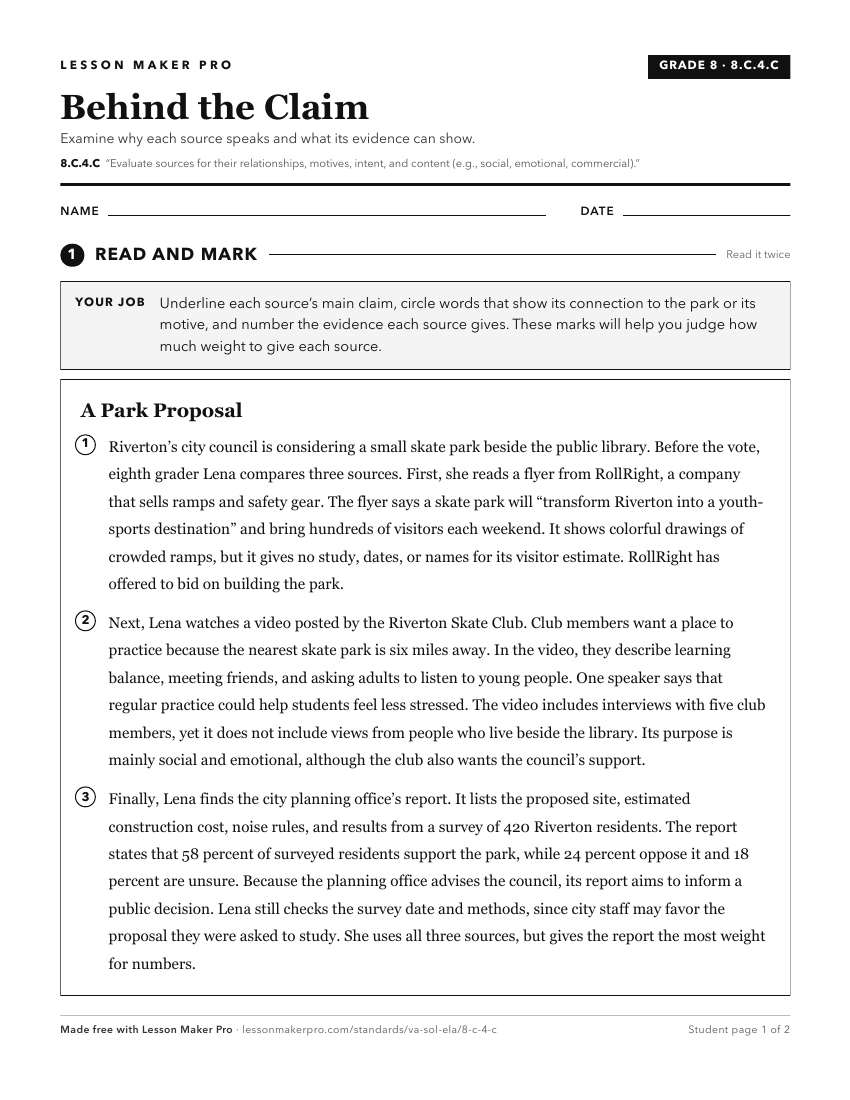
A ready-to-print activity worksheet aligned to 8.C.4.C, with an answer key for the teacher on its own page. No account needed.
PDF, US Letter, prints cleanly in black and white.
Download the worksheetKeep exploring
Related Standards
- 8.R.1.C
Evaluate and analyze the relevance, validity, and credibility of sources (primary, secondary, digital, and print) identifying main and supporting ideas, conflic...
- 10.C.4.D
Evaluate the motives (e.g., social, commercial, and political) behind media messages used to determine author’s purpose, factual content, opinion, and/or possib...
- 9.C.4.E
Evaluate sources including advertisements, editorials, political cartoons, and feature stories for relationships between intent and factual content.
- 12.R.1.C
Objectively evaluate primary and secondary sources for their credibility, reliability, accuracy, usefulness, and limitations; that includes identifying the main...
Turn this exact standard into a lesson
Grade, subject, topic, and the complete standard are prefilled. Create one free, no account needed.
Also for this standard:Make a WorksheetMake a QuizMake a Sub Lesson