Virginia SOL 9.C.4.E
The Standard
Evaluate sources including advertisements, editorials, political cartoons, and feature stories for relationships between intent and factual content.
Virginia Standards of Learning for English · Examining Media Messages
Teacher's field guide
What This Standard Means
What Students Need to Do
- Students identify what a media message wants its audience to think, feel, or do. They check its claims and explain how selected facts, omissions, and framing serve that purpose.
What Mastery Looks Like
- Students can state the creator’s likely intent and separate checkable claims from opinions or persuasive language. They can verify key claims and explain how facts, omissions, and framing shape the message.
Common Misconceptions
- Students may confuse the topic with the creator’s intent. They may treat statistics as automatically reliable or dismiss opinion pieces as having no factual content. They may also read political cartoons literally and miss symbolism or exaggeration.
How to Assess It
- Give students a short editorial with three checkable claims. Ask them to state its intent, verify one claim, and explain how that claim supports the intent.
Lesson moves
Ways to Teach It
Give pairs a printed advertisement to highlight factual claims, circle persuasive wording, and label the action the advertiser wants.
Ask students to write: Which fact most strongly serves the creator’s intent, and what omitted fact could change the message?
Run a claim sorting game where teams classify cards as verified fact, unsupported claim, opinion, or misleading presentation.
Compare a local news feature and editorial about the same issue, then list how each selects facts for a different purpose.
Free download
Printable 9.C.4.E Worksheet
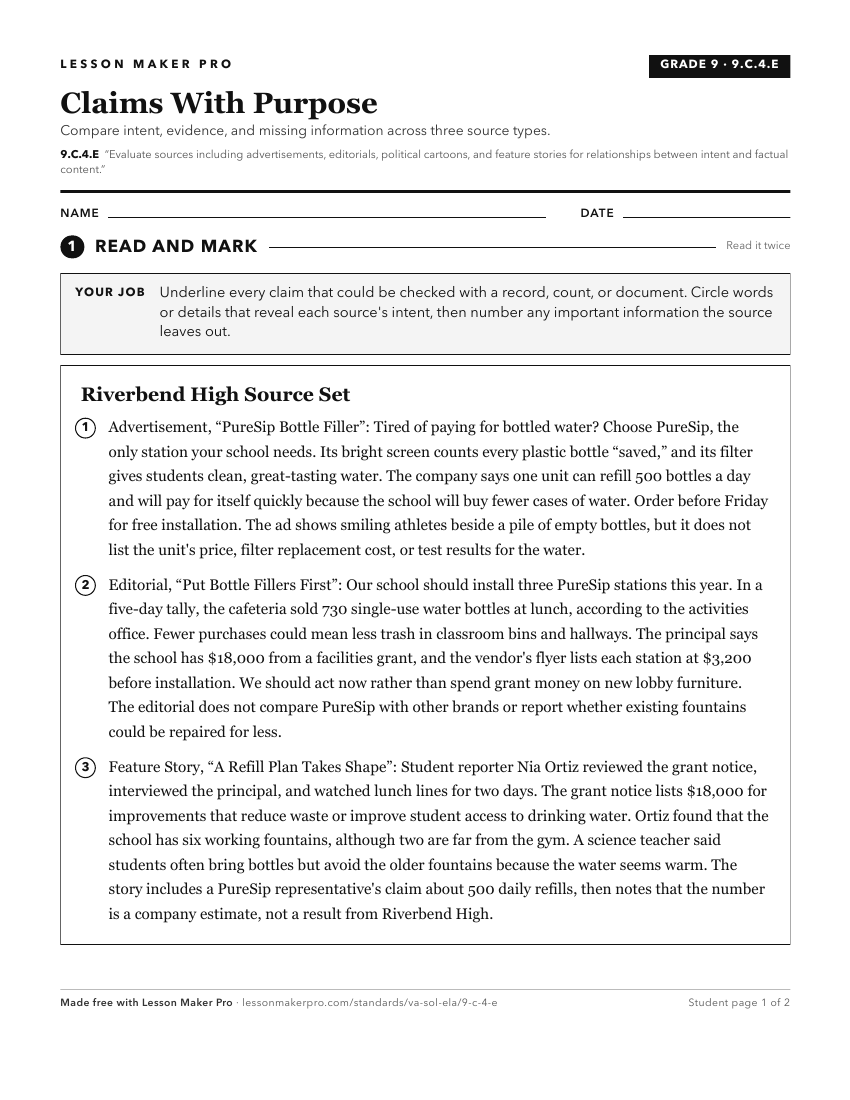
A ready-to-print activity worksheet aligned to 9.C.4.E, with an answer key for the teacher on its own page. No account needed.
PDF, US Letter, prints cleanly in black and white.
Download the worksheetKeep exploring
Related Standards
- 11.C.4.A
Analyze the sources and viewpoint(s) of publications including advertisements, editorials, blogs, and websites.
- 10.C.4.D
Evaluate the motives (e.g., social, commercial, and political) behind media messages used to determine author’s purpose, factual content, opinion, and/or possib...
- 11.R.1.C
Objectively evaluate primary and secondary sources for their credibility, reliability, accuracy, usefulness, and limitations. That includes identifying their ma...
- 8.C.4.C
Evaluate sources for their relationships, motives, intent, and content (e.g., social, emotional, commercial).
Turn this exact standard into a lesson
Grade, subject, topic, and the complete standard are prefilled. Create one free, no account needed.
Also for this standard:Make a WorksheetMake a QuizMake a Sub Lesson