Virginia SOL 6.C
SOL Standard (Knowledge and Skills Cluster)
The student will develop effective oral communication and collaboration skills to build a community of learners that process, understand, and interpret content together.
Virginia Standards of Learning for English
Cluster contents
Knowledge and Skills in This Standard
6.C is a Standards of Learning standard. These are the knowledge and skills expectations under it.
- 6.C.1
Communication, Listening, and Collaboration
- 6.C.1.A.i
Listening actively through verbal and nonverbal communication and using agreed-upon discussion rules.
- 6.C.1.A.ii
Working respectfully by building on others’ ideas and showing value for others’ ideas and contributions.
- 6.C.1.A.iii
Asking relevant questions to clarify others’ perspectives.
- 6.C.1.A.iv
Communicating agreement or tactful disagreement with others’ ideas, using carefully constructed responses.
- 6.C.1.A.v
Paraphrasing and summarizing key ideas being discussed by using ample evidence, examples, or details to support opinions and conclusions.
- 6.C.1.A.vi
Evaluating the effectiveness of participant interactions and one’s own contributions to the collaborative work.
- 6.C.2
Speaking and Presentation of Ideas
- 6.C.2.A.i
Clearly communicating information in an organized or succinct manner.
- 6.C.2.A.ii
Providing evidence to support the main idea.
- 6.C.2.A.iii
Using language, vocabulary, and style appropriate to the audience, topic, and purpose.
- 6.C.2.A.iv
Using verbal communication skills, such as volume, tone, and enunciation to enhance the overall message.
- 6.C.2.A.v
Using nonverbal skills, such as proper posture and stance, gestures, and eye movement to enhance the overall message.
- 6.C.2.A.vi
Encouraging audience participation through planned interactions (e.g., questioning, discussion, gathering responses, and movement).
- 6.C.2.A.vii
Referencing source material as appropriate during the presentation.
- 6.C.3
Integrating Multimodal Literacies
- 6.C.3.A
Use media and visual literacy skills to select, organize, and create multimodal content that articulates the purpose of the presentation, using two or more comm...
- 6.C.3.B
Craft and publish audience-specific media messages that present claims and findings in a logical sequence.
- 6.C.4
Examining Media Messages
- 6.C.4.A
Interpret information presented in diverse media formats and explain how it contributes to the topic.
- 6.C.4.B
Explain how media messages are intentionally constructed to impact a specific audience.
- 6.C.4.C
Explain the characteristics and analyze the effectiveness of a variety of media messages by considering the results and/or impact on the intended audience.
Teacher's field guide
What This Cluster Means
What Students Need to Do
- Students sustain conversations by listening, responding to peers, asking for clarification, paraphrasing ideas, and supporting claims with evidence. They present organized information or opinions using suitable language, clear delivery, sources, audience interaction, and purposeful media. They also explain how media choices shape meaning and influence an audience.
What Mastery Looks Like
- Students contribute without dominating, build on a named idea, ask focused questions, disagree tactfully, and summarize the discussion accurately. They deliver an organized presentation with evidence, clear speech, purposeful body language, and at least two communication modes. They can explain how specific media choices affect an intended audience.
Common Misconceptions
- Students may think active listening means staying quiet rather than responding, questioning, and paraphrasing. They may disagree without evidence or add visuals that do not support the message. Some assume confident volume matters more than clear organization and accurate sources.
How to Assess It
- Have each student give a 60-second report using one visual and one cited detail, then ask a partner to paraphrase and pose a relevant question. Check organization, evidence, delivery, listening, and the visual’s purpose.
Lesson moves
Ways to Teach It
Give groups a short article, three images, and sticky notes, then have them build and deliver a two-minute evidence-based presentation.
Discuss this prompt: Which response better builds the conversation, and what words make it respectful, clear, and useful?
Use discussion-move cards labeled clarify, build, challenge, paraphrase, and summarize during a six-minute group conversation about a shared text.
Compare two public service announcements on the same issue, then identify how images, wording, sound, and format target different audiences.
Free download
Printable 6.C Worksheet
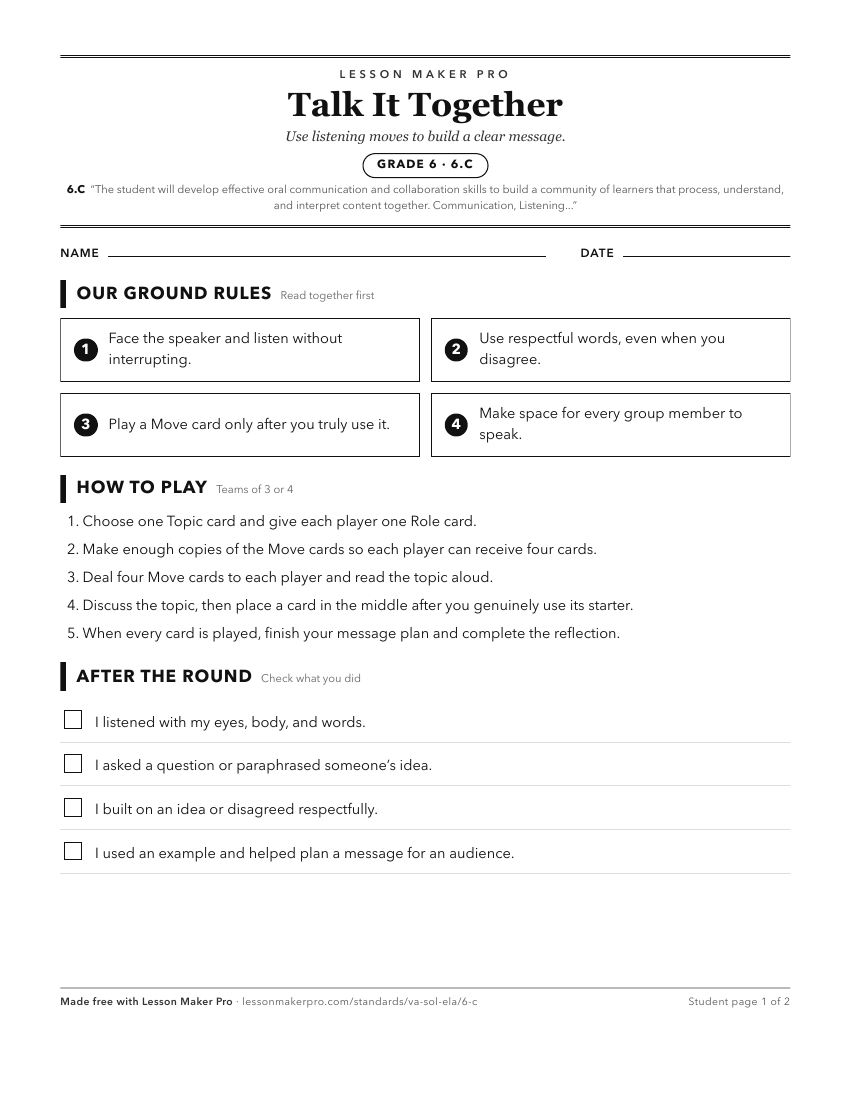
A ready-to-print activity worksheet aligned to 6.C, with an answer key for the teacher on its own page. No account needed.
PDF, US Letter, prints cleanly in black and white.
Download the worksheetKeep exploring
Related Standards
Turn this cluster into a lesson
Grade, subject, topic, and the complete cluster are prefilled. Create one free, no account needed.
Also for this cluster:Make a WorksheetMake a QuizMake a Sub Lesson