Virginia SOL 6.C.4.A
The Standard
Interpret information presented in diverse media formats and explain how it contributes to the topic.
Virginia Standards of Learning for English · Examining Media Messages
Teacher's field guide
What This Standard Means
What Students Need to Do
- Students interpret facts and ideas shown in images, charts, maps, audio, video, and digital texts. They explain how specific media details add to their understanding of a topic.
What Mastery Looks Like
- Students accurately explain information from a visual, audio, or digital source. They point to specific details and explain whether the media adds, clarifies, emphasizes, or challenges ideas about the topic.
Common Misconceptions
- Students may describe a picture, chart, or clip without interpreting its message. They may ignore captions, labels, scale, sound, or camera choices. Some assume every media element simply repeats the written information.
How to Assess It
- Show a short article with a related infographic. Ask, “What information does the infographic add to the topic? Cite two specific features.”
Lesson moves
Ways to Teach It
Set up stations with an article, map, photograph, and chart on one topic, then have students record what each format adds.
Play a short news clip and ask, “How do the images, words, and sounds shape your understanding of the topic?”
Give pairs media cards and claim cards to match, then require a one-sentence justification for each match.
Compare a written weather forecast with a radar map, then list information that is clearer in each format.
Free download
Printable 6.C.4.A Worksheet
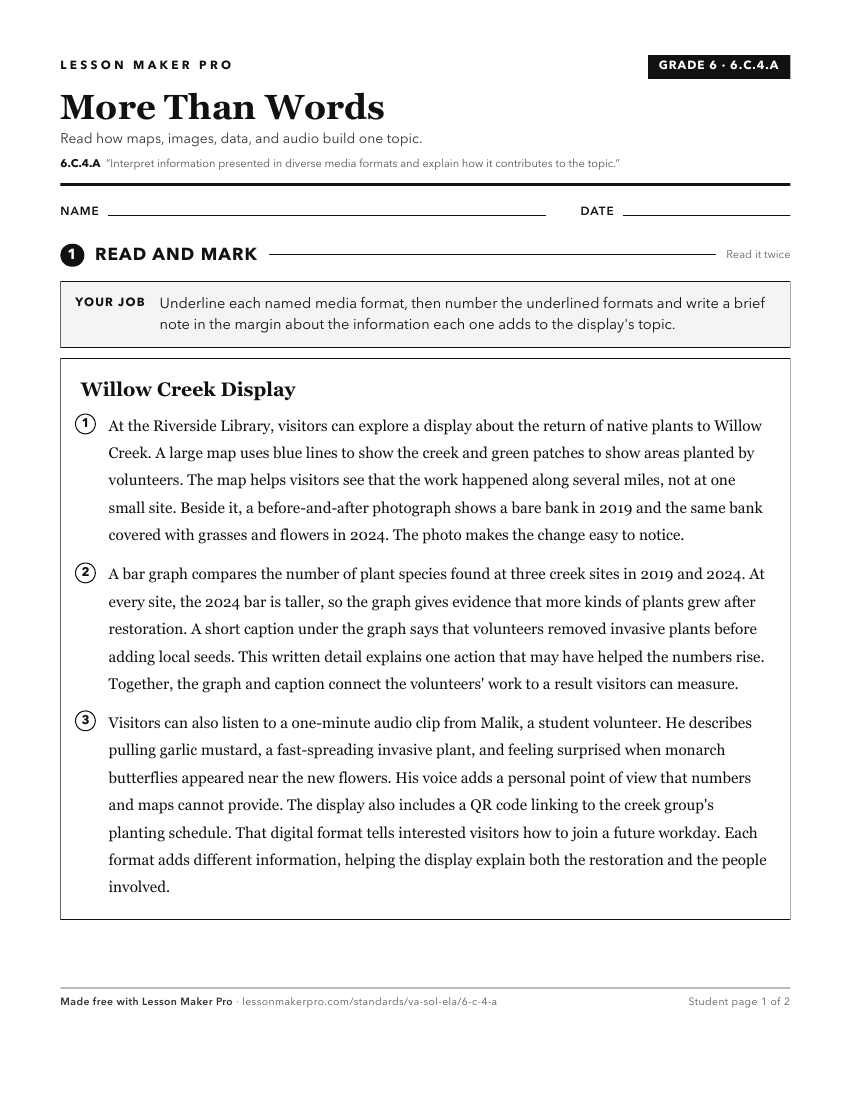
A ready-to-print activity worksheet aligned to 6.C.4.A, with an answer key for the teacher on its own page. No account needed.
PDF, US Letter, prints cleanly in black and white.
Download the worksheetKeep exploring
Related Standards
- 5.C.4.B
Identify the purpose, intended audience, and credibility of information (e.g., auditory, visual, and written media messages) being presented.
- 8.C.4.B
Analyze how similar information is presented in diverse media formats by examining electronic, print, propaganda, and mass media.
- 4.C.4.A
Differentiate between auditory, visual, and written media messages (e.g., videos, podcasts, print advertisements) and their purposes (to explain, to inform, to ...
- 5.R.1.C
Organize and synthesize information from the print and digital resources, evaluating their relevance, reliability, and credibility.
Turn this exact standard into a lesson
Grade, subject, topic, and the complete standard are prefilled. Create one free, no account needed.
Also for this standard:Make a WorksheetMake a QuizMake a Sub Lesson