Virginia SOL 4.C.4.A
The Standard
Differentiate between auditory, visual, and written media messages (e.g., videos, podcasts, print advertisements) and their purposes (to explain, to inform, to persuade).
Virginia Standards of Learning for English · Examining Media Messages
Teacher's field guide
What This Standard Means
What Students Need to Do
- Students identify whether a message uses sound, images, written words, or a combination. They decide whether the message mainly explains, informs, or persuades and point to supporting clues.
What Mastery Looks Like
- Students correctly classify examples such as podcasts, posters, articles, and videos by the forms they use. They identify each message’s main purpose and support their choice with specific details.
Common Misconceptions
- Students may label a video as only visual, ignoring narration, music, or on-screen text. They may confuse informing with explaining, or assume every message containing facts is meant to inform rather than persuade.
How to Assess It
- Give students a podcast clip, a print advertisement, and a how-to video. For each, have them identify the media form, choose explain, inform, or persuade, and cite one clue.
Lesson moves
Ways to Teach It
Set up stations with a podcast clip, poster, article, and video, then have students record each form and purpose on a chart.
Ask students to compare a weather report and a toy commercial, then write which purpose each serves and what clues reveal it.
Play Media Match by having teams pair example cards with auditory, visual, or written labels and explain, inform, or persuade cards.
Have students collect three media messages from home or school, classify each one, and explain how it tries to affect its audience.
Free download
Printable 4.C.4.A Worksheet
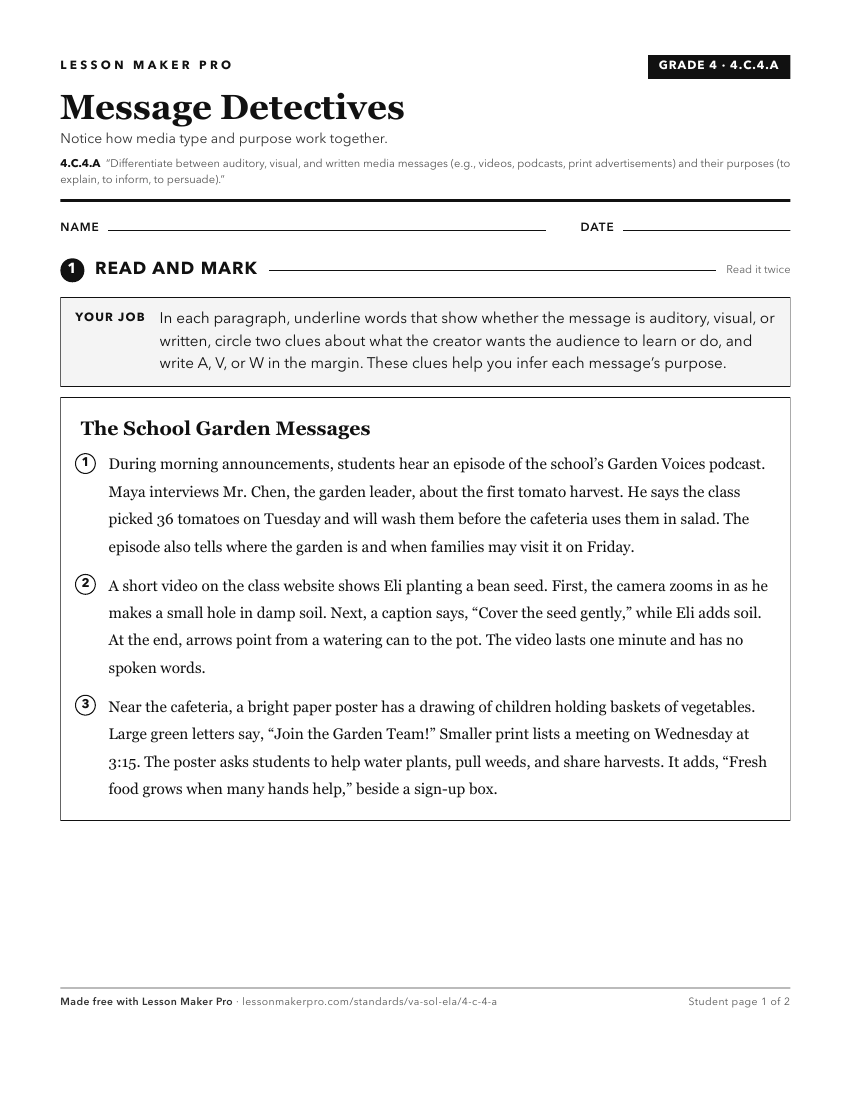
A ready-to-print activity worksheet aligned to 4.C.4.A, with an answer key for the teacher on its own page. No account needed.
PDF, US Letter, prints cleanly in black and white.
Download the worksheetKeep exploring
Related Standards
- 7.C.4.C
Compare and contrast the effectiveness of techniques in auditory, visual, and written media messages (e.g., authorship, format, content, purpose) on the intende...
- 11.C.4.C
Analyze, compare, and contrast visual and verbal media messages for content (e.g., word choice and choice of information), intent (e.g., persuasive techniques),...
- 5.C.4.B
Identify the purpose, intended audience, and credibility of information (e.g., auditory, visual, and written media messages) being presented.
- 10.C.4.B
Analyze, compare, and contrast visual and verbal media messages for content (e.g., word choice and choice of information), intent (e.g., persuasive techniques, ...
Turn this exact standard into a lesson
Grade, subject, topic, and the complete standard are prefilled. Create one free, no account needed.
Also for this standard:Make a WorksheetMake a QuizMake a Sub Lesson