CCSS.
The Standard
Use ratio and rate reasoning to solve real-world and mathematical problems, e.g., by reasoning about tables of equivalent ratios, tape diagrams, double number line diagrams, or equations.
Common Core State Standards for Mathematics · Ratios and Proportional Relationships
Teacher's field guide
What This Standard Means
What Students Need to Do
- Students use ratio and rate reasoning to find unknown quantities in real-world and mathematical problems. They represent equivalent ratios with tables, diagrams, double number lines, or equations.
What Mastery Looks Like
- Students find missing values in equivalent-ratio situations and explain the scale factor they used. They choose a table, tape diagram, double number line, or equation and label quantities and units correctly.
Common Misconceptions
- Students may add the same amount to both quantities instead of multiplying both by the same factor. They may reverse a rate, mix units, or assume every table shows equivalent ratios.
How to Assess It
- Give this exit ticket: “Four notebooks cost $6. How much do 10 notebooks cost? Show your reasoning with a table, diagram, or equation.”
Lesson moves
Ways to Teach It
Give pairs measuring cups and colored water to make several batches of a 2-to-3 mixture, then record equivalent ratios in a table.
Ask students to compare two snack prices and write which is the better buy, including a unit rate and a supporting sentence.
Play Ratio Match with cards showing tables, tape diagrams, double number lines, equations, and situations that represent the same relationship.
Use grocery ads to calculate unit prices, compare package sizes, and determine the cost of buying different quantities.
Free download
Printable 6.RP.A.3 Worksheet
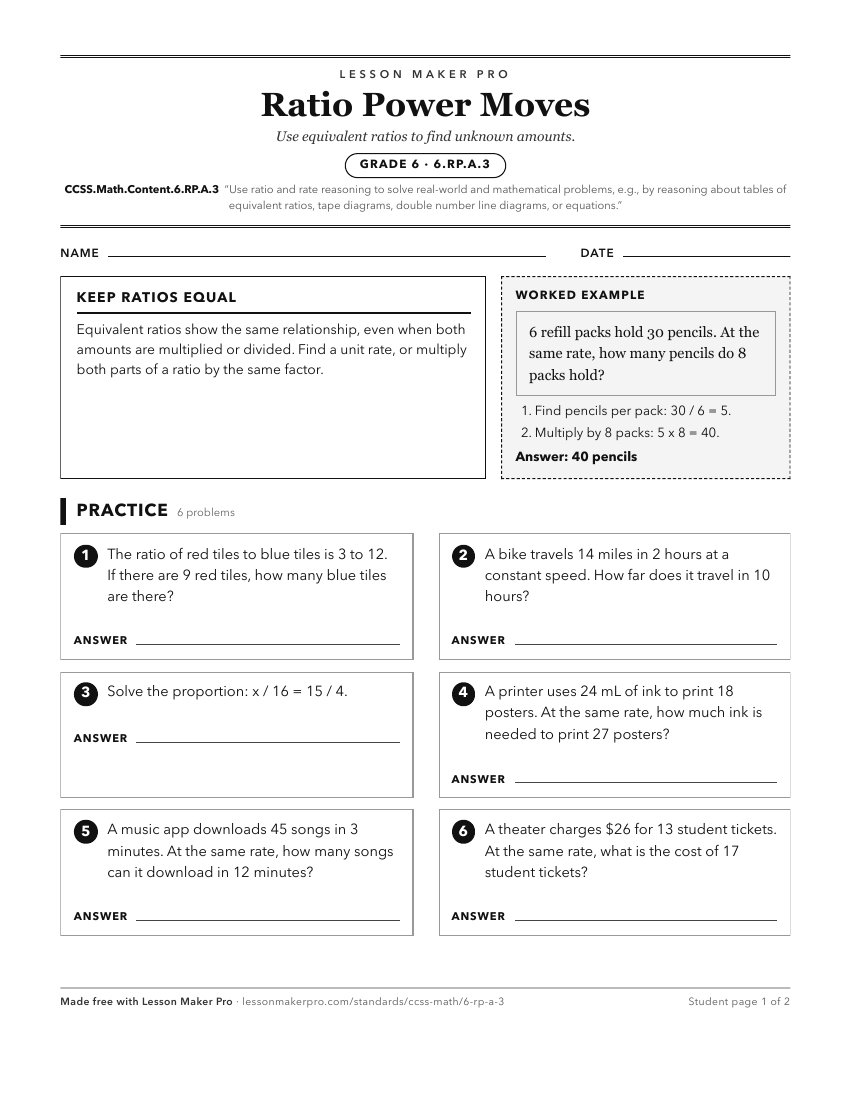
A ready-to-print activity worksheet aligned to CCSS.Math.Content.6.RP.A.3, with an answer key for the teacher on its own page. No account needed.
PDF, US Letter, prints cleanly in black and white.
Download the worksheetLearning progression
Where This Standard Sits
See the whole path on the Ratios & Proportional Relationships progression map.
Before This Standard
If students are struggling here, check these first.
- CCSS.Math.Content.6.RP.A.1
Solving ratio and rate problems requires understanding what a ratio compares and using ratio language to interpret equivalent relationships.
- CCSS.Math.Content.6.RP.A.2
Understanding unit rates helps students interpret ratio situations and solve rate problems using tables, diagrams, and equations.
- CCSS.Math.Content.5.NF.B.3
Interpreting a/b as division supports finding unit rates and fractional values when scaling equivalent ratios.
What This Unlocks
Mastery here sets students up for these next.
- CCSS.Math.Content.7.G.A.1
Scale drawings require using equivalent ratios and scale factors to convert lengths and reproduce figures at a new scale.
- CCSS.Math.Content.7.RP.A.3
Seventh-grade multistep ratio and percent problems require using equivalent ratios, rates, tables, diagrams, or equations from grade 6.
- CCSS.Math.Content.7.SP.C.6
Relative frequency and probability use ratios of outcomes to trials, so ratio tables and rates support predicting counts from probabilities.
- CCSS.Math.Content.7.SP.C.7b
Observed frequencies become relative frequencies, so ratio reasoning helps students turn counts from trials into probability estimates.
Keep exploring
Related Standards
- CCSS.Math.Content.6.RP.A.3d
Use ratio reasoning to convert measurement units; manipulate and transform units appropriately when multiplying or dividing quantities.
- CCSS.Math.Content.6.RP.A
Understand ratio concepts and use ratio reasoning to solve problems.
- CCSS.Math.Content.7.EE.B.3
Solve multi-step real-life and mathematical problems posed with positive and negative rational numbers in any form (whole numbers, fractions, and decimals), usi...
Turn this exact standard into a lesson
Grade, subject, topic, and the complete standard are prefilled. Create one free, no account needed.
Also for this standard:Make a WorksheetMake a QuizMake a Sub Lesson