CCSS.
The Standard
Solve problems involving scale drawings of geometric figures, including computing actual lengths and areas from a scale drawing and reproducing a scale drawing at a different scale.
Common Core State Standards for Mathematics · Geometry
Teacher's field guide
What This Standard Means
What Students Need to Do
- Students use a drawing's scale to find real lengths and areas. They also create an equivalent drawing with a new scale and explain how the dimensions change.
What Mastery Looks Like
- Students use the correct scale factor, keep units consistent, and calculate actual dimensions. They square the linear scale factor when comparing areas and redraw figures accurately.
Common Misconceptions
- Students often multiply when they should divide, or reverse the drawing and actual measurements. They may apply the linear scale factor directly to area instead of squaring it. They also mix units or change some dimensions but not others.
How to Assess It
- Give this exit ticket: A garden is 4 cm by 7 cm on a plan where 1 cm represents 2 m. Find its actual dimensions and area, then redraw it where 1 cm represents 4 m.
Lesson moves
Ways to Teach It
Give pairs rulers, graph paper, and a printed floor plan, then have them measure each side and redraw it at half the original scale.
Ask students to sketch and answer: If every side length triples, what happens to area, and how does your example prove it?
Play Scale Match with cards showing drawings, scales, actual lengths, and areas, then have teams assemble matching sets and explain each match.
Use a local park map to calculate walking distances and redesign the map to fit a half-sheet of paper.
Free download
Printable 7.G.A.1 Worksheet
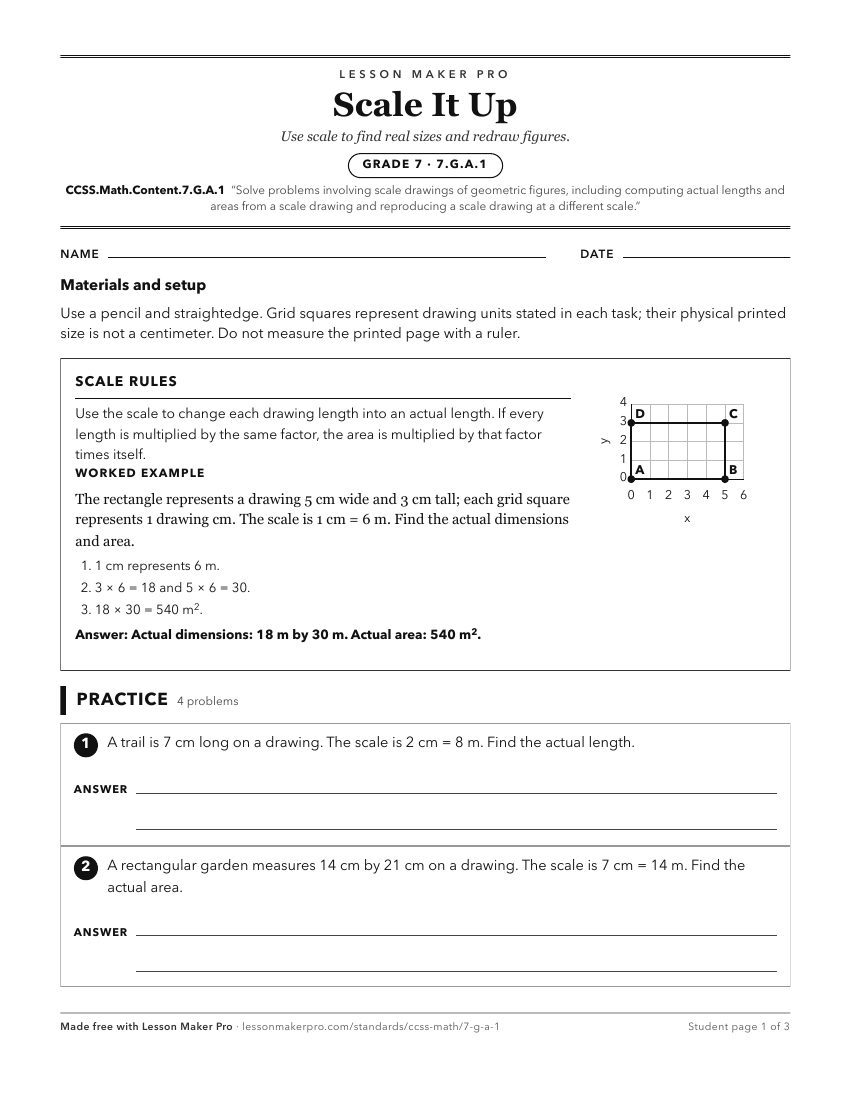
A ready-to-print activity worksheet aligned to CCSS.Math.Content.7.G.A.1, with an answer key for the teacher on its own page. No account needed.
PDF, US Letter, prints cleanly in black and white.
Download the worksheetBefore This Standard
If students are struggling here, check these first.
- CCSS.Math.Content.6.RP.A.3
Scale drawings require using equivalent ratios and scale factors to convert lengths and reproduce figures at a new scale.
- CCSS.Math.Content.6.G.A.1
Finding areas of triangles and polygons supports computing actual areas from scale drawings when figures are not simple rectangles.
- CCSS.Math.Content.7.RP.A.2
Scale drawings require using a constant scale factor to relate drawing lengths to actual lengths and new copies.
What This Unlocks
Mastery here sets students up for these next.
- CCSS.Math.Content.8.G.A.4
Scale drawings give experience with proportional side lengths and resizing figures, which supports understanding dilations within similarity transformations.
- CCSS.Math.Content.HSG-SRT.A.1b
Scale drawings give practice using scale factors to make lengths proportional, which carries directly into dilation changing segment lengths by a ratio.
- CCSS.Math.Content.HSG-SRT.A.1
Scale drawings give students experience with scale factors and proportional lengths before studying dilations from a center.
Keep exploring
Related Standards
- CCSS.Math.Content.7.G.B
Solve real-life and mathematical problems involving angle measure, area, surface area, and volume.
- CCSS.Math.Content.7.G.A
Draw, construct, and describe geometrical figures and describe the relationships between them.
- CCSS.Math.Content.3.MD.D.8
Solve real world and mathematical problems involving perimeters of polygons, including finding the perimeter given the side lengths, finding an unknown side len...
- CCSS.Math.Content.6.G.A
Solve real-world and mathematical problems involving area, surface area, and volume.
Turn this exact standard into a lesson
Grade, subject, topic, and the complete standard are prefilled. Create one free, no account needed.
Also for this standard:Make a WorksheetMake a QuizMake a Sub Lesson