CCSS.
Standard Cluster
Solve real-life and mathematical problems involving angle measure, area, surface area, and volume.
Common Core State Standards for Mathematics
Cluster contents
Standards in This Cluster
CCSS.Math.Content.7.G.B is a cluster heading. These are the individual standards under it.
- CCSS.Math.Content.7.G.B.4
Know the formulas for the area and circumference of a circle and use them to solve problems; give an informal derivation of the relationship between the circumf...
- CCSS.Math.Content.7.G.B.5
Use facts about supplementary, complementary, vertical, and adjacent angles in a multi-step problem to write and solve simple equations for an unknown angle in ...
- CCSS.Math.Content.7.G.B.6
Solve real-world and mathematical problems involving area, volume and surface area of two- and three-dimensional objects composed of triangles, quadrilaterals, ...
Teacher's field guide
What This Cluster Means
What Students Need to Do
- Students identify needed measurements, choose a formula or angle relationship, and solve for unknown values. They explain their steps, use correct units, and check whether answers fit the diagram or situation.
What Mastery Looks Like
- A student can find missing angles using known angle relationships and equations. They can calculate areas of circles and composite figures, plus surface areas and volumes of right prisms. Their work shows correct formulas, substitutions, and units.
Common Misconceptions
- Students often confuse radius with diameter, or use circumference when area is needed. They may mix up surface area and volume, omit hidden faces, or label area and volume with the wrong units. Some treat adjacent angles as equal instead of checking whether they are complementary, supplementary, or vertical.
How to Assess It
- Exit ticket: Two supplementary angles measure (2x + 10)° and 70°; find x. A closed box measures 6 cm by 4 cm by 3 cm; find its surface area and volume, with units.
Lesson moves
Ways to Teach It
Give pairs centimeter cubes and cardstock nets; have them build a rectangular prism, then compare counted volume with calculated surface area.
Ask, “Why can two boxes have equal volume but different surface areas?” Students sketch examples and explain their reasoning.
Run a formula sort: students match angle, circle, composite-area, prism-surface-area, and prism-volume cards to formulas, units, and sample diagrams.
Have students measure a cereal box, calculate its cardboard area and capacity, then identify which measurement matters to a packager.
Free download
Printable 7.G.B Worksheet
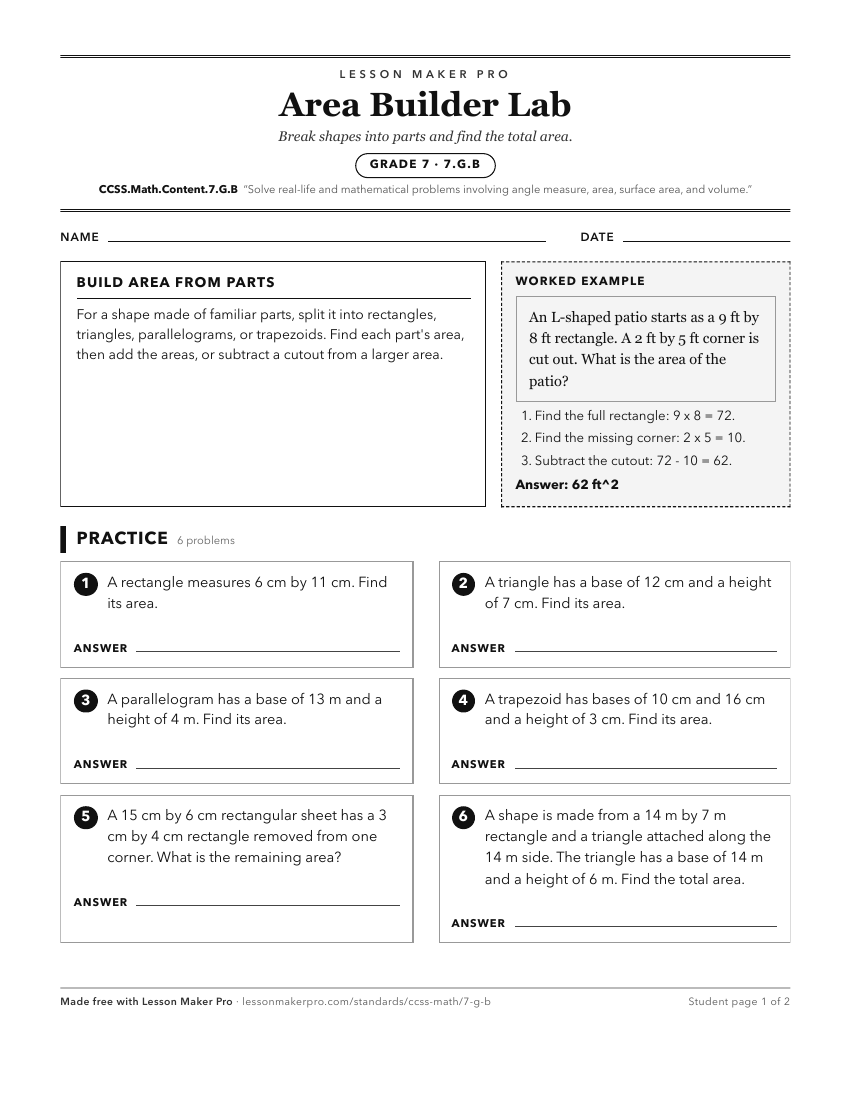
A ready-to-print activity worksheet aligned to CCSS.Math.Content.7.G.B, with an answer key for the teacher on its own page. No account needed.
PDF, US Letter, prints cleanly in black and white.
Download the worksheetKeep exploring
Related Standards
- CCSS.Math.Content.8.G.C
Solve real-world and mathematical problems involving volume of cylinders, cones, and spheres.
- CCSS.Math.Content.5.MD.C.5
Relate volume to the operations of multiplication and addition and solve real world and mathematical problems involving volume.
- CCSS.Math.Content.6.G.A
Solve real-world and mathematical problems involving area, surface area, and volume.
Turn this cluster into a lesson
Grade, subject, topic, and the complete cluster are prefilled. Create one free, no account needed.
Also for this cluster:Make a WorksheetMake a QuizMake a Sub Lesson